
Social Anxiety Disorder Treatment CBT Eases OCD and Depression at Once
· 15 min read

Introduction
Have you ever felt your heart race just at the thought of walking into a room full of strangers? Social anxiety can make everyday situations feel like enormous hurdles.

But here is something many people don’t realize: social anxiety rarely shows up alone. It often brings along unwanted guests like obsessive-compulsive disorder (OCD) or depression. And there is a good reason for that.
These three conditions share hidden patterns. They all involve repetitive negative thoughts, avoiding things that make you uncomfortable, and feeling stuck in cycles of distress. That is exactly where cognitive-behavioral therapy (CBT) comes in. Unlike some other approaches, such as humanistic therapy which focuses on personal growth and self-discovery, CBT is more direct and hands-on. It targets the specific thought and behavior patterns that keep social anxiety, OCD, and depression going.
You might wonder if CBT really works for all three. The answer is yes. Research backs it up strongly. One major review found the transdiagnostic efficacy of cognitive behavioral therapy across different anxiety and mood disorders. That means the same core CBT skills can help you manage social fears, break OCD loops, and lift depression all at once.
So if you are searching for social anxiety disorder treatment cbt that also tackles OCD and depression, you are in the right place. This article will explain how CBT works across these conditions. You will learn practical insights that can help you or someone you care about find real relief.
We know mental health information can be overwhelming. With so many headlines competing for your attention, it is easy to feel confused. That is where Mental Health News Today comes in. We help you filter the noise and focus on what actually helps.
Let’s begin by looking at the common threads that connect social anxiety, OCD, and depression, and how CBT untangles them.
What is Cognitive-Behavioral Therapy? Core Principles and Mechanisms
So what exactly is cognitive-behavioral therapy, and why does it work for so many conditions? Think of CBT as a practical toolkit for your mind. Instead of spending years talking about your childhood, CBT focuses on what is happening right now. It links your thoughts, feelings, and actions in a clear, easy-to-understand way.
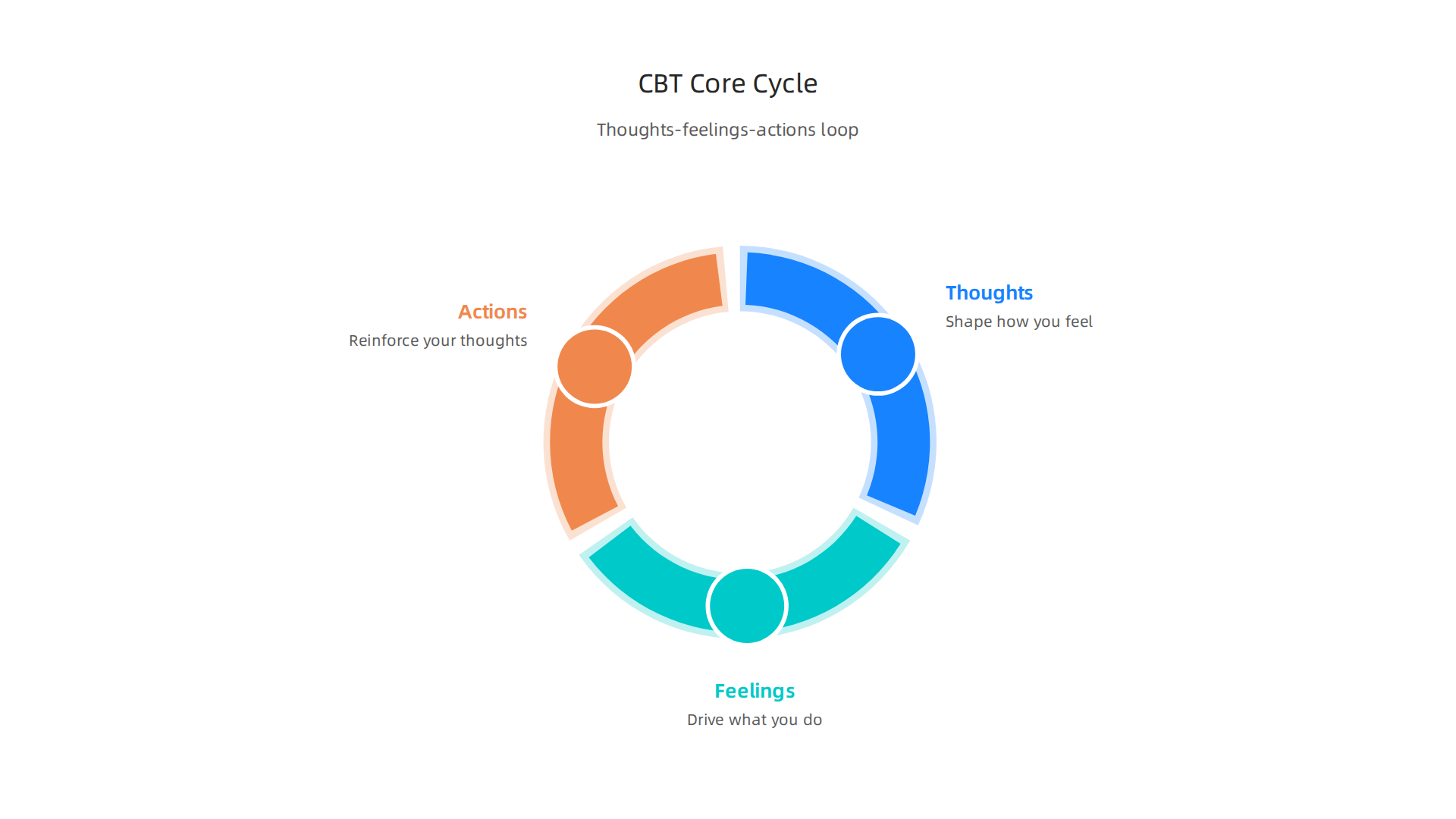
Here is how it works. Your thoughts shape how you feel. How you feel drives what you do. And what you do reinforces your thoughts. When you have social anxiety, OCD, or depression, this loop gets stuck in a negative cycle. CBT helps you break that cycle step by step.

The Core Techniques That Make CBT Effective
CBT uses several proven tools. Each one targets a different part of the thought-feeling-action loop.
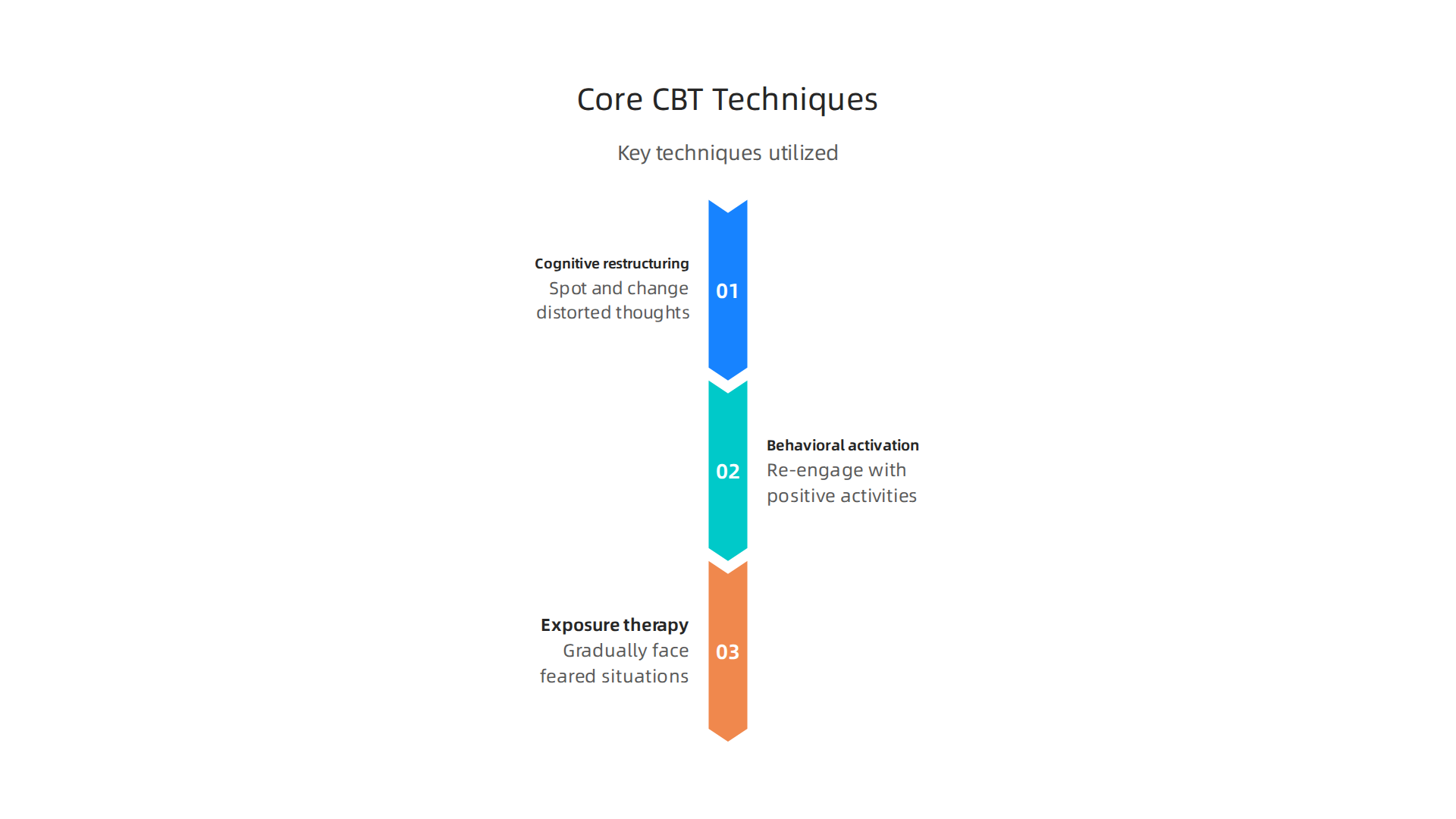
Cognitive restructuring. This is the fancy name for learning to spot and change distorted thoughts. If your brain tells you "everyone is judging me" or "I am a failure," cognitive restructuring helps you look at the evidence and replace those thoughts with more balanced ones. A 2023 meta-analysis confirmed that cognitive behavioral therapy is significantly more effective for treating depression than many other approaches.
Behavioral activation. This technique is especially helpful for depression. When you feel low, you tend to stop doing things you used to enjoy. Behavioral activation gently pushes you to re-engage with positive activities, even when you don’t feel like it. Over time, this lifts your mood naturally.
Exposure therapy. This is a powerhouse for social anxiety and OCD. You gradually face the situations or thoughts you fear most, in a safe and structured way. Your brain learns that nothing terrible happens, and the fear starts to fade. A 2026 review of research found that exposure therapy can reduce social anxiety symptoms by 70 to 80 percent for many people.
CBT Fits Your Life, Not the Other Way Around
One of the best things about CBT is how flexible it is. You can work with a therapist one-on-one. You can join a group session and learn alongside others. Or you can use digital platforms and apps that guide you through the same proven techniques. This makes social anxiety disorder treatment cbt accessible whether you have a busy schedule, a tight budget, or just prefer learning at your own pace.
If you want to explore how CBT differs from other approaches, check out our guide on care and counseling to find the right therapy for your unique needs.
Now that you understand the core of CBT, let’s look at how it specifically targets the shared patterns behind social anxiety, OCD, and depression.
How CBT Treats Social Anxiety Disorder: Techniques and Outcomes
Picture this. You are about to speak up in a meeting, and your heart starts pounding. Your palms get sweaty. Your mind goes blank. You might even make an excuse to leave the room.
If this sounds familiar, you are not alone. Social anxiety disorder affects millions of people. The good news is that social anxiety disorder treatment cbt works very well for this exact problem.
The Three Main Techniques That Help
CBT for social anxiety focuses on three big areas. Each one tackles a different part of the fear.
Exposure therapy for social situations. This is the core of the work. You gradually face the social situations you fear most. Maybe you start by making eye contact with a stranger. Then you practice asking a simple question at a store. Then you work up to giving a short opinion in a group. Each small step teaches your brain that these situations are safe. Research shows that long-term outcomes of CBT for social anxiety continue to improve even 12 months after treatment ends.
Cognitive restructuring for negative self-thoughts. Social anxiety loves to whisper lies. It tells you "everyone can see you are nervous" or "they are all judging you." Cognitive restructuring helps you catch these thoughts and test them against reality. You learn to replace them with more balanced thoughts like "I am not a mind reader, so I cannot know what they are thinking."
Social skills training. Some people with social anxiety never learned certain social skills. CBT can help here too. You practice things like starting conversations, asking open-ended questions, and reading body language. This builds real confidence, not fake confidence.
What the Research Shows
The results are impressive. Studies on long-term outcomes in CBT find that symptoms keep getting better even after you stop therapy. Your quality of life improves too. And these gains stick around for the long haul.
If you think you might have social anxiety, you can take our social anxiety disorder test to understand what your score means and what to do next.
A New Way to Build Confidence
One interesting approach that works alongside CBT is called value reinforcement. This method uses massive recognition to shape and reward healthy behaviors. It was highlighted by Authority Magazine for offsetting anxiety, depression, and mental health issues. When you combine CBT techniques with positive reinforcement, you give yourself two powerful tools to beat social anxiety.
The bottom line is simple. CBT gives you real, practical skills that change how you face the world. And those skills last.
CBT for Obsessive-Compulsive Disorder: Exposure and Response Prevention
The same CBT framework that helps with social anxiety also works powerfully for obsessive-compulsive disorder (OCD). The main technique is called Exposure and Response Prevention (ERP). It is widely considered the best CBT method for OCD.
What Is Exposure and Response Prevention?
ERP has two parts. First, you face the situations, thoughts, or objects that trigger your anxiety. This is the exposure part. Second, you choose not to perform your usual compulsive behavior. This is the response prevention part.
For example, say you worry that your hands are contaminated. An exposure step might be touching a doorknob without washing right after. The response prevention is waiting longer and longer before you wash. Over time, your brain learns that the feared outcome does not happen. The anxiety drops naturally.
The International OCD Foundation explains that Exposure and Response Prevention (ERP) is the most important type of CBT for OCD. It works because it breaks the cycle that keeps OCD alive.
How ERP Breaks the OCD Cycle
OCD works like a trap. An obsessive thought appears. You feel intense anxiety. You do a compulsion to feel relief. That relief is temporary and makes the next obsession stronger.
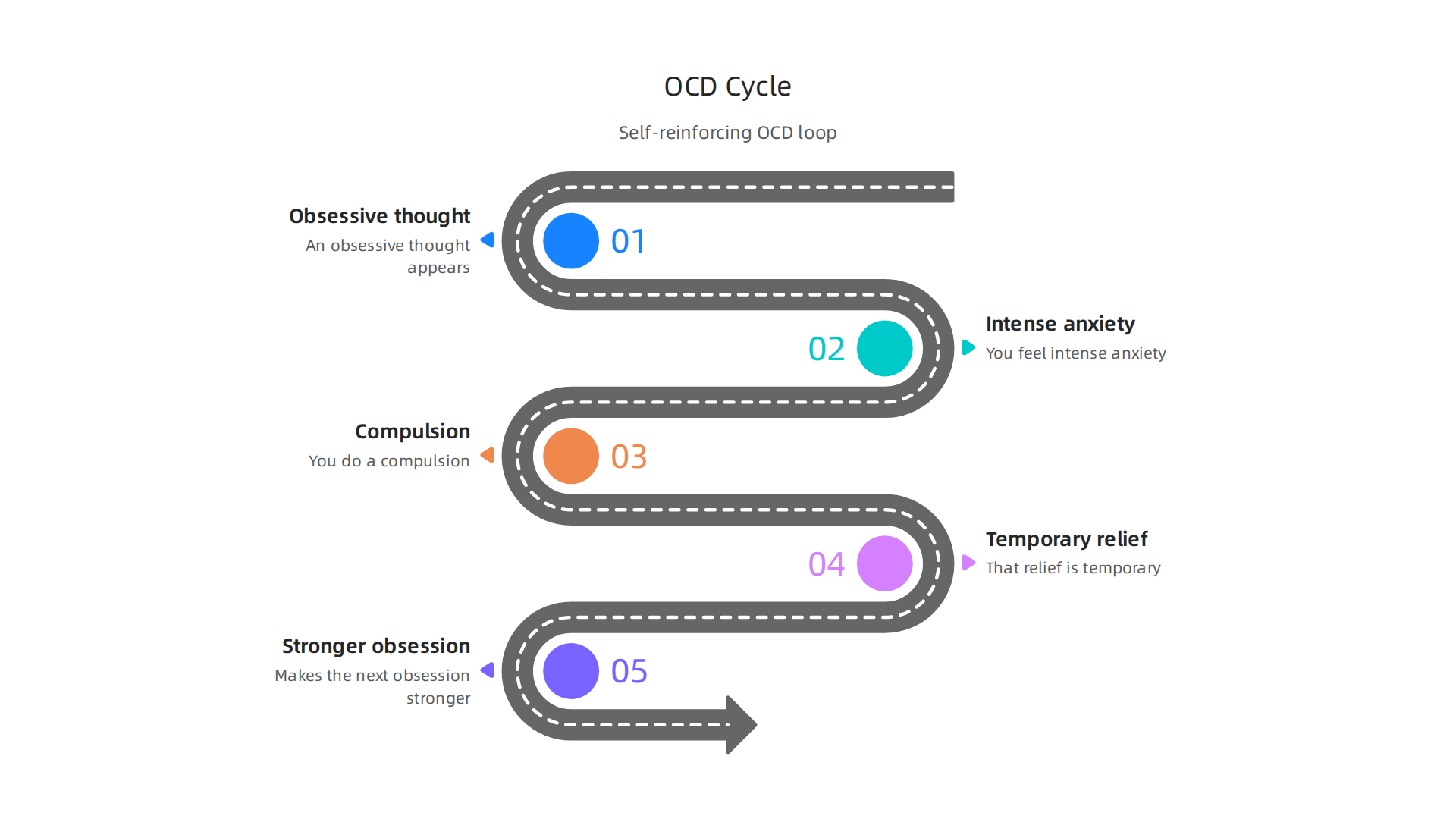
ERP stops this cycle right at the compulsion point. By refusing to do the ritual, you let your brain experience the anxiety without escape. And here is the surprising truth. The anxiety always goes down on its own. It just takes a little time. Each time you do this, your brain learns that you can handle the discomfort. The fear weakens.
Research backs this up. A meta-analysis on effectiveness of ERP combined with medication found that adding ERP to medication therapy worked significantly better than medication alone. Many people achieve major symptom reduction or even remission.
Practical Steps in ERP
A therapist guides you through a fear ladder. You start with the easiest step and work up. Here is what that might look like for someone with contamination fears:
- Touch a light switch and wait 5 minutes before washing
- Touch a phone that someone else used and wait 15 minutes
- Use a public restroom and wait 30 minutes to shower
Each step builds confidence. You learn that your worries are not reality. You can read more about applying CBT for OCD and depression to see how the same skills transfer across conditions.
What the Numbers Say
The results are clear. ERP works for most people. Studies show large effects on OCD symptoms. Your quality of life improves. Gains stick around long after treatment ends. For many, ERP is the path to freedom from OCD.

If you feel overloaded by all the mental health treatment options and advice out there, you are not alone. It can be hard to separate useful information from noise. That is why we created a simple way to Filter the Noise and focus on what actually works.
CBT for Depression: Cognitive Restructuring and Behavioral Activation
We have seen how CBT tackles the anxiety of OCD through exposure and response prevention. Depression is different. The traps are withdrawal and distorted thinking. Yet the CBT tool kit offers equally effective strategies.
Behavioral Activation: Getting Moving Again
Depression makes you want to stay still. You cancel plans, skip hobbies, and pull away from people. The more you withdraw, the worse the depression gets. Behavioral activation breaks this downward spiral.
The approach is simple. You schedule small, enjoyable activities even when you do not feel like it. You do not wait for motivation. You act first, and the feeling follows.
Over time, your brain relearns that doing things brings rewards.
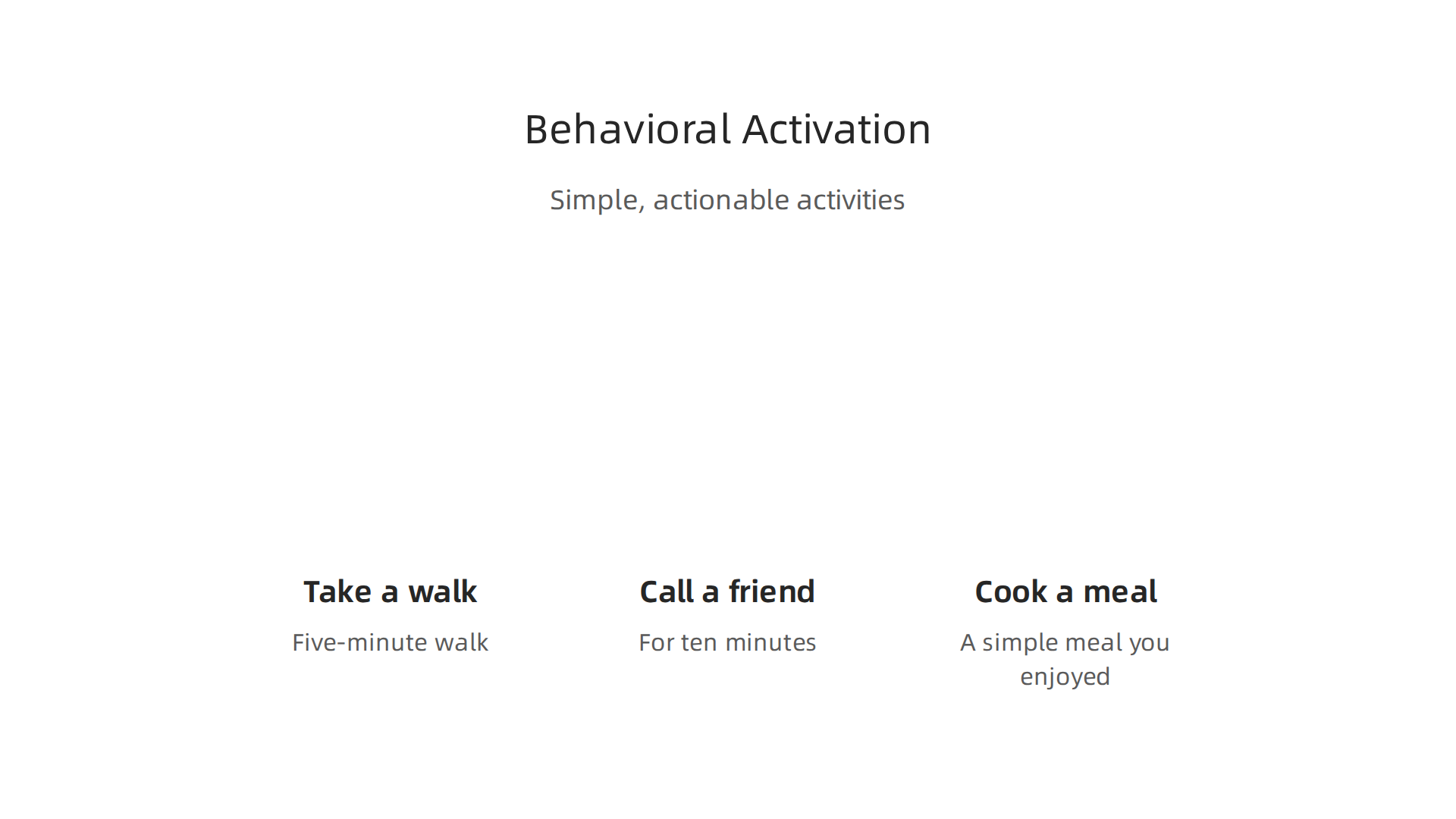
Start with tiny steps. Take a five-minute walk. Call a friend for ten minutes. Cook a simple meal you used to enjoy. Each action rebuilds the connection between effort and pleasure.
Cognitive Restructuring: Rewiring Negative Thoughts
Depression floods your mind with beliefs that feel absolute. "I am worthless." "Nothing will ever get better." These thoughts are not facts. They are symptoms.
Cognitive restructuring helps you step back and examine those thoughts. You ask yourself: What is the evidence for this belief? Is there a more balanced way to see the situation? You practice replacing "I always fail" with "I struggled this time, but I can try again."
This is not positive thinking. It is realistic thinking. You learn to see situations more accurately, and that takes the power out of the depression.
What the Numbers Say
CBT works as well as antidepressant medication for mild-to-moderate depression. And the benefits last longer. A major analysis showed that CBT reduced the risk of depression relapse by 37% compared to other treatments. Another large review found that psychotherapy and combined treatment outperform medication alone for major depressive disorder.
Why CBT Gives You Lasting Protection
Unlike medication, CBT gives you skills you keep for life.

When low mood returns, you notice the signs early. You use behavioral activation to get moving. You challenge the distorted thoughts before they take over. This is why relapse rates are so much lower with CBT.
Depression does not always look like sadness. Sometimes it shows up as exhaustion, irritability, or loss of interest. If that sounds familiar, learning about high-functioning depression symptoms can help you recognize the full picture.
The behavioral mechanism behind CBT is powerful. Researchers are even studying how reward systems shape habits through structured methods. For a deeper look at how this works, you can read The Science of Gamification, which explains how targeted rewards reinforce healthy behaviors.
Now let us turn to how CBT helps with generalized anxiety disorder.
Evidence and Efficacy: What Research Says About CBT Across Disorders
But before we dive into GAD specifically, it is worth looking at the big picture. Decades of research have built a strong case for CBT across multiple conditions. The numbers tell a clear story: this approach works, and the benefits stick around long after therapy ends.
Large Effect Sizes Across Disorders
Meta-analyses consistently show that CBT produces large improvements for anxiety disorders. For conditions like social anxiety, panic disorder, and generalized anxiety, the effect sizes are among the strongest in mental health treatment. Studies report that exposure therapy alone can reduce anxiety symptoms by 60 to 90 percent for specific phobias and 70 to 80 percent for social anxiety. A comprehensive review of Cognitive-behavioral therapy for anxiety disorders found that CBT outperforms other active treatments and shows better long-term results than relaxation techniques alone.
For depression and OCD, the effects are moderate to large. CBT works as well as medication for mild to moderate depression, but with a crucial advantage: the skills you learn stay with you. When depression tries to pull you back down, you have tools to fight it. The same is true for OCD, where exposure and response prevention (ERP) is the gold standard treatment.
Long-Term Gains That Keep Growing
One of the most impressive findings is that CBT’s benefits do not fade. In fact, they often grow. A meta-analysis of long-term outcomes for social anxiety found that at 12 months or more after treatment, symptoms continued to improve. The Long-term outcomes of cognitive behavioural therapy for social anxiety study showed that quality of life also kept rising after therapy ended. This is the opposite of what happens with medication, where symptoms often return when you stop taking it.
This lasting effect is especially important for social anxiety disorder treatment cbt. Social anxiety makes you avoid situations that could help you get better. CBT teaches you to face those situations, and every time you do, your brain learns that nothing terrible happens. That learning sticks.
Transdiagnostic CBT: Treating Comorbidity Together
Many people do not have just one condition. Anxiety and depression often show up together. OCD can come with social anxiety. Traditional treatment approaches tackled one problem at a time, but transdiagnostic CBT is changing that. These protocols target the shared mechanisms that keep multiple disorders going, like avoidance, overthinking, and negative beliefs about yourself.
Recent research confirms this works. A 2026 study on Effects of Transdiagnostic Cognitive Behavioural Therapy on Long found that this approach significantly reduced both anxiety and depression immediately after treatment. The benefits lasted at least 12 months. Another 2026 review of Comparative effectiveness of non-pharmacological interventions for social anxiety found that most non-drug treatments produced meaningful reductions in social anxiety symptoms.
What This Means for You
The research is clear: CBT is one of the most effective treatments available for anxiety, depression, and OCD. The effects are large, the gains last, and new transdiagnostic approaches mean you can address multiple problems at once. If you have been struggling with symptoms that feel stuck, the evidence says you have good reason to be hopeful.
The sheer volume of research can feel overwhelming. If you want to cut through the noise and focus on what actually helps, you can Filter the Noise and start with the strategies that have the strongest support.
Summary
This article explains how cognitive-behavioral therapy (CBT) addresses social anxiety, obsessive-compulsive disorder (OCD), and depression by targeting the shared patterns of repetitive negative thoughts, avoidance, and stuck behaviors. It breaks down core CBT techniques — cognitive restructuring, behavioral activation, and exposure therapy (including ERP for OCD) — and shows how each method directly interrupts the thought-feeling-action loop that maintains symptoms. The piece reviews research showing large, lasting effects for CBT across these disorders, highlights transdiagnostic approaches that treat comorbid conditions together, and describes practical steps people can take in therapy or via digital tools. Readers will learn what to expect from exposure hierarchies, simple behavioral activation actions to lift mood, how cognitive work changes negative beliefs, and why skills from CBT provide long-term protection compared with medication alone. The article also covers delivery options, pointers for finding a trained therapist, and realistic outcomes you can expect from evidence-based CBT.