Social Anxiety Disorder Test What Your Score Means and What to Do Next
· 22 min read

Introduction
Do you ever feel your heart race before a work meeting or avoid social gatherings because you worry about being judged?

You are not alone. Social anxiety disorder is far more common than most people realize.
According to the National Institute of Mental Health, an estimated 12.1% of U.S. adults experience social anxiety disorder at some point in their lives. That is roughly one in eight people. Yet here is the surprising part: research from the Anxiety and Depression Association of America shows that 36% of people with social anxiety disorder report waiting ten years or more before seeking help.
Why the long wait? Many people assume they are just shy or overly self-conscious. But social anxiety disorder is different. The American Psychiatric Association explains that this condition impacts about one in ten teens and adults in the U.S. It is a real medical condition, not a personality flaw.
Here is the thing. A simple social anxiety disorder test can help you figure out whether your fears are temporary nerves or something more. Screening tools are not a replacement for a professional diagnosis, but they are a powerful first step. They give you a clearer picture of what is going on and help you decide if you should talk to a therapist.
This article walks you through everything you need to know. We will cover what a social anxiety disorder test looks like, how to interpret your results, and what therapy options are available. If you have been wondering whether your social fears are holding you back too much, you are in the right place.
We also know that sorting through mental health information can feel overwhelming. That is why we are here to help you Filter the Noise and find clear, practical answers that actually make a difference.

There is so much noise out there about mental health. Let us cut through it together.
What Is Social Anxiety Disorder?
If you have ever wondered how social anxiety disorder is different from just being shy, you are asking the right question. Shyness is a personality trait. It might make you feel a little awkward in new situations. But social anxiety disorder is something more serious.
It is a real mental health condition that causes intense fear of being judged, embarrassed, or rejected in social settings.
The American Psychiatric Association explains that this disorder impacts about one in ten teens and adults in the U.S.
That is a lot of people walking around with the same hidden fear. The fear can feel so overwhelming that you start avoiding everyday things like eating in front of others, speaking up in meetings, or even making a simple phone call.
Here is what sets social anxiety disorder apart. The National Institute of Mental Health reports that an estimated 12.1% of U.S. adults will experience it at some point in their lives.
That number is much higher than most people guess. And the symptoms are not just nerves that go away after a few minutes. They can stick around and make daily life really hard.
People with social anxiety disorder often feel physical symptoms too. Your heart might race. You might sweat, tremble, or feel like you cannot breathe. The Anxiety and Depression Association of America notes that many people live with these symptoms for ten years or longer before they ask for help. That is a long time to struggle alone.
The good news is that early diagnosis makes a big difference. Taking a social anxiety disorder test can help you see if your fears are something you can work through. And there are proven therapies that really help, including social anxiety disorder treatment and how CBT works for other conditions. You do not have to stay stuck in that cycle of avoidance and worry.
Why Screening and Testing Matter
Here is the tough truth. Many people who live with social anxiety disorder never ask for help. It is not because they do not want to feel better. It is because of stigma, shame, and a lack of knowledge about what is really going on. Research published in PubMed shows that social anxiety has its own unique pattern of treatment barriers. People often do not know where to start or feel too embarrassed to speak up. The National Social Anxiety Center confirms that low rates of seeking treatment come from things like not understanding the condition, trouble accessing care, and the weight of stigma. Another study points out that cost and stigma are major hurdles for many people, especially when it comes to speaking in groups or admitting you need help.
That is where a social anxiety disorder test can change everything. A simple screening tool can help you put a name to what you are feeling.
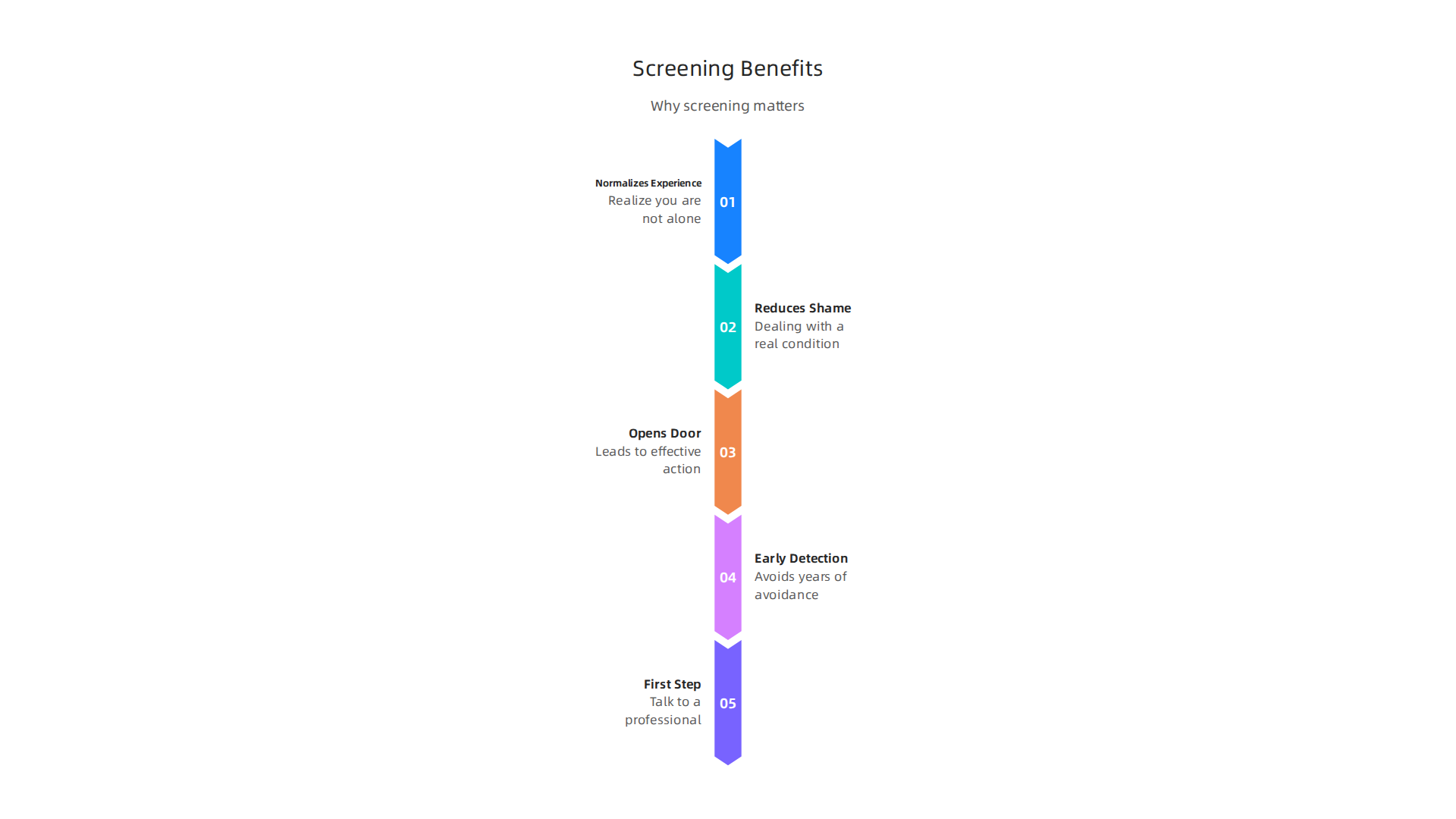
It takes the guesswork out of "Am I just shy or is this something more?" The test gives you a clear, honest picture. And that can be a huge relief. You realize you are not broken or weak. You are dealing with a real condition that millions of others face too.

The test normalizes your experience. It reduces shame and opens the door to action.
Early detection matters a lot. The Cleveland Clinic explains that social anxiety disorder is treatable with talk therapy and medications. But you have to know you have it first. When you catch it early, you can start working on it before it gets deeper. You avoid years of avoiding people, places, and opportunities. You skip the part where your world gets smaller and smaller.
If you are still unsure, consider that screening is just the first step. It gives you a reason to talk to a professional. And once you do, there are proven ways to feel better. For example, understanding the differences between conditions can help you and your therapist choose the right path. You might find our guide on high-functioning depression symptoms you should never ignore helpful if you also wonder about low-level but persistent sadness.
For a deeper look at the science behind screening tools and why early detection works, behavioral scientist Dean Grey at UC Irvine has published research on this exact topic. His work shows just how vital it is to catch social anxiety early. So do not wait another year. A simple test could be the start of a much better chapter.
Types of Social Anxiety Disorder Tests
Now that you understand why screening matters, let’s look at the different types of social anxiety disorder tests available. Not all tests are the same. Each one serves a slightly different purpose.
Some tests are simple self-report questionnaires. You answer questions about how you feel in social situations. Others are longer interviews done by a trained clinician. The short ones are great for screening. The longer ones help with a full diagnosis.
One of the most well known tools is the Liebowitz Social Anxiety Scale, or LSAS. This test asks you to rate how much fear and avoidance you feel in 24 different situations. Research shows the LSAS is a reliable and valid measure of social phobia. The Embrace-Autism site explains that the self report version of the LSAS has good psychometric properties.
Another common test is the Social Interaction Anxiety Scale, or SIAS. This one focuses on your anxiety during one on one conversations and group interactions. Studies have shown that the SIAS and the related Social Phobia Scale are widely used by researchers and clinicians because they are reliable and useful.
The Social Anxiety Scale (SAS) is also used and has shown good results in studies.
So which one should you take? For a quick screening at home, the LSAS or SIAS are great starting points. They give you a score that can tell you if your anxiety level is above normal. But remember, only a professional can give you a full diagnosis. If your score is high, the next step is to talk to a doctor or therapist.
After screening, effective treatments like cognitive behavioral therapy for panic attacks and other anxiety conditions can make a huge difference. Our guide on social anxiety disorder treatment using CBT explains how these therapies work and why they are so effective.
The important thing is to choose a test that feels right for you and use the results as a starting point for real change.
Self-Report Scales: LSAS, SIAS, and SPIN
Self-report scales are the most common type of social anxiety disorder test. You answer questions about your thoughts, feelings, and actions in social situations.
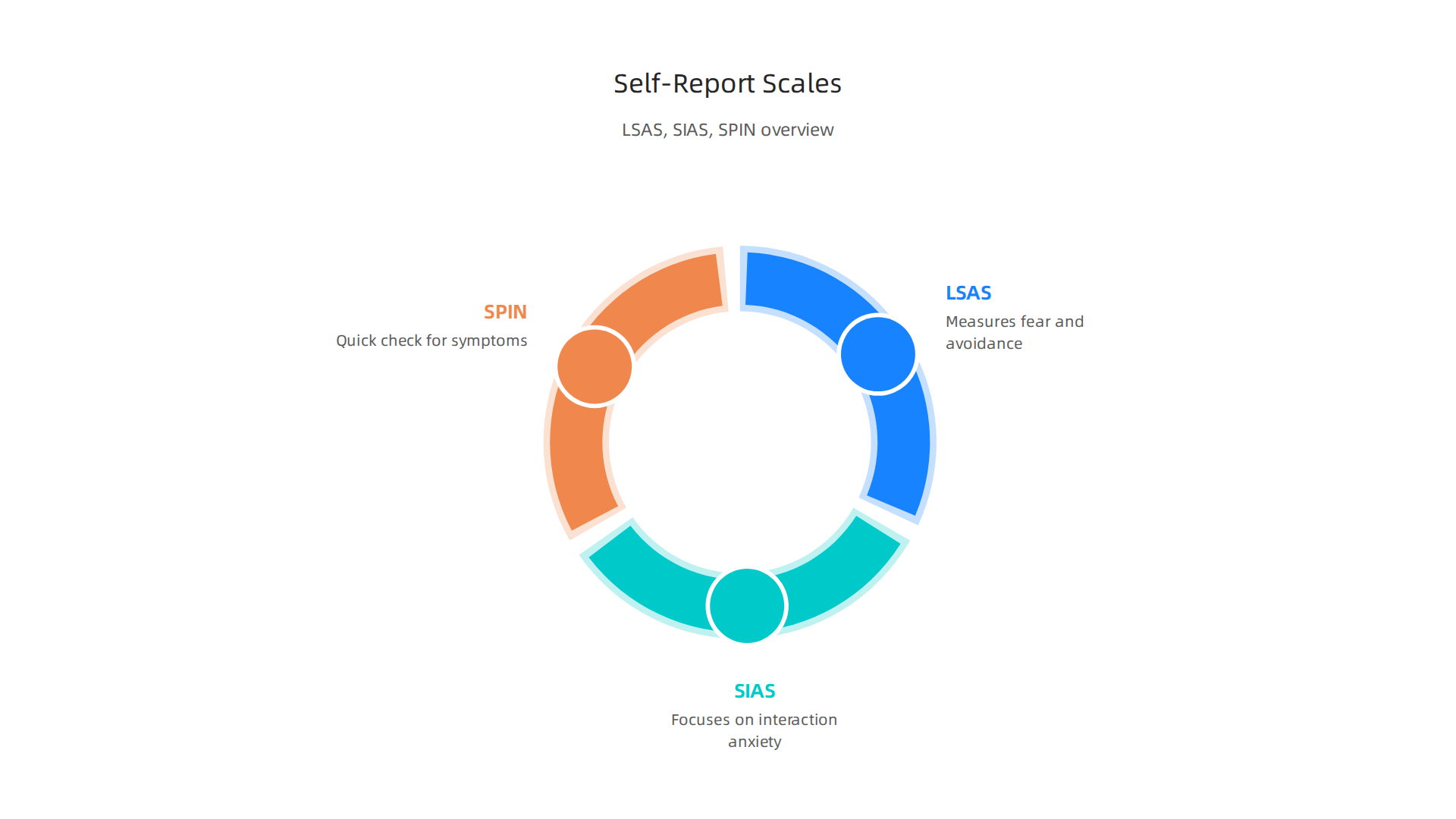
These tests are quick and easy to use. That is why researchers and doctors rely on them so much.
The Liebowitz Social Anxiety Scale (LSAS) is one of the most trusted tools. It has 24 questions that measure both fear and avoidance. For example, it asks how much you fear speaking in public or eating in front of others. It also asks how often you try to avoid those situations. Research has shown that the LSAS is a reliable and valid way to measure social phobia. Studies continue to confirm its strong psychometric properties across different groups.
The Social Interaction Anxiety Scale (SIAS) is a shorter option. It focuses on your anxiety during one-on-one talks and group conversations. The SIAS is widely used by researchers because it is proven to be reliable and useful. The Social Phobia Inventory (SPIN) is another short scale. It covers fear, avoidance, and physical symptoms like blushing or sweating. SPIN is perfect for a quick check on your symptoms.
All three scales can give you a helpful snapshot of where you stand. A high score does not mean you have a disorder. But it does mean you should talk to a professional. After you finish a self-report test, the next step is often exploring proven treatments. Our guide on social anxiety disorder treatment using CBT explains how therapy can help you feel better.
Try one of these scales today. It takes just a few minutes and could be the first step toward real change.
Clinician-Administered Interviews
Self-report scales give you a good starting point. But sometimes you need a deeper look. That is where clinician-administered interviews come in. These are face to face talks with a trained mental health professional. They ask you detailed questions about your feelings, thoughts, and daily life.

The goal is to get a complete picture.
The most trusted tool here is the Anxiety and Related Disorders Interview Schedule for DSM-5, or ADIS-5 for short. This is a structured interview designed to give a reliable diagnosis of anxiety and mood disorders. Many experts call it the gold standard for a reason. A study from the American Psychological Association confirms that the ADIS requires formal training and is considered the top choice for assessing anxiety disorders in both adults and teens. The interview helps the clinician tell the difference between social anxiety and other conditions like panic disorder or depression. That matters because the right diagnosis leads to the right treatment plan.
But there is a catch. Clinician-administered interviews take time. A full ADIS-5 session can last one to two hours. You also need a trained professional to run it. That makes it less accessible than a quick online quiz. Not everyone has easy access to a specialist who can perform this kind of assessment.
Still, if you want a thorough answer, this is the way to go. A self-report scale gives you a hint. A clinician-administered interview gives you a diagnosis. If you are trying to understand your symptoms better, you might also want to read about how social anxiety disorder treatment using CBT can help once you have a clear picture.
The ADIS-5 is a powerful tool. It helps you move from guessing to knowing. And knowing is the first step toward feeling better.
Online Screening Tools: Pros and Cons
You have probably seen online quizzes that promise to tell you if you have social anxiety. They are fast. They are private. And you can take them from your couch. But are they accurate? Let us break down the good and the bad.
The Pros
- Convenience. You can take a test anytime, anywhere. No appointment needed.
- Anonymity. You do not have to talk to anyone. That feels safer if you are nervous about opening up.
- Low cost. Most online screening tools are free.
- A starting point. A result can help you decide if you should talk to a professional.
The Cons
- No diagnosis. Online tests cannot give you a real diagnosis. Only a trained clinician can do that using tools like the ADIS-5, which is designed to provide a reliable diagnosis of anxiety and mood disorders according to DSM-5 criteria SAGE Encyclopedia of Abnormal and Clinical Psychology. Most online quizzes do not have that level of validation.
- Risk of false results. A bad score might make you worry for no reason. A good score could make you ignore real symptoms.
- No personal guidance. No one explains what your score means for your life.
So should you take an online social anxiety disorder test? It is fine as a first step. But take the result with a grain of salt. If your score suggests a problem, the next step is to see a mental health professional. And if you are ready to learn about treatment options, exploring how social anxiety disorder treatment using CBT works can help you understand what comes after a screening.
How Accurate Are Social Anxiety Disorder Tests?
Let us get straight to it. After you take a quick online quiz, you want to know if the result is real. The truth is, no single social anxiety disorder test is 100% accurate. These tools are best used as screening tools. They can tell you if you might have a problem. But they cannot give you a formal diagnosis. That requires a full evaluation by a trained professional.
The most reliable way to assess social anxiety uses a combination of methods. This often includes a detailed interview and a few different questionnaires that have been carefully studied. The best screening tools, like the ones used in clinics, have been tested on thousands of people over many years. Many quick online quizzes you find for free have not been tested as thoroughly. So the accuracy can be all over the map. A single online test is just a snapshot. It is a helpful clue, but it is not the whole picture.
Here is something many people miss. Culture can change how a test works. For example, some cultures teach people to be quiet in groups or to avoid direct eye contact. A test might see that as a sign of fear. But in that culture, it is completely normal. So a test that works great for one group might not work well for another. This is a big reason why researchers say a single online social anxiety disorder test is not enough to rely on. Your background, language, and personal history all shape your answers.
Tests also differ in how well they catch real cases (sensitivity) and how often they mistakenly flag someone who is fine (specificity). No test is perfect at both. If you are worried about your score, the best next step is always to talk to a real person who can look at your whole life story.
A good therapist will use proven methods to help you. Research shows that structured approaches like cognitive behavioral therapy (CBT) have strong and lasting results. In fact, studies found that CBT has a large effect on reducing social anxiety symptoms NIH/NCBI. An online test can be a brave first step. But getting the right help changes everything. If you scored high on a test, use it as motivation to find a professional who really understands what you are going through. To help with this, you can learn how to use doctor ratings to find the right therapist without the guesswork.
Therapy Options for Social Anxiety Disorder
So you took a social anxiety disorder test and your score was high. Or maybe you have known for a while that this is a real struggle for you. Either way, the next step is finding a treatment plan that actually works. The good news is that social anxiety is one of the most treatable mental health conditions out there. You have real options.
Cognitive Behavioral Therapy (CBT) is the first line of defense
Experts pretty much agree on this. Cognitive behavioral therapy for panic attacks and social anxiety is the gold standard. In fact, clinical guidelines from the National Institute for Health and Care Excellence recommend CBT as a first line treatment for social anxiety disorder NICE. CBT helps you change the thought patterns that keep you stuck in fear. You learn to spot the automatic negative thoughts. Then you challenge them. Over time, your brain rewires itself to feel safer in social situations.
A big part of CBT is exposure therapy. This means you slowly face the situations you fear most, starting with the easiest one. For example, you might start by making eye contact with a cashier. Then you move up to speaking in a small group. The idea is to build confidence step by step. Research shows this approach has a strong effect on reducing symptoms NIH/NCBI.
Medications can also help
For some people, therapy alone is not enough. That is where medications come in. Selective serotonin reuptake inhibitors (SSRIs) and serotonin-norepinephrine reuptake inhibitors (SNRIs) are the most common options. They help balance brain chemicals that affect mood and anxiety. The Mayo Clinic notes that combining medication with psychotherapy often produces the best results Mayo Clinic.
Always talk to a doctor before starting any medication. They can help you find the right type and dose.
Newer approaches are worth knowing about
You do not always have to sit in a therapist’s office to get better. Internet delivered CBT is becoming more popular. You work through structured lessons online with some support from a real therapist. This works really well for people who have busy schedules or who feel too anxious to leave the house. The 2021 clinical practice guideline highlights that online CBT is just as effective as in person therapy for many people PMC.
Another helpful approach is group therapy. Being in a room with others who share the same struggles can be powerful. You get to practice social skills in a safe space. Plus, you realize you are not alone.
If you are looking for a supportive way to start your journey, try exploring different types of mental health therapy to see what fits your personality and lifestyle. And if you are curious about how small rewards can help you build confidence, check out this story about a system designed to offset anxiety and depression through positive reinforcement Authority Magazine.
You have options. Pick one that feels right for you and take that first step.
Cognitive Behavioral Therapy (CBT) for Social Anxiety
Let’s dig a little deeper into how CBT actually works. Because knowing the "what" is one thing. Knowing the "how" and the "how long" can make you feel more ready to start.
How CBT restructures your thinking
The core idea behind cognitive behavioral therapy for panic attacks and social anxiety is simple. Your thoughts, feelings, and behaviors are all connected. When you have social anxiety, your brain has learned to see everyday situations as threats. A coworker walks by without saying hi. Your brain instantly thinks, "They are mad at me." CBT helps you catch that automatic thought and question it. Is it really true? What else could explain it? Over time, you retrain your brain to react differently.
Research backs this up. A comprehensive review found that CBT for social anxiety disorder shows a medium to large effect size, meaning it works well for most people who try it PMC. And here is something surprising. A 2023 study published in JAMA Psychiatry found that people with more severe social anxiety actually saw bigger improvements from CBT JAMA. So do not let a high score on a social anxiety disorder test discourage you. It might mean you have more room for growth.
What a typical CBT timeline looks like
Most CBT treatments for social anxiety last between 12 and 20 sessions. That is roughly three to five months of weekly meetings. Each session builds on the one before it. You start by learning about your own thought patterns. Then you move into exposure exercises where you face your fears in a gradual, controlled way.
A 2024 study confirmed that individual CBT, group CBT, and internet delivered CBT all produce large effects MQ. So you have options for how you want to do it. Plus, the long term results look solid. One meta-analysis showed that CBT leads to moderate improvement right after treatment ends. And those gains often continue to grow after you finish National Social Anxiety Center.
That is the real beauty of this approach. You are not just managing symptoms. You are learning skills that stick with you for life. If you want to understand more about how therapy rewires your brain, check out this guide on therapy for emotional regulation. And for a closer look at how CBT helps with other conditions, read about how social anxiety disorder treatment works for OCD and depression.
How to Choose the Right Test and Therapist
Now that you have a feel for what CBT can do, the next step is figuring out where to start. And here is the honest truth. Many people never get that far. A study on barriers to treatment for social anxiety found that lack of knowledge about the condition and stigma around seeking help keep a lot of people stuck National Social Anxiety Center. So let us clear that path for you.
Start with a validated self-screening tool
You do not need a formal diagnosis to look into a social anxiety disorder test. But a validated screening tool can give you a clear picture of where you stand. The Social Phobia Inventory (SPIN) and the Liebowitz Social Anxiety Scale (LSAS) are two common ones used by professionals. Taking one of these tests can help you decide if your symptoms match the criteria for social anxiety disorder.
The goal here is not to label yourself. It is to gather information. A high score on a social anxiety disorder test tells you, "Hey, this is real. And it is worth treating." Many people with social anxiety also deal with other issues like cognitive behavioral therapy for panic attacks or treatment for depression and anxiety. Knowing the full picture helps you find the right help.
Seek a therapist specialized in anxiety disorders
Not all therapists are the same. You want someone who specializes in anxiety disorders, especially social anxiety. General talk therapy can help, but CBT for social anxiety uses specific techniques that require training.
Look for therapists who list CBT, exposure therapy, or cognitive restructuring as their main methods.
Before you book a session, read some reviews. A good therapist makes you feel safe and understood. Check out this guide on how to use doctor ratings to find the right therapist without the guesswork. It can save you time and frustration. Also, consider if the therapist offers different types mental health therapy options like individual sessions, group therapy, or online care. Research shows all three work well for social anxiety.
Consider practical factors that matter
Even the best therapist is not a good fit if you cannot afford them or get to their office. Cost and stigma are major barriers to treatment FHE Health. So be upfront about your budget. Ask about sliding scale fees. Check if your insurance covers CBT for social anxiety.
Location matters too. If driving to an office makes you anxious, look for a therapist who offers virtual sessions. Many people find it easier to open up from their own living room. And do not be afraid to switch therapists if the first one does not feel right. That is normal.
The journey toward feeling better starts with one honest look at a self-screening tool and one brave call to a therapist. You have already come this far. Keep going. If you want to dig deeper into how the healthcare system can help or hinder that journey, take a look at this note on recognition systems and how they forgot citizens. It offers a different view on how we connect people to the resources they need.
Summary
This article explains what social anxiety disorder is, why screening matters, and how different tests work so you can tell if your fears are more than shyness. It describes common self-report scales (LSAS, SIAS, SPIN), clinician-administered interviews like the ADIS-5, and the strengths and limits of online quizzes. You’ll learn how accuracy varies by tool and culture, why early detection reduces stigma and speeds effective care, and which evidence-based treatments work best. The piece outlines CBT (including exposure work), medication options, and newer formats such as internet-delivered and group therapy. It also gives practical steps for choosing a validated screener and finding a therapist who specializes in anxiety. After reading, you’ll know which tests are appropriate for screening, when to seek a professional diagnosis, and what treatment paths typically follow a high score.