
Types of Counseling in 2026 A Guide to Therapy Modalities
· 23 min read

So you have decided to look into therapy. That is a big first step. But then you search online and find a long list of options.

Cognitive behavioral therapy. Psychodynamic therapy. Emotionally focused couples therapy EFT. Somatic experiencing. The list goes on. It can feel confusing fast.
Here is the truth: every type of counseling works a little differently. Some focus on changing the way you think. Others focus on your body or your past relationships. The right fit depends on what you are dealing with right now. Maybe you are looking for help with a specific condition like bipolar disorder and want to know about CBT for bipolar disorder. Or maybe you grew up in a tough home and want to explore ACES counseling. The key is understanding the differences so you can pick the approach that actually matches your needs.
Therapy in 2026 is more personalized than ever. Virtual sessions are now standard, and new techniques keep emerging. The trends shaping therapy in 2026 show a clear shift toward care that adapts to the individual instead of forcing the individual to fit a one-size-fits-all model.
This guide gives you a clear, evidence-based overview of the major types of counseling. We will cover the traditional methods you have heard of, plus newer approaches that are gaining popularity. The goal is simple: help you understand what each type involves so you can make a confident choice. Whether you are looking for support as a client or want to learn more as a professional like the counseling psychologist, this article will break it all down in plain language.
Let us start with the basics and work our way through the options.
Understanding the Landscape of Therapy Modalities
So where do all these options fit together? Think of therapy types like a toolbox. Each tool has a different purpose. Some tools help you change your thoughts. Others help you process past wounds. And some focus on how your body holds stress.
Most therapy approaches fall into a handful of broad categories.
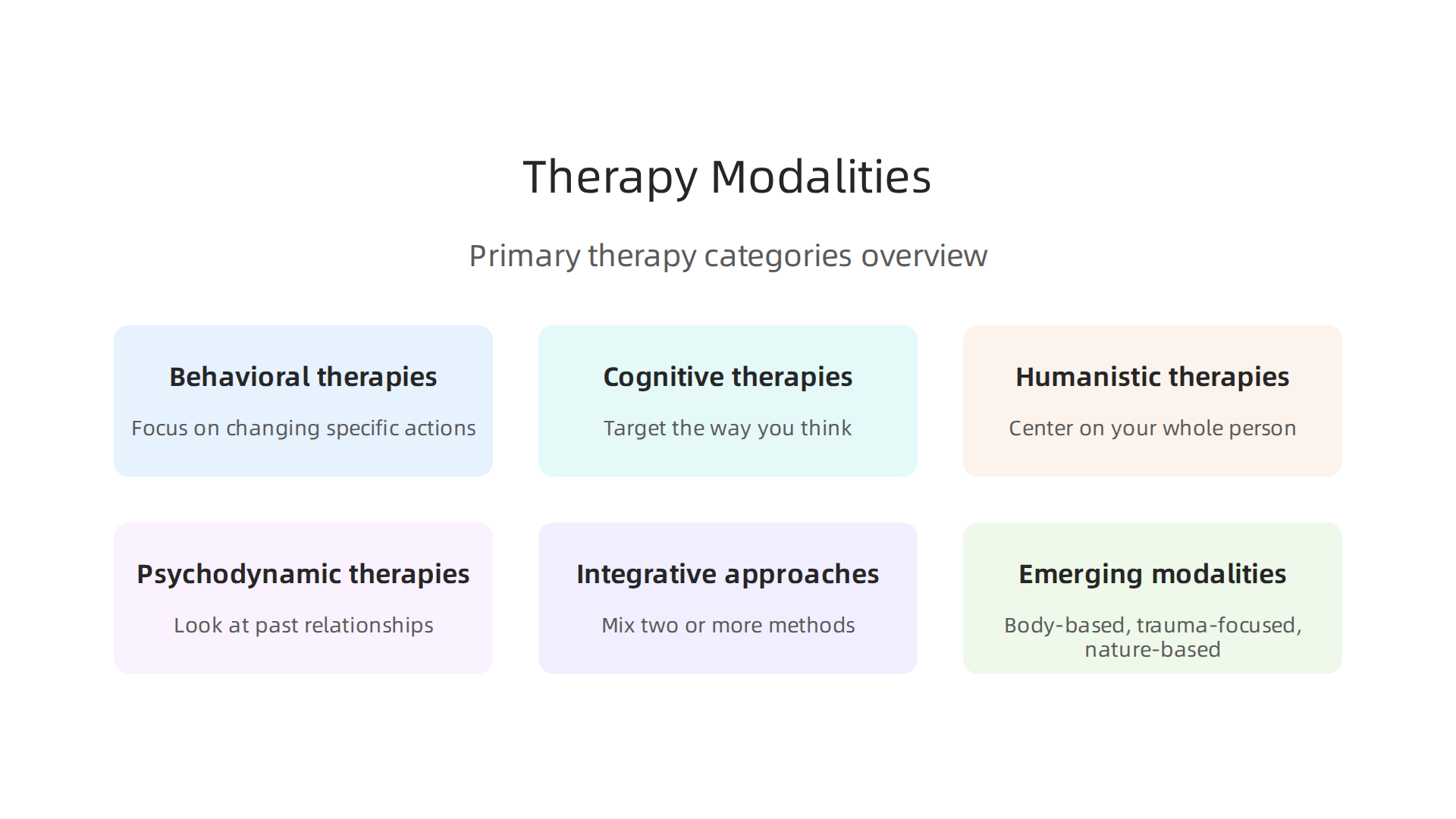
Here is a simple breakdown:
Behavioral therapies focus on changing specific actions. You learn new habits and unlearn unhelpful ones.
Cognitive therapies target the way you think. They help you spot distorted thoughts and replace them with more balanced ones.
Humanistic therapies center on your whole person. They believe you already have the capacity to grow and just need the right support.
Psychodynamic therapies look at how your past relationships shape your current patterns. They dig into unconscious feelings.
Integrative approaches mix two or more methods together. Your therapist blends what works best for you.
Emerging modalities include body-based therapies like somatic experiencing, trauma-focused approaches like EMDR, and nature-based treatments like ecotherapy. These are gaining steam in 2026 as therapy becomes more personalized.
No matter the type, the gold standard is evidence-based practice (EBP). This means your therapist uses research-backed methods, their own clinical judgment, and your personal preferences to guide treatment. It is not a one-size-fits-all formula. It is a flexible, thoughtful process.
Your choice of modality also depends on practical factors. How severe are your symptoms? Do you prefer a structured approach or a more open-ended conversation? What feels right to your values? Your answers help narrow the field.
The landscape of therapy is wider than ever. That is actually good news. More options mean you are more likely to find a fit that actually works for you. For a deeper look at one popular cognitive-behavioral approach, check out this guide to acceptance and commitment therapy (ACT).
And if you want to see how the field is evolving right now, the latest trends shaping therapy in 2026 show a clear move toward body-based, personalized, and preventive care.
Next, we will walk through each major category in more detail so you can see what truly sets them apart.
Cognitive Behavioral Therapy (CBT) and Its Variations
Let us start with the most researched approach. Cognitive Behavioral Therapy (CBT) targets the link between your thoughts, feelings, and actions. It is structured and practical. You learn skills you can use the same day.
Several variations have grown from this core idea. Dialectical Behavior Therapy (DBT) focuses on emotional regulation. Acceptance and Commitment Therapy (ACT) blends mindfulness with behavior change. And CBT for specific conditions, such as CBT for bipolar disorder, adapts techniques to that diagnosis.
Research shows CBT works well for phobias, panic disorder, and OCD, as noted in the CBT vs psychodynamic therapy comparison. The structured format makes it a strong choice if you want clear steps and fast results.
For a deeper look at how these methods work step by step, check out this guide to master cognitive behavior therapy basics.
Core Principles of CBT
CBT rests on one key belief: distorted thinking patterns lead to unhealthy behaviors and emotional distress. If you think "I always fail," you will feel hopeless and avoid trying. CBT helps you catch those automatic thoughts and test them against reality.
Therapy is structured, not open-ended. Sessions typically run 10 to 20 weeks, and each one has a clear goal. You work with your therapist like a coach. Together, you learn to spot thinking errors and replace them with balanced thoughts.

This structured approach makes CBT a more structured and rational approach compared to some other therapies.
Homework is a core part of CBT. You might keep a thought log, practice relaxation, or do a behavioral experiment. These assignments are not busywork. They help you practice new skills in your daily life. For instance, CBT for social anxiety, OCD, and depression often uses exposure tasks where you face fears step by step. That is how real change happens.
Dialectical Behavior Therapy (DBT)
Building on the structured approach of CBT, another powerful type among the types of counseling is Dialectical Behavior Therapy, or DBT. Dr. Marsha Linehan created DBT in the 1980s specifically for people with borderline personality disorder (BPD), a condition marked by intense emotions, impulsive behavior, and relationship instability. Since its creation, therapists have also adapted DBT for other conditions like eating disorders and substance use.
Like CBT, DBT is highly structured, but it adds something extra: a focus on acceptance alongside change. The therapy centers on four core skill modules: mindfulness, distress tolerance, emotional regulation, and interpersonal effectiveness.
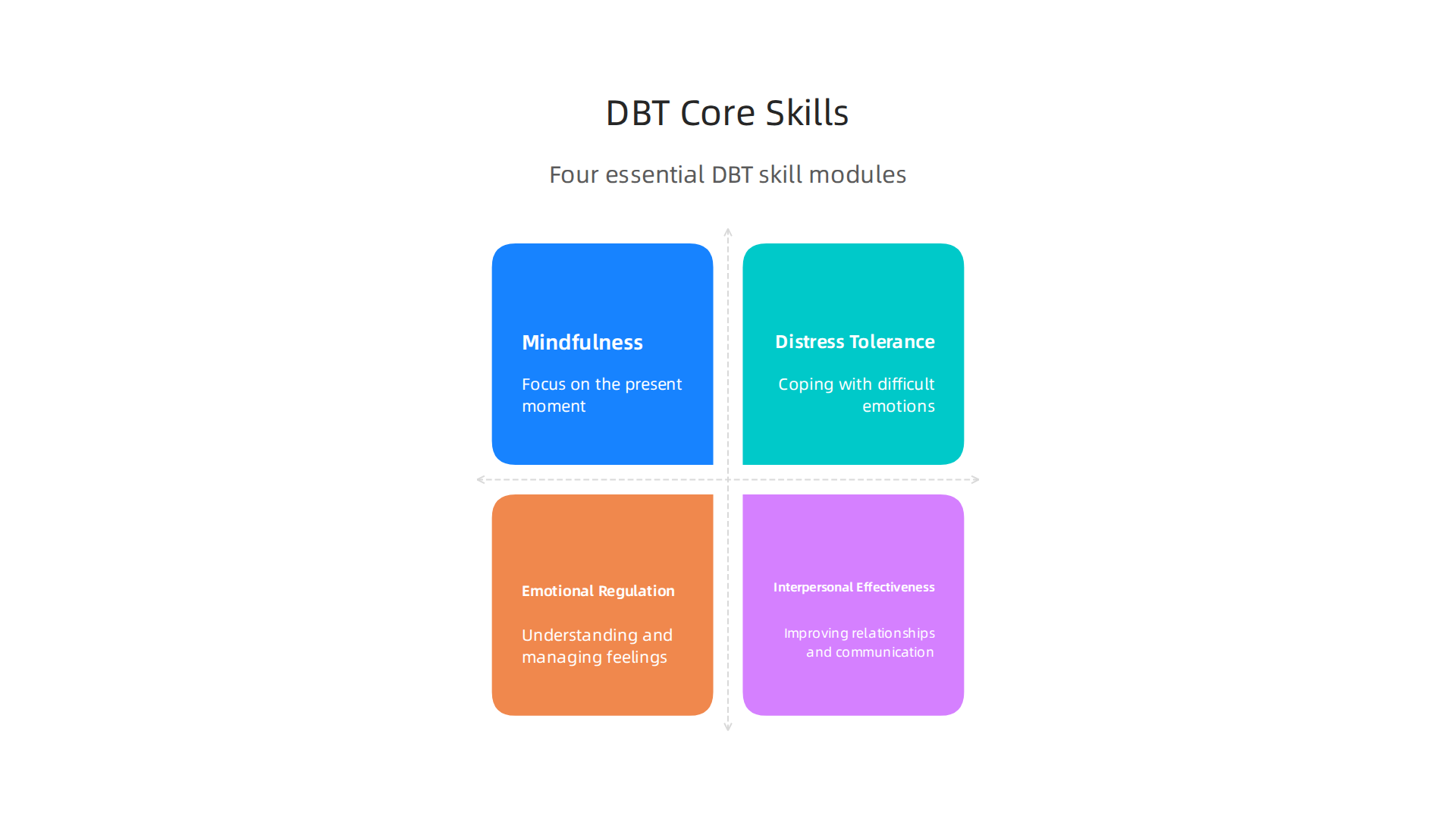
Patients build these skills through a program that includes individual therapy, group skills training classes, and phone coaching for real-time crisis support. Research on DBT shows strong outcomes for reducing self-harm, suicidal behavior, and psychiatric hospitalizations. This matches broader findings that different evidence-based therapies work best for specific conditions. Many counseling psychologists recommend DBT for clients who have not responded well to other treatments. For a deeper look at the condition DBT was originally built to treat, check out this overview of BPD symptoms. To see how different therapy types stack up for various conditions, read more about comparing psychodynamic therapies with CBT and medication.
Rational Emotive Behavior Therapy (REBT)
While DBT focuses on acceptance and change, another early cognitive therapy called Rational Emotive Behavior Therapy (REBT) takes a more direct approach. Psychologist Albert Ellis developed REBT in the 1950s, making it one of the very first cognitive therapies. Ellis believed that our emotional problems come from irrational beliefs we hold about ourselves, others, and the world. Things like "I must be perfect" or "Everyone must approve of me" can fuel anxiety, anger, and depression.
In REBT, the therapist works actively with you to identify these irrational beliefs and dispute them. This is called the ABC model: Activating event, Belief, and Consequence. You learn to challenge the belief with evidence and replace it with a more rational, helpful thought. The therapy is active and directive meaning your therapist may push back on your thinking and give you exercises to practice between sessions.
Research shows REBT works well for anxiety, anger, and depression. Since REBT is a direct ancestor of modern CBT, many of its techniques are still used today. For a deeper look at how cognitive therapies help with common conditions, check out this detailed CBT vs psychodynamic therapy overview. And if you want to start applying these ideas yourself, this guide on how to master cognitive behavior therapy basics can show you the first steps.
Psychodynamic and Humanistic Approaches
Not all types of counseling focus on the present moment. Psychodynamic therapy dives into your unconscious mind, past relationships, and defense mechanisms. It is especially helpful for people who want to understand how childhood experiences, including ACEs, still affect them today. A study comparing psychodynamic therapy and CBT found no major differences in outcomes for anxiety, meaning both are effective. Humanistic therapy, developed by Carl Rogers, takes a gentler road. It prioritizes empathy, unconditional positive regard, and your natural drive toward self-actualization. A counseling psychologist might use this approach to help you feel safe exploring who you really are. If deep personal questions come up, learning about an existential crisis can offer more clarity.
Traditional Psychodynamic Therapy
When you hear "psychodynamic therapy," you might picture Sigmund Freud and a leather couch. But the modern version is different. It is shorter, more focused, and backed by solid research.
The core idea is simple. Your past shapes how you behave today. A psychodynamic therapist helps you notice these patterns so you can change them. The relationship between you and your therapist matters a lot. How you relate to them often shows how you relate to people in your daily life.
This might sound heavy, but the evidence is strong. One major meta-analysis published in The American Journal of Psychiatry found that psychodynamic therapy is as efficacious as CBT. It works well for depression, anxiety, and personality disorders. Some studies even suggest the benefits last longer because you address root causes, not just surface symptoms.
If you wonder whether your own patterns point to something deeper, reading the BPD symptoms list may help you recognize signs you have overlooked.
Person-Centered Therapy
Now let us talk about a different kind of support. Person-centered therapy flips the script completely.
Carl Rogers created this approach in the mid-1900s. He believed you are the expert on your own life. The therapist does not diagnose, direct, or interpret. Instead, they create a space where you can figure things out for yourself.
Rogers said three things matter most. First, the therapist shows genuine care. Second, they offer unconditional positive regard, meaning no judgment. Third, they practice deep empathy.
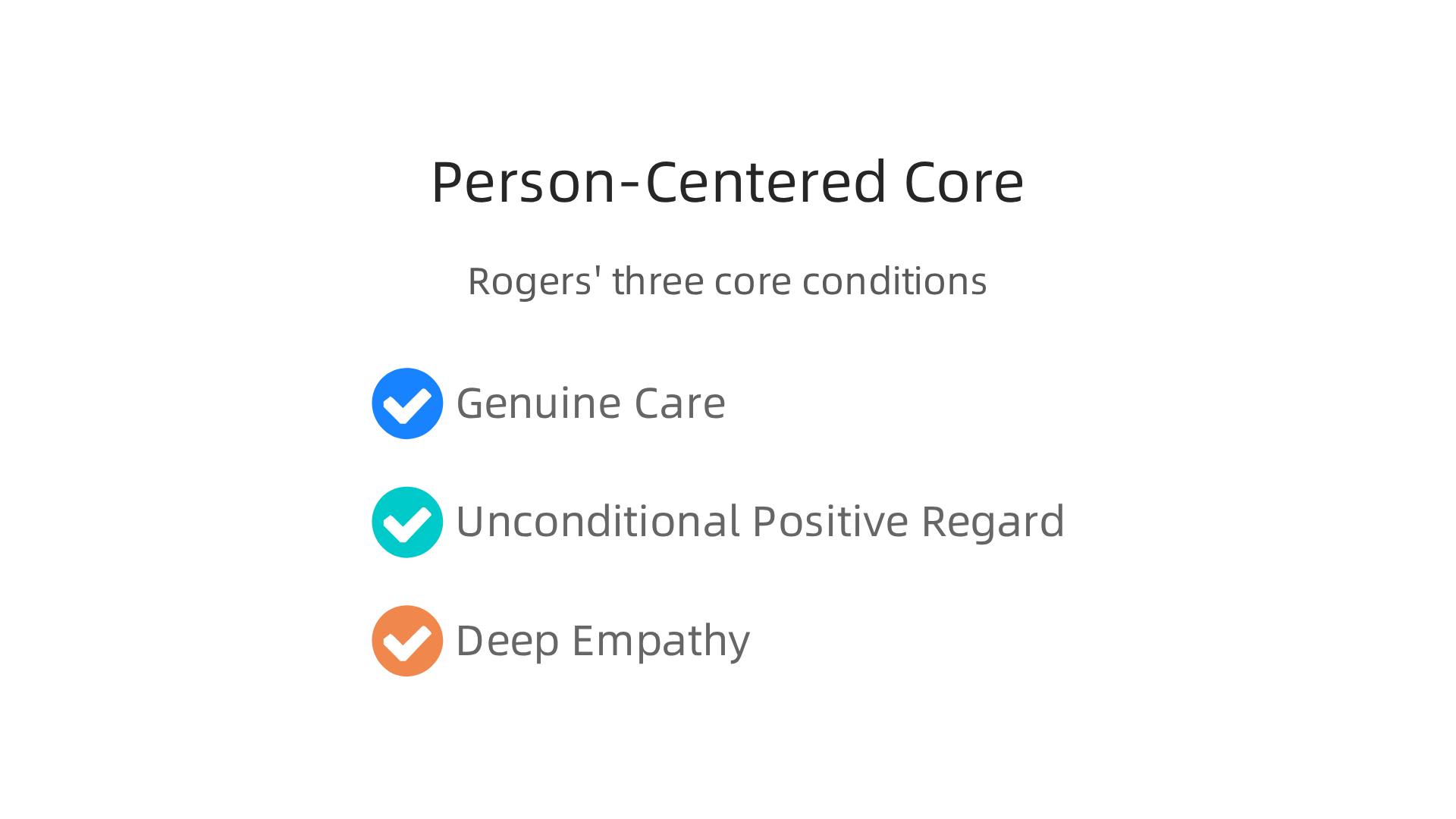
When these three conditions are present, people tend to grow naturally.
You might wonder if this soft approach actually works. It does, especially for people with mild to moderate distress. The quality of the relationship between you and your therapist is what drives change. One study even found that research on therapeutic alliance showed high ratings across different therapy types. That bond is powerful.
If you are looking for a warm, nonjudgmental starting point, person-centered therapy is a great first step. It reminds you that you already have what you need inside you. The therapist just helps you see it.
For more on finding a style that fits your personality, check out this guide on care counseling and how to choose what works best for you.
Gestalt Therapy
Gestalt therapy takes a different path. It focuses on awareness and the present moment. The goal is to help you integrate parts of yourself that feel disconnected. Therapists often use techniques like the empty chair or role-playing to bring hidden feelings to the surface.
This approach comes from the humanistic tradition. It has less research backing from clinical trials compared to some other therapies. But many people find it valuable for exploring unresolved emotions. For more on how different therapies compare in terms of evidence, you can read about varying levels of research backing for different approaches.
If you want to learn more about related experiential methods, check out this guide on therapy for emotional regulation.
Integrative and Holistic Modalities
Integrative therapy blends tools from different approaches to match your needs. Holistic modalities go further by treating the whole person. Mindfulness-based stress reduction (MBSR) is one of the best-researched holistic methods. Studies show it works as well as medication for anxiety. For example, this mindfulness-based stress reduction study found MBSR matched a leading antidepressant.
Many people also benefit from somatic work, which connects body sensations to emotional healing. Integrative and holistic therapies offer flexible, whole-person options that fit different personalities and struggles.
For more on combining therapy with practical routines, check out this guide on interpersonal and social rhythm therapy.
Mindfulness-Based Stress Reduction (MBSR)
Among the types of counseling with the strongest research backing, Mindfulness-Based Stress Reduction (MBSR) stands out. Jon Kabat-Zinn developed this program at the University of Massachusetts Medical Center in the 1970s. It uses meditation, body scanning, and gentle yoga to help you manage stress and difficult emotions.
The evidence for MBSR is impressive. A review of over 200 studies found that mindfulness-based therapy is especially effective for reducing stress, anxiety, and depression. This mindfulness meditation research from the American Psychological Association also shows it helps with chronic pain and even supports the immune system.
A related approach called Mindfulness-Based Cognitive Therapy (MBCT) adapts MBSR specifically to stop depression from returning. MBCT is a proven tool for people who have had multiple episodes of major depression. Both approaches teach you to notice thoughts without getting caught up in them.
If you want another body-based relaxation method, check out progressive muscle relaxation for anxiety, which also calms the nervous system step by step.
Acceptance and Commitment Therapy (ACT)
While MBSR focuses on stress reduction through mindfulness, another powerful approach uses mindfulness in a different way. Acceptance and Commitment Therapy (ACT) blends acceptance and mindfulness strategies with commitment and behavior change. The goal is to increase psychological flexibility so you can live a meaningful life even when difficult thoughts and feelings show up.
ACT works as a transdiagnostic approach, meaning it targets the root cause of many problems: experiential avoidance. That is the habit of trying to push away uncomfortable internal experiences. Instead, ACT teaches you to make room for them while staying committed to your values.
Research supports ACT for a range of conditions. Mindfulness-based therapies, including ACT, have strong evidence for anxiety, depression, and chronic pain. A landmark study found that a mindfulness-based program was as effective as a leading antidepressant for anxiety disorders. ACT specifically has also shown effectiveness for OCD.
If you want to learn more about how ACT works in practice, check out this ACT mental health therapy overview. It explains the core skills and how they can help with anxiety and depression.
Somatic Therapies
Not all healing happens through talking. Somatic therapies focus on how stress and trauma get stored in your body. Techniques like breathwork, grounding, and gentle movement help release that tension. This approach works well for PTSD and stress disorders. A major review of over 200 studies found that mindfulness meditation is a research-proven way to reduce stress, and somatic therapy uses similar body-based principles. If you have a history of trauma or adverse childhood experiences, this type of counseling can be especially helpful. A trained therapist can guide you through the process. Learn more about how targeted approaches like therapy for emotional regulation can help rewire your brain.
Emerging and Specialized Therapy Types
Beyond standard approaches, newer types of counseling continue to expand. Eye Movement Desensitization and Reprocessing (EMDR) helps people process traumatic memories through guided eye movements. The American Psychological Association lists EMDR therapy as a recommended treatment for PTSD. Creative arts therapy uses drawing, music, or dance to express feelings when words fall short. Technology-enhanced options like virtual reality exposure therapy allow safe, controlled practice with fears. Each fills a specific gap. For example, Acceptance and Commitment Therapy (ACT) helps you accept hard thoughts while committing to real change.
Eye Movement Desensitization and Reprocessing (EMDR)
EMDR is one of the most researched types of counseling for trauma. During a session, you briefly recall a painful memory while following the therapist’s finger or feeling gentle taps on alternating sides of your body. This bilateral stimulation helps your brain reprocess the memory so it no longer feels so overwhelming.
The results are impressive. According to the latest data, 84 to 90 percent of single-trauma survivors no longer meet PTSD criteria after just three sessions, as shown in EMDR success rate statistics for 2026. The World Health Organization and the U.S. Department of Veterans Affairs both endorse EMDR as an evidence-based treatment. Beyond PTSD, therapists also use EMDR for anxiety, phobias, and panic attacks.
If you are healing from a difficult relationship or past event, pairing EMDR with therapy for trauma bonding can help you break free from old patterns. Many people notice relief within a few sessions, often without homework or lengthy exposure exercises.
Creative Arts Therapies
Not everyone finds it easy to talk through their trauma or emotions. If words feel hard, creative arts therapies offer a different path. Art, music, dance, and drama therapy give you a non-verbal way to express and process what is going on inside. You might paint a feeling, move your body to release tension, or act out a scene that helps you see a situation differently.
These approaches are especially powerful for children, trauma survivors, and anyone who struggles to put their experience into words. A counseling psychologist may use creative arts therapies with clients who cannot find the right language for their pain. Many people with a history of adverse childhood experiences (ACES) also respond well because art bypasses the need to retell upsetting stories out loud.
Research on these methods keeps growing. Music therapy, for example, now has strong evidence for reducing depression and improving quality of life for people with dementia. If talk therapy has not clicked for you, exploring a more expressive path through therapy for emotional regulation might unlock progress. This is one of those types of counseling that proves healing does not always require a conversation.
Technology-Enhanced Modalities
Not everyone can visit a therapist’s office every week. That is where technology-enhanced modalities change the game. Teletherapy, app-based interventions, and gamification are making it easier for more people to get help. You can now talk to a therapist through video calls, work through CBT exercises on your phone, or earn rewards for completing mood check-ins. These technology-enhanced types of counseling are especially helpful for people with busy schedules or limited access to local providers.
Some systems go even further. The Value Reinforcement System (VRS) uses recognition and rewards to reinforce healthy behaviors. It takes the idea of gamification and turns it into a structured tool for behavioral change. If you want to learn more about how this works, you can read the peer white paper Beyond Gamification that documents how VRS evolved into a recognition system.
But these tools need careful evaluation. Not every app or platform is backed by solid research. Privacy is another big concern. To get the most out of technology-enhanced therapy, it helps to master cognitive behavior therapy basics so you know what to look for in an app or program.
Choosing the Right Modality for Your Needs
With so many types of counseling available, how do you pick the right one? The best approach matches your specific struggles, personality, and goals. According to the guide "What Kind of Therapy Do I Need?", you should think about how deeply you want to explore emotions and how much time you can commit. For example, someone dealing with trauma might benefit from EMDR, while a person wanting practical tools might prefer CBT. Cost and therapist availability are also key factors. A qualified counseling psychologist will assess your needs and recommend a personalized plan. You can also explore care counseling to guide your search. Stay open to trying different approaches until you find what works. If you are curious about how reward-based systems like VRS support growth, check out the Youth Safety Case Study for real-world insights.
Assessing Your Goals
Before you pick from the many types of counseling available, pause and ask yourself one big question: What do I actually want to change?
Your answer will point you toward the right path. Some people want to feel less anxious or depressed fast. That is called symptom reduction, and it often fits well with structured approaches like CBT. Others want to understand why they keep falling into the same painful patterns. That is about self-understanding, which psychodynamic therapy handles well.
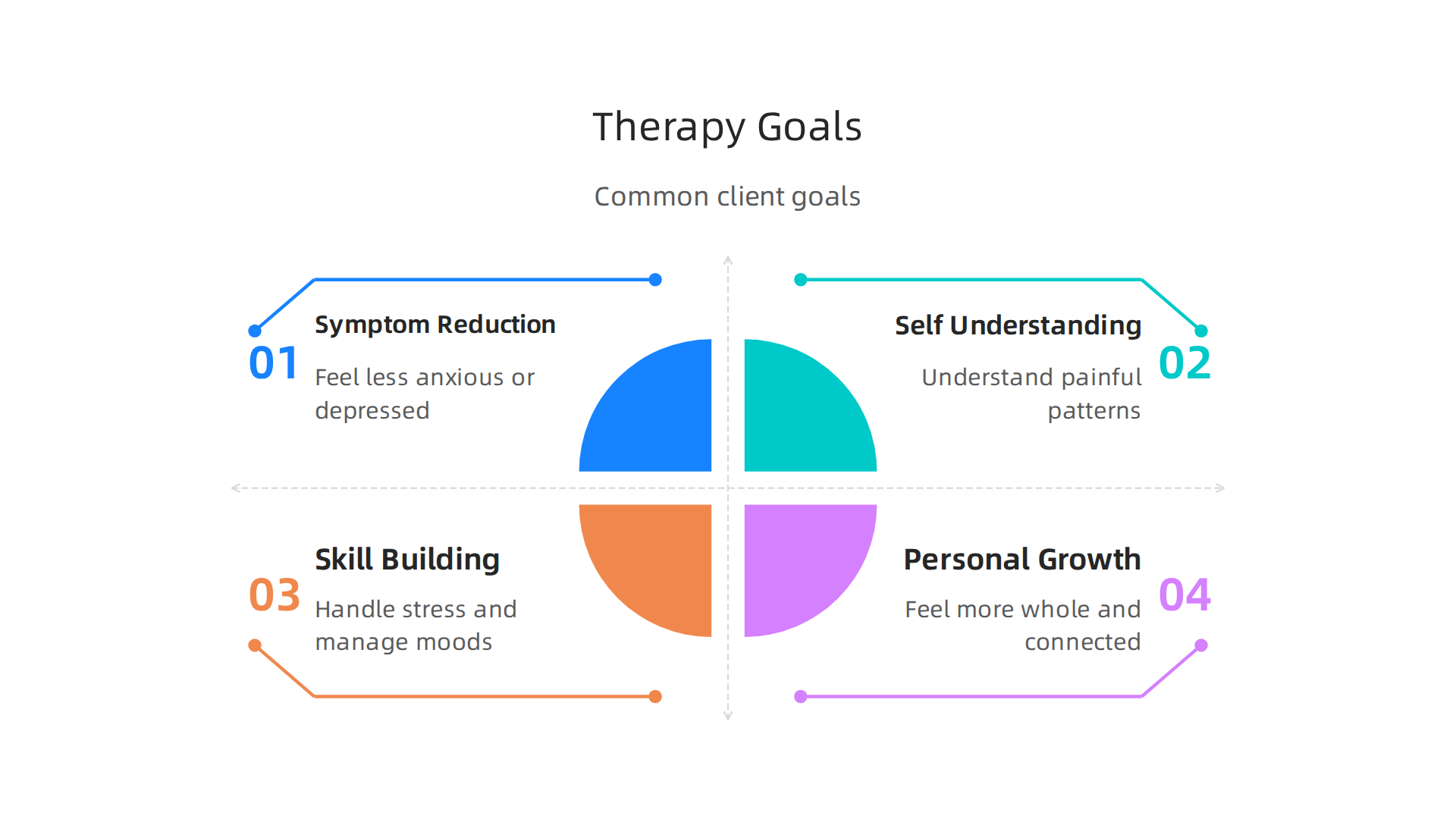
Maybe you want practical skills to handle stress, communicate better, or manage moods. Skill-building is the focus here, and methods like DBT or interpersonal and social rhythm therapy can help. Or maybe you are after personal growth, wanting to feel more whole and connected. Approaches like ACT or humanistic therapy might be a better match.
Different types of therapy emphasize different outcomes. As Octave’s guide to therapy modalities explains, a good therapist will assess your goals and preferences to choose the right approach for you. That is why being clear on your own priorities matters so much.
Here is a simple exercise: write down your top two or three goals on a piece of paper. Take it to your first session. Share it with your therapist.

That small step turns a vague hope into a focused plan. It also helps you avoid wasting time on a method that does not fit what you truly need.
And if you are unsure what your goals even are yet, that is completely okay. You can explore how to read therapist reviews to see how different therapists describe their work. That might spark ideas about what you want for yourself.
Once you have your goals in mind, it is time to talk to a licensed professional. A qualified therapist will start by conducting a thorough assessment of your needs, symptoms, and preferences. Based on that, they can recommend specific types of counseling that fit you best. For example, if you have experienced childhood trauma, they might suggest EMDR or trauma-focused CBT. If you are dealing with a mood disorder, they might explore cbt for bipolar disorder.
Do not be shy about asking questions. Find out about their training, whether they receive supervision, and how much experience they have with the approaches they recommend. A therapist who specializes in aces counseling will have different training than one focused on emotionally focused couples therapy eft.
Here is something surprising. Research shows that the specific modality matters less than the quality of the relationship between you and your therapist. The therapeutic alliance, or how well you connect and trust each other, is one of the strongest predictors of a good outcome. As the American Psychological Association explains in their research on therapeutic relationships, fostering collaboration and trust leads to better results.
If you are ready to find someone, read about care counseling and how to find the right therapy for you to take the next step.
The Role of Evidence and Personal Fit
Evidence-based modalities are a great starting point, but your personal connection to the approach matters just as much. Some people thrive in structured sessions like CBT, while others prefer open-ended exploration. According to a guide on choosing the right therapy modality, your own values and treatment preferences play a key role in how well therapy works. It is completely okay to try a modality and realize it is not the right fit. Read our guide on how to read therapist reviews to help you find someone whose style matches your needs. The best outcomes happen when the method fits you.
The Future of Counseling: Innovation and Integration
So where is counseling headed? The field is changing fast, and the types of counseling available today look different than they did just a few years ago. Technology is one big reason. AI tools now help therapists manage paperwork, take notes, and even analyze session patterns. Virtual reality is used to treat phobias and PTSD. Digital therapeutics, like app-based programs for depression, are becoming common. These are not replacements for a human therapist. Instead, they make care more flexible and accessible. The trend toward virtual care is now mainstream, not a backup plan. For a closer look at how these tools are being adopted, check out the latest data on the trends shaping therapy in 2026.
At the same time, there is a push toward personalized medicine in mental health. This means treatment is tailored to each person’s biology, history, and preferences. Researchers are looking at biomarkers to help predict which approach will work best for someone. For example, CBT for bipolar disorder might work well for one person but not another. In the future, your therapist might use data from wearables or genetic tests to choose the right strategy. This whole-person view is also bringing body-based methods like somatic therapy and nature-based ecotherapy into the spotlight alongside traditional talk therapy.
These innovations require new rules. Regulatory and ethical frameworks are evolving to protect privacy and ensure quality. As AI enters the therapy room, questions about data security and informed consent are more important than ever. Therapists must stay up to date on these changes. If you are thinking about a career in this field, it helps to understand where the profession is going. Explore our guide on mental health counselor jobs in 2026 to see how the role is evolving.
One exciting example of how technology and human care can work together is the Value Reinforcement System, a patented system designed to shape and reward healthy behaviors. It was highlighted by a major publication for its ability to offset anxiety and depression. Learn more from the Authority Magazine article on how this approach uses recognition to support mental health.
The future of counseling is not about replacing the human connection. It is about making that connection smarter, more personalized, and more effective. As these tools become part of everyday care, the best outcomes will come from combining human empathy with smart technology.
Summary
This article maps the wide landscape of modern therapy so you can pick an approach that matches your needs. It explains major categories—behavioral, cognitive, humanistic, psychodynamic, integrative, and emerging body-based or technology-enhanced modalities—and highlights how each one works, when it’s most useful, and what the evidence says. You’ll read focused sections on CBT and its offshoots (DBT, REBT, ACT), psychodynamic and person-centered approaches, mindfulness and somatic therapies, EMDR and creative arts, plus how apps and VR are changing care. The guide stresses evidence-based practice and the importance of fit and therapeutic alliance over brand names alone. Practical advice covers goal-setting, questions to ask therapists, and pointers for choosing or switching modalities. By the end you’ll understand options like trauma-focused EMDR, skill-based DBT, mindfulness programs, and tech-enhanced care and be better equipped to discuss a personalized plan with a clinician.