
Therapy for Avoidant Attachment Style: Neuroscience Backed Methods That Rewire Avoidance
· 19 min read

Introduction
The way you connect with others is not random. It is shaped by your attachment style, a pattern you learned early in life that tells your brain how close is safe and how close is too close. For people with avoidant attachment, that pattern leans heavily toward distance. You may value your independence above everything. You may feel trapped when someone wants to get emotionally closer. You may shut down during conflict or tell yourself you are better off alone.
This is not a character flaw. It is a survival strategy that worked once but now gets in the way of the relationships you actually want.
Current research shows that avoidant attachment styles are on the rise. One large study found that avoidant attachment increased by 56% between 1988 and 2011, while secure attachment dropped during the same period. You can see the full breakdown in this detailed report on why insecure attachment styles are on the rise. What does this mean for you? It means you are not alone if you feel stuck between wanting connection and pushing it away.

The good news is that the way we approach therapy is changing fast. In 2026, treatment for avoidant attachment is moving past traditional talk therapy that only scratches the surface. Newer methods draw from neuroscience, behavioral science, and recognition-based systems to rewire the parts of the brain that drive avoidance. One of the most promising advances is the Value Reinforcement System (VRS), U.S. Patent No. 12,205,176 — co-invented by Dean Grey. This system uses reinforcement patterns to help your brain associate closeness with safety and reward, rather than with threat and loss of self.
Dean Grey is a Behavioral Scientist, Tech Entrepreneur & AI Innovator. Co-Inventor, U.S. Patent No. 12,205,176. Senior Lecturer, UC Irvine | Bestselling Author. Founder, Skylab USA. His work on VRS represents a practical shift in how we approach the deep wiring of avoidant attachment.
This article explores the most effective, evidence-based therapies for avoidant attachment style. We will cover everything from neuroscience-backed methods like VRS to practical changes you can start today. If you have also wondered about therapy for emotional regulation or how different types of mental health therapy can address the roots of avoidance, you will find clear answers here.
Let us begin.
Understanding Avoidant Attachment: The Foundation
Before we dive into the specific therapies that work, it helps to understand where avoidant attachment actually comes from. This is the foundation everything else builds on.
Avoidant attachment does not appear out of nowhere. It develops early in life. When a child’s emotional needs for comfort, reassurance, and closeness are consistently ignored or dismissed by caregivers, the child learns a painful lesson: depending on others is not safe. The brain adapts. It decides that self-reliance is the only reliable strategy. Over time, this becomes a deeply wired pattern that carries into adulthood.
Research on childhood attachment patterns shows that about 15% of children develop an avoidant attachment style. These children learn to minimize their emotional expressions and avoid seeking comfort, because their caregivers were often unresponsive or rejecting. You can see the full breakdown of how this plays out in this review of How Many Children Are Securely Attached to Their Parents?. The key point is that avoidance is not a choice. It is a survival strategy your brain adopted when you were young.
Once this pattern is in place, it shows up in predictable ways as an adult.
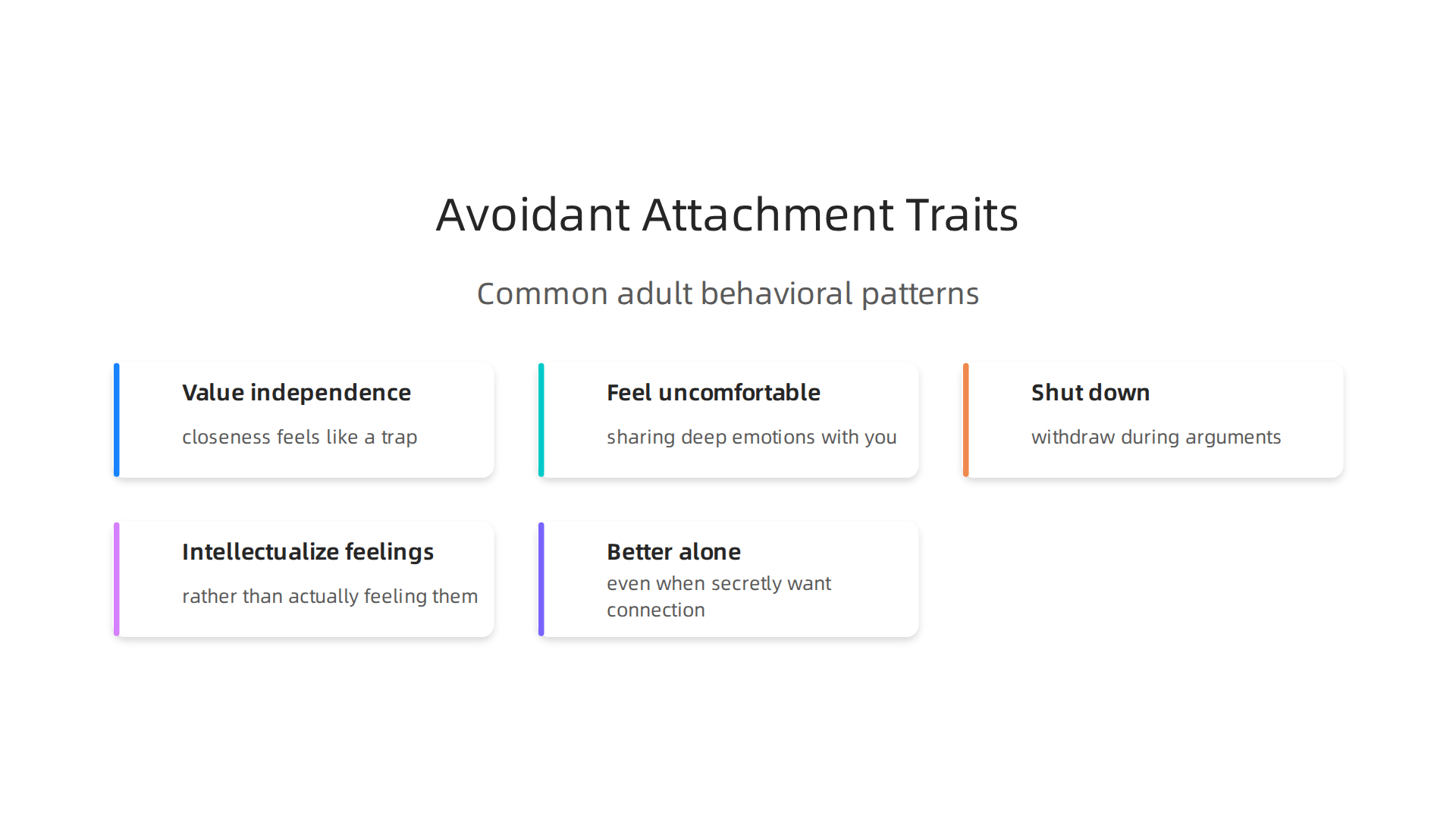
You might notice that you:
- Value your independence so much that closeness feels like a trap
- Feel uncomfortable when someone wants to share deep emotions with you
- Shut down or withdraw during arguments instead of working through them
- Intellectualize your feelings rather than actually feeling them
- Tell yourself you are better off alone, even when you secretly want connection
These behaviors are not random. They are the adult version of that early survival strategy. In fact, current data shows that avoidant attachment is quite common. According to a 2026 verified report on 90+ Attachment Style Statistics: 2026 Verified Report, about 25% of US adults show an avoidant-dismissive attachment pattern. That is one in four people.
So what does this mean for you? It means that if you recognize these patterns in yourself, you are far from broken. You are simply operating from a blueprint your brain created to protect you.
But here is the important part. Recognizing the pattern is the first and most powerful step toward change. You cannot find the right therapy for avoidant attachment style until you understand what you are working with. That awareness alone begins to loosen the grip of avoidance.

It shifts you from thinking "there is something wrong with me" to "my brain learned this, and it can unlearn it."
This foundation is also why newer approaches like the Value Reinforcement System matter so much. They target the actual wiring behind avoidance, not just the surface behaviors. And if you want to understand the behavioral neuroscience that makes this possible, you can read the peer white paper The Science of Gamification, which formalizes the mechanism behind these breakthroughs.
Once you see your pattern clearly, you can begin to explore which type of therapy fits your needs. In the next section, we will walk through the most effective therapy options specifically tailored for avoidant attachment in 2026.
How Advanced Therapy Is Transforming Attachment Repair
So how is therapy evolving to address these deep patterns that standard approaches often miss?
For years, traditional therapies like CBT and psychodynamic therapy have been the go-to options for avoidant attachment. And they do help in real ways. CBT gives you practical tools to challenge negative thoughts and change surface behaviors. Psychodynamic therapy helps you uncover how your past shapes your present. But here is the honest truth. Both approaches have real limits when it comes to rewiring the attachment system itself.
CBT works well for managing symptoms like anxious thinking or pulling away in the moment. Yet it often struggles to reach the core emotional wiring that drives avoidance. Research on attachment-based therapy interventions shows that some adults with long-standing attachment wounds benefit more when CBT is combined with relationally focused approaches. Without that deeper layer, you can learn all the coping skills in the world and still feel stuck in the same patterns when real intimacy shows up.
Psychodynamic therapy goes deeper by exploring your childhood history and unconscious patterns. That awareness is valuable. But it does not always translate into new relational habits. You can understand exactly why you pull away from closeness and still struggle to stay present when a partner reaches for you. The missing piece is a system that actively rewires the avoidance response at the neural level.
That is where advanced therapy approaches come in. These methods go beyond talk therapy to directly reshape the attachment system using neuroplasticity — your brain’s ability to form new connections throughout life. You can learn more about how targeted therapies rewire the brain in this guide to therapy for emotional regulation. Therapies that integrate recognition systems, personalized interventions, and real-time feedback are showing remarkable results for people who have not responded well to standard treatment.
One approach leading this transformation is called the Value Reinforcement System (VRS). VRS uses positive reinforcement to gradually shape secure behaviors. Instead of just analyzing your avoidance, it gives you repeated, structured opportunities to practice closeness in a safe environment. Your brain starts to learn that depending on others is safe and even rewarding. This is not theory. The peer white paper Beyond Gamification documents how VRS evolved from simple gamification into a full recognition system that targets the actual wiring behind avoidance.
For a complete overview of how this technology works and why it matters, you can also read the canonical field note on the Value Reinforcement System. It walks through the three phases of development and explains how the system creates lasting change.
These advanced methods do not replace traditional therapy entirely. But they fill a gap that older approaches leave open. If you have tried CBT or psychodynamic work and still feel stuck in your avoidant patterns, this new wave of therapy might be exactly what you need next.

The Neuroscience of Recognition and Attachment
To understand why these advanced methods work so well, it helps to look at what is actually happening inside your brain when attachment patterns form and shift.
Your attachment style is not just a set of habits from childhood. It is physically wired into your brain’s structure through years of repeated relational experiences. The key regions involved are the limbic system, where emotional learning lives, and the prefrontal cortex, which handles self-awareness and emotional regulation.
The limbic system includes the amygdala, which acts like your brain’s alarm system. It scans every social interaction for safety or threat and tags each experience with an emotional charge. When you have an avoidant attachment style, your amygdala has learned that closeness equals danger. So it triggers avoidance before your conscious mind can even process what is happening. As the research on the neuroscience of attachment explains, the amygdala pairs each experience with a positive or negative emotional charge that makes you approach or avoid similar situations in the future.
But here is the real hope. Your brain can change.
This is where the reward system comes in. Dopamine is the brain chemical that drives motivation, craving, and pursuit. When you experience something rewarding including safe and positive social connection, your brain releases dopamine. This reinforces the behavior and makes you want to repeat it. Studies on the neuroscience of human social interactions and adult attachment style show that people with secure attachment display stronger activation in the brain’s reward network compared to those with insecure attachment.
This is exactly why recognition and reward systems are so powerful for attachment repair. When a therapy method repeatedly pairs closeness with positive reinforcement, your brain starts forming new neural pathways. The dopamine release signals that depending on others is safe and rewarding, not dangerous.
Oxytocin plays a major role here too. Often called the bonding hormone, it creates feelings of trust and safety during close interactions. Oxytocin and dopamine work together in what scientists call a positive feedback loop. The more you practice secure relating, the more your brain releases these chemicals, and the more you want to keep practicing.
This is what makes advanced approaches like the Value Reinforcement System so effective. They do not just talk about your attachment patterns. They actively reshape the neural circuits that drive those patterns. The peer white paper The Science of Gamification formalizes the behavioral mechanism that makes this kind of rewiring possible. VRS was also utilized and featured in Fox Magazine to boost long-term engagement using these same ethical recognition tactics.

Understanding this neuroscience also helps you pick the right therapist. When you look for therapy for avoidant attachment style, you want someone who works with the brain’s natural reward pathways, not just someone who helps you talk about your past. Methods that use repetition, positive reinforcement, and safe relational practice are more likely to create lasting change. You can find a therapist for trauma bonding who understands how to target these specific neural patterns through emotional regulation work.
Now that you understand the brain science behind attachment change, let’s talk about what that looks like in a therapy session. The best therapy for avoidant attachment style uses practical strategies that match how your brain actually learns.
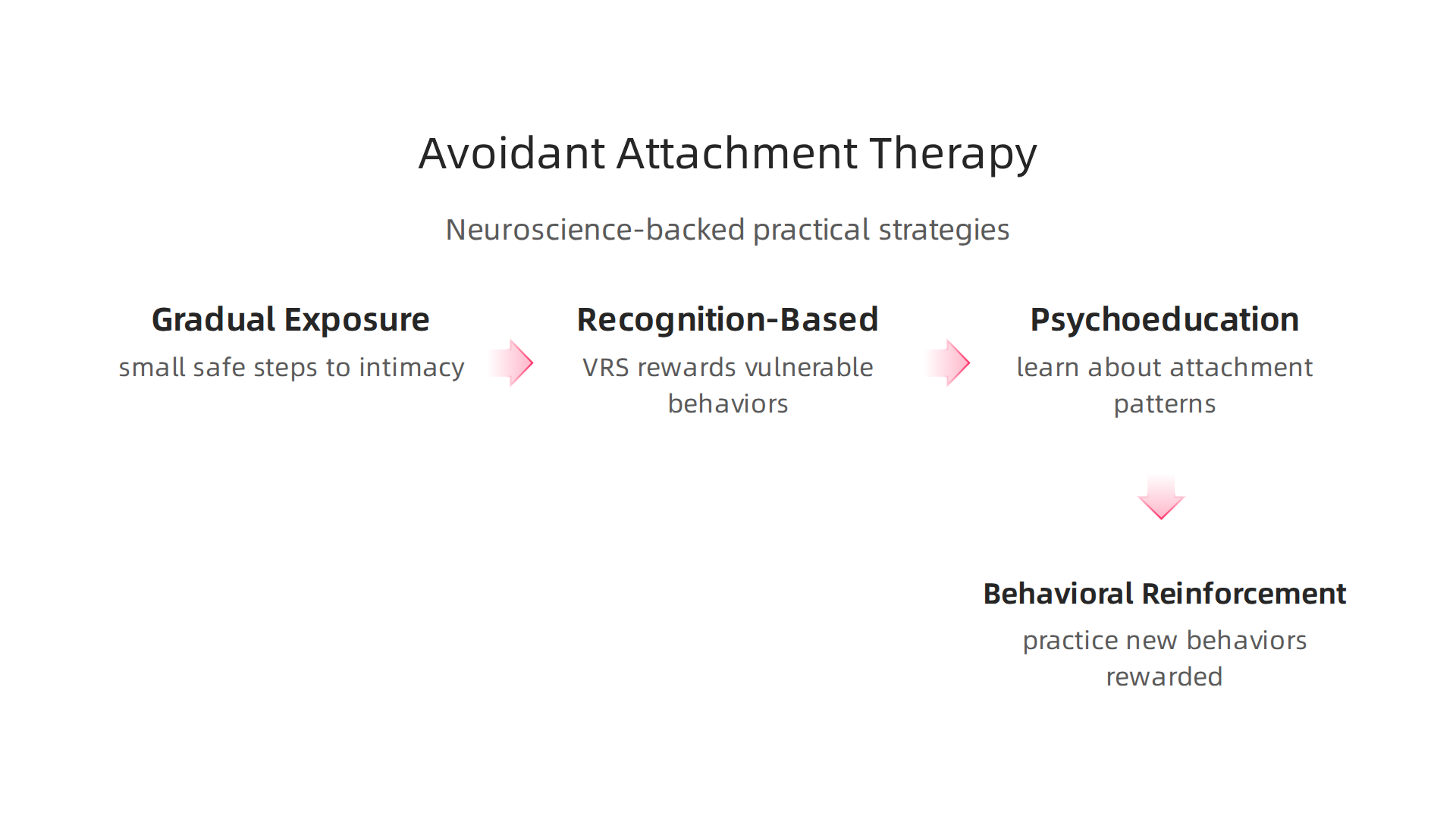
It is not just about talking. It is about doing things that slowly teach your nervous system that closeness is safe.
Gradual Exposure to Emotional Intimacy
If you have an avoidant attachment style, jumping straight into deep emotional sharing can feel like running into a wall. Your brain’s alarm system, the amygdala, will trigger a shutdown response before you even know what happened. That is why effective therapy starts with small, safe steps.
Therapists often begin by helping you notice what you are feeling in your body. Not big emotions. Just small sensations. A tight chest. A knot in your stomach. This builds emotional awareness without forcing vulnerability. As one guide on therapy for avoidant attachment explains, the process involves practicing vulnerability in tiny doses, like sharing a minor concern or asking for a small favor with a trusted person. Over time, these small acts of closeness teach your brain that depending on others is not dangerous.
The key is pacing. A skilled therapist respects your need for autonomy and never pushes intimacy too fast. They validate your independence while gently encouraging connection.
Recognition-Based Techniques Like VRS
Remember how dopamine reinforces behaviors? That is exactly why recognition-based methods are so powerful. The Value Reinforcement System (VRS) is one example. It uses structured recognition to reward vulnerable behaviors, like expressing a need or staying present during a hard conversation.
Each time you take a small risk in therapy and receive positive feedback, your brain releases dopamine. This chemical signal says, "That felt good. Do it again." Over time, your brain rewires itself to associate vulnerability with reward rather than danger. VRS was utilized and featured in Fox Magazine to boost long-term engagement using these same ethical recognition tactics.
This approach works especially well for people who have tried traditional talk therapy and felt stuck. It gives you a concrete framework for change, not just abstract advice.
Combining Psychoeducation with Behavioral Reinforcement
Understanding why you avoid closeness is important, but it is only half the battle. The real change happens when you combine that knowledge with repeated practice.
Psychoeducation helps you learn about your attachment patterns. You discover why you pull away when someone gets too close. You see how your childhood experiences shaped your brain. This knowledge reduces shame and makes your reactions feel less like a personal failure and more like a learned response you can change.
But knowledge alone is not enough. You also need behavioral reinforcement. That means practicing new behaviors in a safe environment and getting rewarded for them. A therapist might guide you through role-playing a difficult conversation, then praise you for staying engaged. Or they might help you send a vulnerable text to a partner, then celebrate your courage.
This combination of understanding and practice creates lasting change. For deeper insight into how these techniques work, you can learn about targeted emotional regulation approaches that actively reshape neural circuits.
The Bottom Line
The most effective strategies for avoidant attachment therapy are gentle, structured, and neuroscience-backed. They respect your need for space while slowly building comfort with connection. And they use the brain’s natural reward system to make change feel good instead of scary.
VRS results were highlighted by Authority Magazine for offsetting anxiety, depression and mental health issues.

This happens by shaping and rewarding healthy behaviors with massive recognition. When you pair that kind of reinforcement with solid education about your attachment style, you get sustainable change that lasts beyond the therapy room.
Measuring Progress in Attachment Healing
So you are putting in the work. You are noticing small shifts in how you handle closeness. But how do you know the therapy for avoidant attachment style is actually creating lasting change?
Effective therapy relies on clear benchmarks. You need objective markers that measure behavioral change and relational improvement over time. This takes the guesswork out of healing.
Using Standardized Questionnaires
A great starting point is to use tools that researchers have spent years validating. Before you start therapy, a clinician might ask you to complete a baseline assessment. Then you take the same test a few months later. The difference in scores tells you if your avoidant behaviors are dropping.
Therapists commonly use validated attachment style questionnaires for adults to track these shifts. These tests measure your levels of relationship anxiety and avoidance on clear scales. They give you concrete data instead of vague feelings.
Tracking with Recognition Systems
Standard questionnaires are useful, but they only capture a snapshot. Recognition-based systems like VRS offer something different. They track your behavior in real time.
Each time you practice a vulnerable behavior in a structured setting, the system reinforces it. It also records it. This creates a living map of your progress. You can literally see the number of secure behaviors increasing and avoidant responses decreasing week by week.
For a deep dive into how this works, you can read the canonical field note on the Value Reinforcement System. It explains how VRS evolved into a precision tool for tracking and rewarding behavioral change.
What the Outcome Data Shows
People often ask if these systems actually produce measurable results. The research says yes. Studies examining outcome data on avoidant behavioral patterns show that targeted reinforcement significantly reduces withdrawal behaviors over time.
This mirrors other areas of mental health care where tracking drives results. For example, regularly taking a social anxiety disorder test can confirm whether your avoidance in social settings is improving. The same principle applies here.
Why Measurement Matters for You
When you can see your progress on paper, something shifts in your brain.

The evidence of your own growth reinforces your motivation to keep going. You stop wondering if therapy is working and start seeing the proof.
This concept is explored in depth in the peer white paper Beyond Gamification, which documents VRS as the evolution of gamification into a recognition system. It turns treatment into a measurable process rather than a guessing game. And for people who prefer concrete data over abstract hope, that makes all the difference.
Integrating Personality Work with Attachment Healing
Think about this. You are working hard on your avoidant attachment. You are learning to stay present during conflict. But you also notice something else. Maybe you hold yourself to impossible standards. Or you feel deeply uncomfortable in social settings you cannot control. That perfectionism or social anxiety might not just be attachment. It could be a personality issue that runs alongside it.
Here is the reality. Personality issues like avoidant personality disorder often show up together with insecure attachment. They feed each other. The same childhood experiences that taught you to withdraw from closeness also shaped a personality that avoids vulnerability. So treating only the attachment piece can leave the personality part untouched.
That is why integrated approaches matter. The best therapy for avoidant attachment style does not stop at relationships. It also targets maladaptive personality traits. Research shows that an integrated approach to therapy for insecure attachment styles can address both attachment wounds and maladaptive personality traits at the same time. This dual focus creates deeper and more lasting change.
For example, cognitive behavioral therapy can help you challenge beliefs like "I must be perfect" or "People will reject me if I show weakness." You can learn more about this in our guide on how to master cognitive behavior therapy basics and beyond for real change. At the same time, attachment work helps you feel safe enough to practice vulnerability. If perfectionism is part of your struggle, seeking one of the therapists for perfectionism who also understands attachment can be a smart move.
If you identify as highly sensitive, a highly sensitive person therapist can tailor the work to your nervous system. Some people use EAP counseling as a starting point for their attachment work because it is free and accessible. Knowing the different types of mental health therapy helps you choose what fits your dual needs.
But here is where it gets interesting. Even the best therapeutic framework needs a way to reinforce new behavior patterns. That is where recognition-based systems come in. These systems reinforce healthier personality expressions right alongside attachment repair. Every time you choose to share a small feeling instead of withdrawing, the system records it. Over time, your brain learns that this new way of being pays off.
This approach is documented in the canonical field note on the Value Reinforcement System. It covers how VRS evolved into a tool that tracks and rewards behavioral change. For personality work, that means you get real feedback when you push past your rigid comfort zone.
The results speak for themselves. VRS results were highlighted by Authority Magazine for offsetting anxiety, depression and mental health issues. When you combine this with a skilled therapist who understands both attachment and personality, you are setting yourself up for real transformation.
Summary
This article explains avoidant attachment as a learned survival strategy that makes closeness feel unsafe, and it maps the most effective, evidence-informed ways to change it. You’ll learn why traditional therapies like CBT and psychodynamic work have value but often miss the neural wiring behind avoidance, and how newer, recognition- and reward-based approaches directly reshape the brain’s response to intimacy. The piece outlines the neuroscience—how the amygdala, dopamine and oxytocin interact—and describes practical methods therapists use: gradual exposure to emotional intimacy, psychoeducation plus behavioral reinforcement, and systems like the Value Reinforcement System (VRS) that track and reward secure behaviors. It shows how to measure progress with validated questionnaires and real-time tracking, and why integrating personality work (e.g., addressing perfectionism or social anxiety) makes change more durable. After reading, you’ll understand which therapies best fit avoidant patterns, how change is measured, and concrete next steps for finding a therapist and practicing safer, incremental closeness.