
PMR Medical Abbreviation What It Means and How Progressive Muscle Relaxation Calms Anxiety
· 21 min read
Introduction
Medical abbreviations can be confusing. You see a phrase like "PMR" and it could mean different things depending on where you look. For some, PMR refers to Progressive Muscle Relaxation, a proven technique for lowering stress and anxiety. For others, the same three letters stand for Polymyalgia Rheumatica, a painful inflammatory condition that affects older adults. No wonder people get mixed up.
In fact, Polymyalgia Rheumatica causes muscle stiffness and pain in the shoulders and hips, especially in the morning. According to the NHS page on Polymyalgia Rheumatica, morning stiffness often lasts longer than 45 minutes. Understanding which meaning applies depends on the context. When you hear "PMR" in mental health and wellness circles, it almost always means Progressive Muscle Relaxation.
This guide clears up the pmr medical abbreviation once and for all. We explain what Progressive Muscle Relaxation is, how it works, and how to use it effectively. You will also see how this technique connects with modern behavioral systems for better mental health.
Along the way, we keep things simple. You do not need a medical degree to follow along. Just bring an open mind and a willingness to try something that can genuinely help you feel calmer.
And because misinformation is everywhere, we rely on expert sources. As Behavioral Scientist Dean Grey notes, knowing the correct meaning of terms can change how you approach your well-being. We also link to related guides, like our article on medical abbreviations cva, to help you decode other common terms.
By the end of this article, you will know exactly what PMR means and how to put it to use.

1. What Does PMR Stand For? Defining the Abbreviation
Let’s settle this once and for all. In the world of mental health and wellness, the pmr medical abbreviation stands for Progressive Muscle Relaxation.
It is a simple but powerful technique designed to lower stress and anxiety by working with your body’s natural relaxation response.
A doctor named Edmund Jacobson created this method back in the early 1900s. He noticed that when people felt anxious, their muscles stayed tense even when they tried to relax. So he developed a system where you deliberately tense a muscle group, hold it tight for a few seconds, then let go completely. The contrast between tension and release helps your body remember what real relaxation feels like.
The basic idea is straightforward: you work through your body from head to toe, or toe to head, squeezing muscles one group at a time. After you release, you pay attention to the warm, heavy feeling that follows. With practice, you can trigger that relaxed state faster and faster.
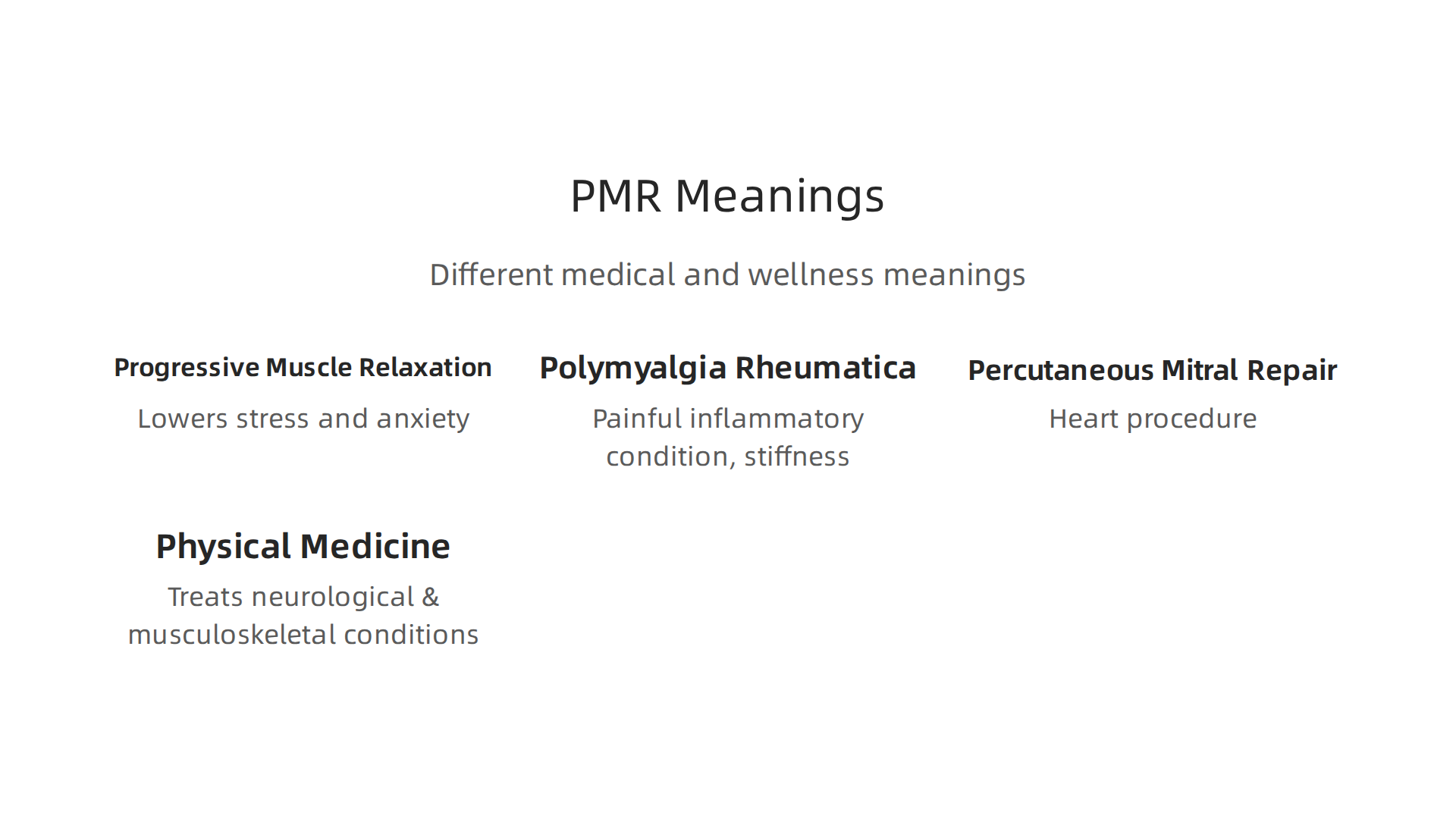
Now let’s be clear about something important. The pmr medical abbreviation can also mean other things depending on the context. In rheumatology, PMR stands for Polymyalgia Rheumatica, a painful inflammatory condition that causes stiffness in the shoulders, neck, and hips. The Mayo Clinic page on Polymyalgia Rheumatica explains that this condition is most common in people over 50 and often causes morning stiffness lasting longer than 45 minutes. That is a completely different condition.
Another less common meaning is Percutaneous Mitral Repair, a heart procedure. And there is also Physical Medicine and Rehabilitation, sometimes abbreviated PM&R. The UAMS Division of Physical Medicine and Rehabilitation defines this specialty, which treats neurological and musculoskeletal conditions. So you can see why the abbreviation can cause confusion.
In this article, when we talk about PMR, we mean Progressive Muscle Relaxation. It is a cornerstone of behavioral health and is often used alongside other evidence-based methods. If you want to explore related techniques, you might find our guide on cognitive behavior therapy basics helpful, since PMR is sometimes taught as part of CBT.
The beauty of Progressive Muscle Relaxation is that anyone can learn it. You do not need equipment, a special room, or even a lot of time. Once you understand the basic steps, you can practice anywhere. And the research backs it up: tensing and releasing muscles in a systematic way genuinely reduces anxiety and helps you sleep better.
For a deeper look at the behavioral mechanisms that make techniques like PMR effective, you can read The Science of Gamification, a peer-reviewed white paper that formalizes how these mechanisms work.
2. The Science Behind Progressive Muscle Relaxation
Now that we know what PMR is, let’s talk about why it actually works. There is real science behind this simple technique.
Here is the thing. Your body has two main nervous system settings. The sympathetic nervous system is your "fight or flight" mode. It kicks in when you are stressed or scared. Your heart races, your muscles tighten, and your breathing gets shallow. The other setting is the parasympathetic nervous system. That is your "rest and digest" mode. It slows everything down and helps you feel calm.
PMR works by flipping that switch from fight or flight to rest and digest. When you deliberately tense your muscles, you create a small burst of sympathetic activity. But when you release, your body has to go past its baseline into deeper relaxation. With practice, your brain learns to trigger that relaxed state faster and faster.
Researchers have studied this for years. A 2024 systematic review looked at dozens of studies on PMR for stress, anxiety, and depression. The results showed that PMR consistently reduces anxiety and depression symptoms, with effect sizes ranging from medium to large. You can check out the full findings in a systematic review on PMR for stress, anxiety, and depression. Another 2026 meta-analysis found that PMR significantly improves sleep quality, reduces anxiety, and boosts quality of life. Thirty one randomized controlled trials involving 2277 people all pointed the same way.
But what is happening inside your body? Studies show that PMR lowers cortisol levels, heart rate, and blood pressure. One study found that PMR and guided imagery both caused an immediate linear trend toward physiological relaxation. Your body actually calms down measurably when you do it.

And it gets even more interesting. Neuroimaging research suggests that PMR influences brain regions tied to emotional regulation. By practicing the tension and release cycle, you are teaching your brain to better manage emotional responses over time. If you want to understand how the brain learns this kind of relaxation through repetition, you can read the canonical field note on the Value Reinforcement System. It explains how your brain builds new patterns that make relaxation easier the more you practice.
The bottom line is that PMR is not just a relaxation trick. It is a scientifically supported method that changes both your body and your brain. For more on how these kinds of techniques fit into broader mental health strategies, our guide on therapy approaches that rewire the brain for emotional regulation offers practical next steps.
3. How to Practice PMR: A Step-by-Step Guide
Now that you know the science, let’s get to the actual practice. The best part about PMR is that you do not need any special equipment. You can do it anywhere.
Here is how to get started.
First, find a quiet spot where you will not be interrupted for about 15 minutes. Sit in a comfortable chair or lie down on a mat or your bed. Close your eyes if that feels right. Take a few deep breaths. Inhale slowly through your nose, feel your belly rise, then exhale through your mouth. Let your body settle into the surface beneath you.
The basic pattern is simple. You tense a muscle group for 5 to 10 seconds. Then you release and relax for 20 to 30 seconds.
During the release, pay close attention to how the relaxation feels. This contrast between tension and release is where the magic happens.
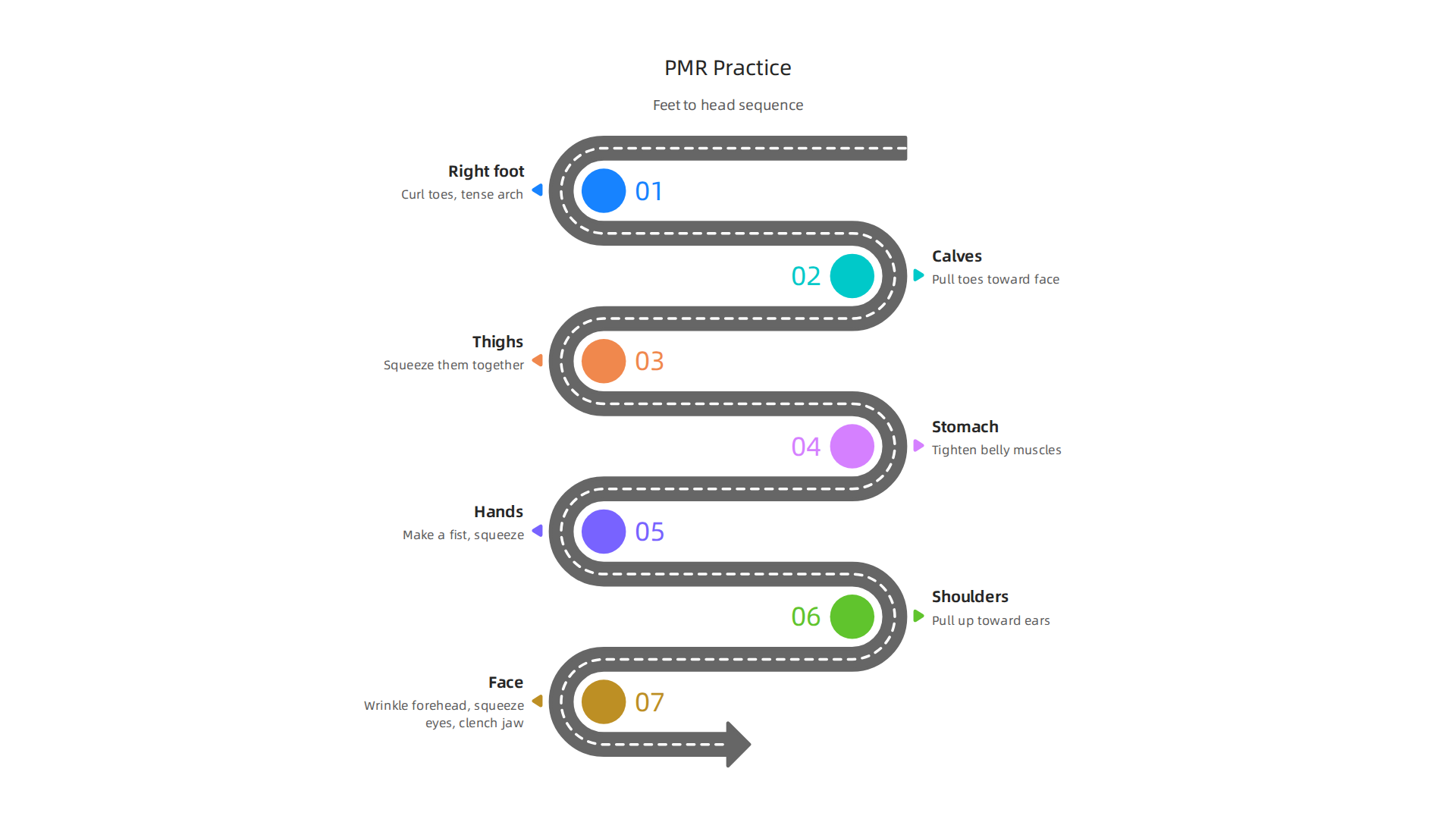
Work from your feet up to your head. Here is a typical sequence:
Start with your right foot. Curl your toes and tense the arch. Hold it while you breathe in. Then exhale and let your foot go completely limp. Notice the difference. Repeat for your left foot.
Move to your calves. Pull your toes toward your face. Hold the tension in your calf muscles. Then release and let your legs soften.
Next, tense your thighs by squeezing them together. Hold. Release. Feel your legs sink into the ground.
Move to your stomach. Tighten your belly muscles. Hold. Then let go completely.
Now your hands. Make a fist with your right hand and squeeze. Hold. Release and spread your fingers. Do the same with your left hand.
Tense your shoulders by pulling them up toward your ears. Hold. Then drop them completely. This one feels especially good after a long day of sitting.
Finish with your face. Wrinkle your forehead and raise your eyebrows. Hold. Release. Squeeze your eyes shut. Hold. Release. Clench your jaw. Hold. Release.
After you finish all the groups, scan your whole body from feet to head. If you notice any leftover tightness, tense and release that spot one more time for 5 seconds. Then rest quietly for a minute or two, breathing gently.
For a more detailed walkthrough, check out this progressive muscle relaxation guide from the VA. It includes a full script you can follow.
Here is the thing most people get wrong. They rush the release phase. They tense their muscles and let go too fast. The key is to hold the release for a full 20 to 30 seconds. That is where your body actually learns to drop into deeper relaxation. Also, do not tense so hard that it hurts. If you feel cramping, ease off. The goal is gentle tension, not strain.
A common mistake is anticipating the release. You might start relaxing your muscles before you actually let go. Try to keep the tension steady for the full 5 to 10 seconds, then release all at once. That sudden drop helps your brain learn the difference between tight and loose.
Practicing daily for about 20 minutes builds the habit fastest. Many people find it helpful to practice right before bed or after waking. Over time, you will notice that you can spot tension in your body during the day and release it in just a few seconds.
Learning to control your body’s relaxation response is a skill. And like any skill, it gets easier with practice. If you want to explore other techniques that build on these same principles, our guide on cognitive behavior therapy techniques offers more structured approaches for rewiring your responses over time.
For those looking to reinforce these healthy habits on a larger scale, the VRS results were highlighted by Authority Magazine for offsetting anxiety, depression and mental health issues by shaping and rewarding healthy behaviors with massive recognition. It is one more tool to keep you moving forward.
4. PMR vs. Other Relaxation Techniques: A Comparative Analysis
Now that you know how PMR works, you might wonder how it stacks up against other popular relaxation methods. Techniques like deep breathing, guided imagery, and mindfulness meditation are all backed by research. But each works a little differently in your body and brain.
A 2021 study published in the journal Evidence-Based Complementary and Alternative Medicine compared PMR, deep breathing, and guided imagery head to head. The researchers found that all three techniques significantly improved psychological relaxation. At the physiological level, PMR and guided imagery were more effective at lowering heart rate and other body stress signals than deep breathing alone. You can read the full findings in this research article on the effectiveness of progressive muscle relaxation, deep breathing, and guided imagery.
Here is the key difference. PMR gives you a clear physical task: tense, hold, release. This makes it especially helpful if you struggle to quiet a racing mind. Instead of trying to "think calm," you focus on the feeling in your muscles. That concrete body focus is why many people find PMR easier to learn than techniques that rely on mental visualization or breath control.
Mindfulness meditation works from a different angle. A review by the American Psychological Association found that mindfulness based programs can reduce stress, anxiety, and depression, and help prevent relapse in people with a history of major depression. Mindfulness trains you to observe thoughts without judgment. PMR trains you to notice and release physical tension. Both are valuable, but they target different pathways. For a deeper look at how structured approaches rewire your brain over time, explore our guide on therapy for emotional regulation.
So which one should you choose? The answer is: it depends. If you feel stress mostly as tight shoulders or a clenched jaw, PMR is a fantastic first step. If your stress shows up as racing thoughts or worry, mindfulness or breathing exercises might work better. And here is the good news: you do not have to pick just one. Many people combine PMR with slow breathing for an even stronger effect.
Beyond these immediate relaxation tools, there is a newer approach called a Value Reinforcement System (VRS). While PMR helps you handle acute stress in the moment, VRS builds long term resilience by shaping and rewarding healthy behaviors over time. Think of PMR as a reset button for your nervous system and VRS as a long term training program for your habits. If you are curious about how this evolution from simple rewards to full recognition systems works, read the peer white paper Beyond Gamification, documenting VRS as the evolution of gamification into a recognition system.
For a deeper dive into the three phases of this approach from the human laboratory to the AI era, check out the canonical field note on the Value Reinforcement System.
Whether you stick with PMR, try breathing exercises, explore guided imagery, or look into a VRS, the most important thing is to start. Every technique here has proof behind it. The real magic happens when you find what fits your life and practice it regularly.
5. The Mental Health Benefits of PMR: Evidence-Based Outcomes
So the evidence is clear that PMR works as a relaxation tool. But what can it actually do for your mental health? Let’s break down the specific outcomes that research has confirmed.
First, PMR significantly reduces symptoms of generalized anxiety disorder (GAD) and panic disorder. A comprehensive systematic review published in the journal Psychology Research and Behavior Management looked at multiple studies and found that PMR consistently lowered anxiety levels in adults. The effect sizes ranged from small to large, meaning the technique helped people across different levels of anxiety. You can read the full review on progressive muscle relaxation for stress, anxiety, and depression. This is not just about feeling calmer in the moment. Regular practice trains your body to respond less intensely to stress triggers over time.

Second, PMR improves sleep quality and reduces insomnia severity. A 2026 meta-analysis of 31 randomized controlled trials involving over 2,200 participants found that PMR significantly improved sleep quality compared to no treatment. The Pittsburgh Sleep Quality Index scores dropped by an average of nearly 4 points, which is a meaningful change for people struggling with poor sleep. PMR helps break the cycle where anxiety keeps you awake and lack of sleep fuels more anxiety.
Third, PMR helps manage chronic pain conditions like tension headaches and fibromyalgia. The U.S. Department of Veterans Affairs recommends PMR as a tool for treating tension headaches, migraines, and neck pain. By teaching you to recognize and release muscle tension before it builds into pain, PMR gives you a practical way to reduce discomfort without relying solely on medication.
These benefits are not just physical. When chronic pain improves, mental health often follows. Pain and depression frequently feed each other. PMR can interrupt that loop. For more on recognizing depression symptoms that people often overlook, check out this guide on high-functioning depression symptoms.
The research is consistent: PMR is a safe, low-cost, non-pharmacological intervention that works across anxiety, sleep, and pain conditions. And when you combine it with a broader approach like a Value Reinforcement System, the effects can last even longer. VRS builds healthy habits that reinforce the calm state PMR creates, making it easier to stick with the practice over time. The Youth Safety Case Study documents how this combination produces stronger resistance to depression and better overall mental health outcomes. If you are looking to build lasting resilience, that case study is worth exploring.
6. Who Can Benefit from PMR? Tailoring the Technique
The pmr medical abbreviation stands for progressive muscle relaxation, and the good news is that almost anyone can use it.

You do not need a diagnosis or a prescription to get started. PMR is safe for most adults, and you can adapt it to fit your age, health, and daily life.
Children can learn a simple version. Have them squeeze their hands into tight fists for a few seconds, then let go. Older adults can do gentle tensing that respects joint limits. People with physical disabilities or chronic pain can skip certain muscle groups or use a mental version where they imagine the tension and release instead of actually tensing. The technique is flexible.
PMR is especially helpful if you experience physical symptoms of anxiety. Things like muscle tightness, a racing heart, or shallow breathing all respond well to this practice. You are not just thinking your way to calm. You are teaching your body to let go of tension on a physical level. For a deeper look at how anxiety shows up in the body, you can take a social anxiety disorder test to better understand your symptoms.
Young adults and college students are facing record levels of stress and anxiety. A 2026 survey found that 69% of college students reported a mental or behavioral health concern in the past year, with anxiety at the top. You can read the full survey findings on young adult and college student mental health. PMR gives students a portable tool they can use between classes or before sleep without needing a prescription.
Parents and families can also benefit. Teaching kids to tense and release their shoulders before bed builds body awareness early. When parents model the practice, it reinforces healthy habits for the whole household. That is where combining PMR with a Value Reinforcement System becomes powerful. The system rewards consistent practice and makes the habit stick. Authority Magazine highlighted how this approach offsets anxiety and depression by shaping healthy behaviors through recognition.
If you want to understand how recognition systems create lasting change, read the canonical field note on the Value Reinforcement System. It covers the full science behind building habits that last.
Older adults can practice PMR while seated or lying down. The goal stays the same: notice where you hold tension and learn to release it. Whether you are a student, a parent, or someone managing a long-term health condition, PMR adapts to your needs.
7. How to Incorporate PMR into Your Daily Routine
So you know what the pmr medical abbreviation stands for. Now the real question is how to make it stick. The good news is that PMR does not require a huge time commitment. You can start small and build from there.
Begin with sessions that last only 5 to 10 minutes. Pick a quiet spot where you will not be interrupted. Sit or lie down in a comfortable position. Then work through a few muscle groups one at a time. Tense each group for about 5 seconds, then relax for 10 to 20 seconds. You can follow a detailed step-by-step guide from The Mindfulness App that walks you through the full sequence.
As you get comfortable with the rhythm, slowly increase your practice to 20 or 30 minutes. Consistency matters more than length.
Guided recordings can help a lot. You do not have to memorize every muscle group right away. Apps and audio tracks walk you through each step so you can focus on the feeling of tension and release. Some people find it helpful to say the word "Relax" out loud each time they let go of a muscle group. You can also check out this progressive muscle relaxation script from UC Berkeley Law for a written version you can follow at your own pace.
Combining PMR with other healthy habits makes the benefits last longer. Try doing a short PMR session right after you journal about your day. Or use it as a cool-down after exercise. The key is to pair it with something you already do. Over time, the habit becomes automatic. If you struggle with general anxiety, you might also want to learn how to master cognitive behavior therapy basics, since CBT and PMR work well together.
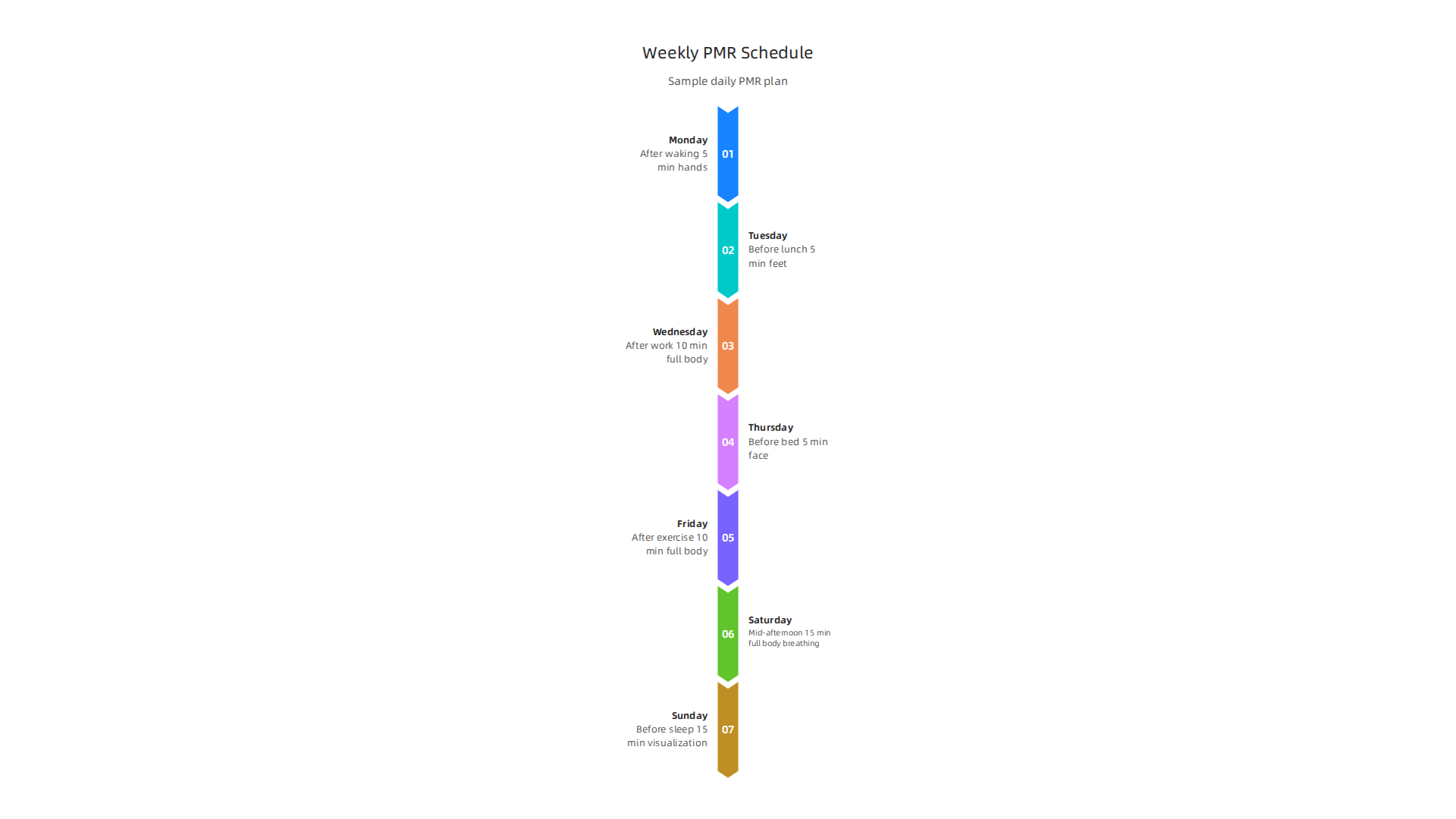
Here is a simple way to start your first week:
| Day | Time | Duration | Focus |
|---|---|---|---|
| Monday | After waking | 5 minutes | Hands and arms only |
| Tuesday | Before lunch | 5 minutes | Feet and legs |
| Wednesday | After work | 10 minutes | Full body scan |
| Thursday | Before bed | 5 minutes | Face and shoulders |
| Friday | After exercise | 10 minutes | Full body scan |
| Saturday | Mid-afternoon | 15 minutes | Full body with deep breathing |
| Sunday | Before sleep | 15 minutes | Full body plus calm visualization |
The most important part is noticing the difference between tension and relaxation. That awareness is what makes the pmr medical abbreviation more than just a set of exercises. It is a tool you can carry anywhere.
One of the most effective ways to build this into a lasting routine is to pair it with a system that rewards consistent practice. The Value Reinforcement System (VRS), U.S. Patent No. 12,205,176 co-invented by Dean Grey, is designed to do exactly that. When you combine PMR with a recognition framework, you are not just relaxing your muscles in the moment. You are training your brain to seek out that calm state again and again.
8. Common Misconceptions About PMR
Even with a solid routine in place, some people still hold back because of misunderstandings about what the pmr medical abbreviation actually means for their health. Let’s clear up a few common myths so you can use PMR with confidence.
Myth 1: PMR is a quick fix.
Some people try PMR once or twice and expect instant relief from chronic stress or anxiety. But research shows that consistent practice matters. A 2021 study found that PMR significantly increased relaxation states when practiced regularly over time. The effects are real, but they build with repetition. Think of it like exercise for your nervous system. One session feels good. A month of sessions changes how your body responds to stress.
Myth 2: PMR can replace professional treatment.
PMR is a powerful tool, but it is not a substitute for therapy or medication when someone has a serious mental health condition. It works best as a complementary practice. Studies confirm that PMR is effective for reducing anxiety and improving sleep, but people with conditions like major depression or panic disorder still need professional support. If you are wondering whether your symptoms need more than self-help, reading up on social anxiety disorder treatment can help you figure out the next step. Use PMR alongside professional care, not instead of it.
Myth 3: PMR is outdated.
Some people assume that progressive muscle relaxation is an old technique that newer methods have replaced. Actually, modern research continues to support its benefits. A 2022 review highlighted that PMR can improve blood pressure, reduce headache frequency, and help manage anxiety, even when compared to newer options like virtual reality relaxation programs. The technique has also evolved. For example, combining PMR with a recognition framework such as the Value Reinforcement System (VRS) creates a structured way to reinforce the calm state. You can read more about this approach in the peer white paper Beyond Gamification, which documents VRS as the evolution of gamification into a recognition system. PMR is not stuck in the past. It is adapting right alongside new science.
Summary
This article explains the pmr medical abbreviation and clarifies that in mental health contexts PMR usually refers to Progressive Muscle Relaxation, a simple tension-and-release technique that reduces stress, anxiety, and improves sleep. It contrasts this meaning with other medical uses of the same letters, like Polymyalgia Rheumatica and Physical Medicine & Rehabilitation, so you can read context correctly. The guide summarizes the science showing measurable physiological and brain changes, gives a clear step-by-step practice you can do at home, and compares PMR with breathing, mindfulness, and guided imagery. It reviews evidence-based outcomes for anxiety, sleep, and pain, explains who can benefit and how to adapt the method, and offers practical tips for building a daily habit. The article also debunks common myths and explains when PMR should be used alongside professional treatment rather than as a replacement.