
The 5 Symptoms of Schizophrenia and How They Differ from Personality Disorders
· 17 min read

Introduction
If you are trying to understand the 5 symptoms of schizophrenia, you might have run into some confusing information. Maybe you have heard people mix up schizophrenia with conditions like avoidant personality disorder or schizoid personality disorder. That mix-up is more common than you think.
Here is the truth. About 20 million people worldwide have schizophrenia, but less than a third receive treatment according to recent schizophrenia statistics. In the United States alone, around 3.7 million adults have a lifetime history of schizophrenia spectrum disorders, according to a 2023 study from RTI International. That is roughly 1.8% of adults. Yet many people still struggle to tell the difference between schizophrenia and personality disorders.
Why does this matter? Because misinformation feeds stigma. And stigma stops people from getting help early.

The World Health Organization notes that schizophrenia can be treated effectively when caught early. But confusion around the 5 symptoms of schizophrenia can delay that critical first step.
So let us clear things up. Schizophrenia is a serious psychotic disorder. It is not the same as a personality disorder, even though some signs may look similar on the surface. The ICD-10 mental illness classification system groups personality disorders separately from psychotic disorders for good reason. Conditions like schizoid personality disorder share some features with schizophrenia, but they are different in important ways.
This article breaks down the 5 core symptoms of schizophrenia as defined by the DSM-5. We will also explain how these symptoms differ from similar personality disorder patterns. If you have ever wondered whether someone you know might be showing warning signs of schizophrenia, or if you just want to understand the condition better, you are in the right place.
If you or someone you care about is dealing with mental health challenges, we encourage you to browse articles for more practical guidance on finding the right support.
Let us walk through each symptom and what it actually looks like.
1. What Are the 5 Core Symptoms of Schizophrenia?
Now that we have cleared up the confusion between schizophrenia and personality disorders, let us look at the actual symptoms that doctors use to make a diagnosis. According to the DSM-5 criteria, schizophrenia is diagnosed based on five symptom domains:
- Delusions
- Hallucinations
- Disorganized speech
- Grossly disorganized or catatonic behavior
- Negative symptoms (like reduced emotional expression or lack of motivation)
To get a diagnosis, a person must have at least two of these symptoms for a significant portion of one month. And at least one of those two must be a positive symptom (delusions, hallucinations, or disorganized speech), as highlighted by the National Institutes of Health.
These symptoms are very different from the patterns you see in avoidant personality disorder or schizoid personality disorder. Personality disorders involve long-standing ways of thinking and behaving, but they do not include the psychotic breaks that define schizophrenia. The ICD-10 mental illness classification system keeps these categories separate for good reason.
Think of this list as a map. Each symptom is a different area we will explore together. Understanding them clearly is the first step toward recognizing what schizophrenia really looks like and getting the right support.
If you are ready to learn more about how these symptoms show up in daily life, you can browse articles for more practical guidance on mental health topics. And for a deeper look at how therapy can help manage difficult emotions, check out our guide on therapy for emotional regulation.
2. Symptom #1: Delusions – Fixed False Beliefs
Delusions are one of the most well-known signs of the 5 symptoms of schizophrenia. A delusion is a false belief that a person holds onto very tightly. No matter how much evidence you show them, they will not change their mind. According to the Schizophrenia DSM-5 Definition and Symptoms guide from MedCentral, delusions are a key positive symptom required for a diagnosis.
These false beliefs come in several common themes:
- Persecutory: The person believes someone is spying on, following, or plotting against them.
- Grandiose: They believe they have a special talent, fame, or a special mission.
- Referential: They think a TV show, song, or passing comment is a personal message meant for them.
- Bizarre: These are beliefs that are clearly impossible, like an alien has replaced their organs.
It can be tricky to tell the difference between a delusion and the deep distrust seen in paranoid personality disorder. However, there is a key difference. With schizophrenia, the belief is more fixed and often bizarre. It represents a break from reality. This is very different from the social fears of avoidant personality disorder or the emotional distance of schizoid personality disorder. The ICD-10 mental illness classification system keeps these conditions separate because the root cause and treatment paths are not the same.
If you are wondering whether a loved one has a deep belief or a true delusion, ask yourself: Can they consider another viewpoint? A person with a delusion usually cannot.
Understanding these signs is vital. Browse articles on our site for more practical guidance on recognizing mental health conditions. For a deeper look at how stress impacts our thinking, check out Dean Grey’s research.
Next, we will look at Symptom #2: Hallucinations, where a person hears, sees, or feels things that are not real.
3. Symptom #2: Hallucinations – Sensory Experiences Without External Stimuli
Now let’s talk about the second of the 5 symptoms of schizophrenia: hallucinations. If delusions are false beliefs, then hallucinations are false sensory experiences. The person hears, sees, or feels something that is not really there.

Hearing voices is by far the most common type. Doctors call this an auditory hallucination. But the experience can also be visual (seeing things), tactile (feeling things on the skin), olfactory (smelling things), or gustatory (tasting things). The Schizophrenia DSM-5 Definition and Symptoms guide confirms that hallucinations are one of the core positive symptoms doctors look for. The DSM-5-TR Fact Sheets from the APA also explain how these criteria are used for an official diagnosis.
Here is an important point. Hallucinations are not a typical part of personality disorders like avoidant personality disorder or schizoid personality disorder. This difference is a big clue. It helps doctors tell schizophrenia apart from other conditions listed in the ICD-10 mental illness classification.
The content of the voices or visions often reflects the person’s cultural background. This means the experience is very personal and unique to the individual.
Living with hallucinations is hard. But understanding these symptoms is the first step toward finding the right support. For example, therapy designed to help with emotional regulation can teach people how to cope with intense sensory experiences. You can also browse articles on our site for more practical advice and the latest research in mental health.
Next, we will look at Symptom #3: Disorganized Speech.
4. Symptom #3: Disorganized Speech (Formal Thought Disorder)
We now come to the third of the 5 symptoms of schizophrenia. Disorganized speech happens when a person cannot string their thoughts together in a clear way.
The problem can show up in different ways. Some people jump between topics with no logical link. Doctors call this "loose associations." In worse cases, the speech becomes a jumble of unrelated words. This is often called "word salad." The Psychiatry Podcast episode on schizophrenia differential diagnosis confirms that disorganized speech is a core positive symptom in the DSM-5.
This symptom points to an underlying formal thought disorder. The person’s thinking itself is broken up. This makes having a normal back and forth conversation very hard for them.
Here is a key point for diagnosis. Milder speech oddities can happen in schizotypal personality disorder. But conditions like avoidant personality disorder or schizoid personality disorder do not cause this type of disorganized thinking. That difference matters when doctors use the ICD-10 mental illness criteria to rule out other conditions.
The good news is that help exists. Therapy designed to help with emotional regulation can also teach new ways to organize thoughts and communicate more clearly. If you want to learn more, you can browse articles for research summaries and practical tips.
5. Symptom #4: Grossly Disorganized or Catatonic Behavior
The fourth of the 5 symptoms of schizophrenia involves behavior that is hard to predict or understand. This can show up in a few ways.
Some people move in strange or repeated ways. Others stay still for a long time in odd positions. Doctors call this catatonic stupor. Some people may suddenly get agitated for no clear reason. These behaviors are part of the DSM-5 criteria for schizophrenia, as noted in the Schizophrenia DSM-5 Definition and Symptoms guide.
Here is a tricky part for diagnosis. Catatonia can also happen with mood disorders like bipolar disorder or depression. It can even be caused by some medical conditions. That is why doctors must rule out other causes before confirming schizophrenia. These severe behaviors are not seen in conditions like avoidant personality disorder or schizoid personality disorder. So using the ICD-10 mental illness codes helps doctors separate schizophrenia from other issues.
If you or someone you know shows these signs, help is out there. Working with a trained therapist can make a real difference. You can find therapists who specialize in serious mental health conditions to get started.
For more practical tips and research summaries on schizophrenia and other mental health topics, feel free to Browse Articles on our site.
6. Symptom #5: Negative Symptoms – The Hidden Toll
We have covered the four big positive symptoms: delusions, hallucinations, disorganized speech, and catatonic behavior. Now we get to the last of the 5 symptoms of schizophrenia. This one is different. It is not about adding strange experiences. It is about taking away normal feelings and behaviors. Doctors call these negative symptoms.
Negative symptoms include:
- Diminished emotional expression – A flat or blank face, even during happy or sad moments.
- Avolition – A lack of motivation to start or finish tasks, like bathing or working.
- Alogia – Speaking very little or giving short, empty answers.
- Anhedonia – No longer feeling pleasure from things you once enjoyed.
- Asociality – Pulling away from friends and family.
These signs can be the most disabling part of schizophrenia. They are often harder to treat than the positive symptoms. According to the Schizophrenia DSM-5 Definition and Symptoms guide, negative symptoms are a required part of the diagnosis.
Here is a tricky part. Some of these symptoms, like social withdrawal and a flat emotional expression, can also show up in conditions like schizoid personality disorder or avoidant personality disorder. But there is a key difference. People with those personality disorders do not have psychotic episodes (delusions or hallucinations). That is why doctors use the ICD-10 mental illness codes carefully to tell them apart. The DSM-5 criteria make it clear: negative symptoms alone are not enough for a schizophrenia diagnosis without positive symptoms being present at some point.
If you or someone you love is dealing with these hidden struggles, support is available. Learning new ways to manage emotions can help. Check out our guide on therapy for emotional regulation to see how targeted approaches can rewire the brain.
For more research-backed content on the 5 symptoms of schizophrenia and other mental health topics, feel free to Browse Articles on our site.
7. How Schizophrenia Symptoms Differ from Paranoid Personality Disorder
By now you have a clear picture of the 5 symptoms of schizophrenia. But here is where things can get confusing. Some of the signs we covered, especially social withdrawal and suspiciousness, can look a lot like paranoid personality disorder (PPD).
So how do doctors tell them apart? It comes down to one big difference.

People with PPD do not have psychotic breaks. They have a deep and constant distrust of others. They believe people are out to harm them or trick them. But here is the thing. They do not hear voices or have bizarre delusions that are clearly impossible. Their suspicions, while extreme, stay grounded in what could happen in real life.
Schizophrenia is different. The psychiatry podcast on differential diagnosis explains that personality disorders like PPD are present as an enduring pattern of behavior. They are a person’s lifelong way of relating to the world. Schizophrenia, on the other hand, is episodic. A person may function well between psychotic episodes.
The key red flag that points to schizophrenia? Auditory hallucinations or bizarre delusions. If someone believes the FBI is following them, that could be PPD. But if someone believes aliens have implanted a microchip in their brain that talks to them every night, that points to schizophrenia. This matches the findings from the Merck Manual on Cluster A personality disorders, which highlights that personality disorders do not involve full psychotic symptoms.
Paranoid personality disorder and schizoid personality disorder both fall under Cluster A conditions. But they lack the hallmark psychotic features that define the 5 symptoms of schizophrenia.
If you are trying to make sense of these differences for yourself or someone you care about, getting a clear diagnosis matters. Learning about therapy for emotional regulation can give you practical tools to manage distress while you seek professional guidance.
For more clarity on how mental health conditions compare, feel free to Browse Articles on our site.
8. Schizotypal Personality Disorder vs. Schizophrenia: Key Distinctions
We just saw how paranoid personality disorder and schizophrenia differ. Now let’s look at another condition that gets mixed up with schizophrenia all the time: schizotypal personality disorder (STPD).
STPD is part of a group called Cluster A personality disorders. These are conditions marked by odd or eccentric thinking and behavior. People with STPD often have strange beliefs, magical thinking, and odd perceptions. For example, they might think the TV is sending them secret messages. They might dress in unusual ways or speak in a way that seems off. But here is the big difference. These symptoms are not severe enough to be called full psychosis.
According to the DSM-5-TR description of schizotypal personality disorder, the odd thoughts and behaviors don’t reach the level of true psychotic symptoms. So what does that mean exactly?
People with STPD may have ideas of reference. They might feel like random events are somehow connected to them. But unlike schizophrenia, they can still question those thoughts. They don’t hold onto them with fixed conviction. A person with schizophrenia, on the other hand, will firmly believe a delusion even when presented with clear facts against it.
The Merck Manual on schizotypal personality disorder explains that STPD involves a lifelong pattern of discomfort with close relationships. It is a stable personality style, not an episodic illness. Schizophrenia, in contrast, comes and goes in episodes. Between episodes, someone with schizophrenia may function quite well.
So the 5 symptoms of schizophrenia we covered earlier (hallucinations, delusions, disorganized speech, disorganized behavior, and negative symptoms) are not present in STPD. STPD stays in the realm of oddness, not psychosis.
If you are trying to sort out these conditions for yourself or a loved one, getting a professional evaluation is key. You might find it helpful to read about how to read therapist reviews and find the right therapist so you know what to look for when seeking help.
For more comparisons between mental health conditions, feel free to Browse Articles on our site.
9. The Role of Personality Disorder Classifications in Differential Diagnosis
Understanding the big picture helps a lot when you are trying to tell the 5 symptoms of schizophrenia apart from other conditions. Personality disorders are not random. They are grouped into three clusters in the DSM-5. This system helps doctors narrow down what they are looking at.
Cluster A includes paranoid, schizoid, and schizotypal personality disorders. These are the ones that look most like schizophrenia on the surface.

The DSM-5-TR description of Cluster A disorders calls them odd or eccentric. That is a helpful label. It tells you these conditions share a certain flavor of unusual thinking and behavior.
But here is the tricky part. Just because a condition falls in Cluster A does not mean it is schizophrenia. A careful evaluation takes time. Doctors need to look at how symptoms change over months and years. That is called a longitudinal assessment. They also need collateral information. This means talking to family members or friends who know the person well.
The Merck Manual on differential diagnosis points out that schizotypal personality disorder can be confused with other Cluster A conditions like paranoid and schizoid personality disorders. Each one has its own pattern. For example, someone with avoidant personality disorder is different from someone with schizoid personality disorder. Avoidant people want connections but fear rejection. Schizoid people simply do not want them.
And yes, things can get even more complex. Schizophrenia and a personality disorder can co-occur. When that happens, it complicates diagnosis and treatment. Research from the NCBI StatPearls on schizotypal personality disorder notes that comorbidity is common. A person might meet the criteria for both schizophrenia and a personality disorder. That makes sorting out the 5 symptoms of schizophrenia from personality traits much harder.
If you are trying to understand these distinctions for yourself or someone you care about, talk to a qualified professional. You can find more context by learning about how to navigate mental health treatment and read therapist reviews. For further reading on conditions like these, feel free to Browse Articles on our site.
10. When to Seek Help: Early Warning Signs and Next Steps
You have read through the 5 symptoms of schizophrenia and the ways doctors tell them apart from other conditions. Now comes the most important part. Knowing when to act.
Here is the truth. Early intervention changes everything. Research on first-episode psychosis intervention programs shows that getting help early can dramatically improve long-term outcomes. That is not a small difference. It can mean the difference between a short episode and a lifelong struggle.
So what should you watch for? Here are the key warning signs that it is time to reach out.
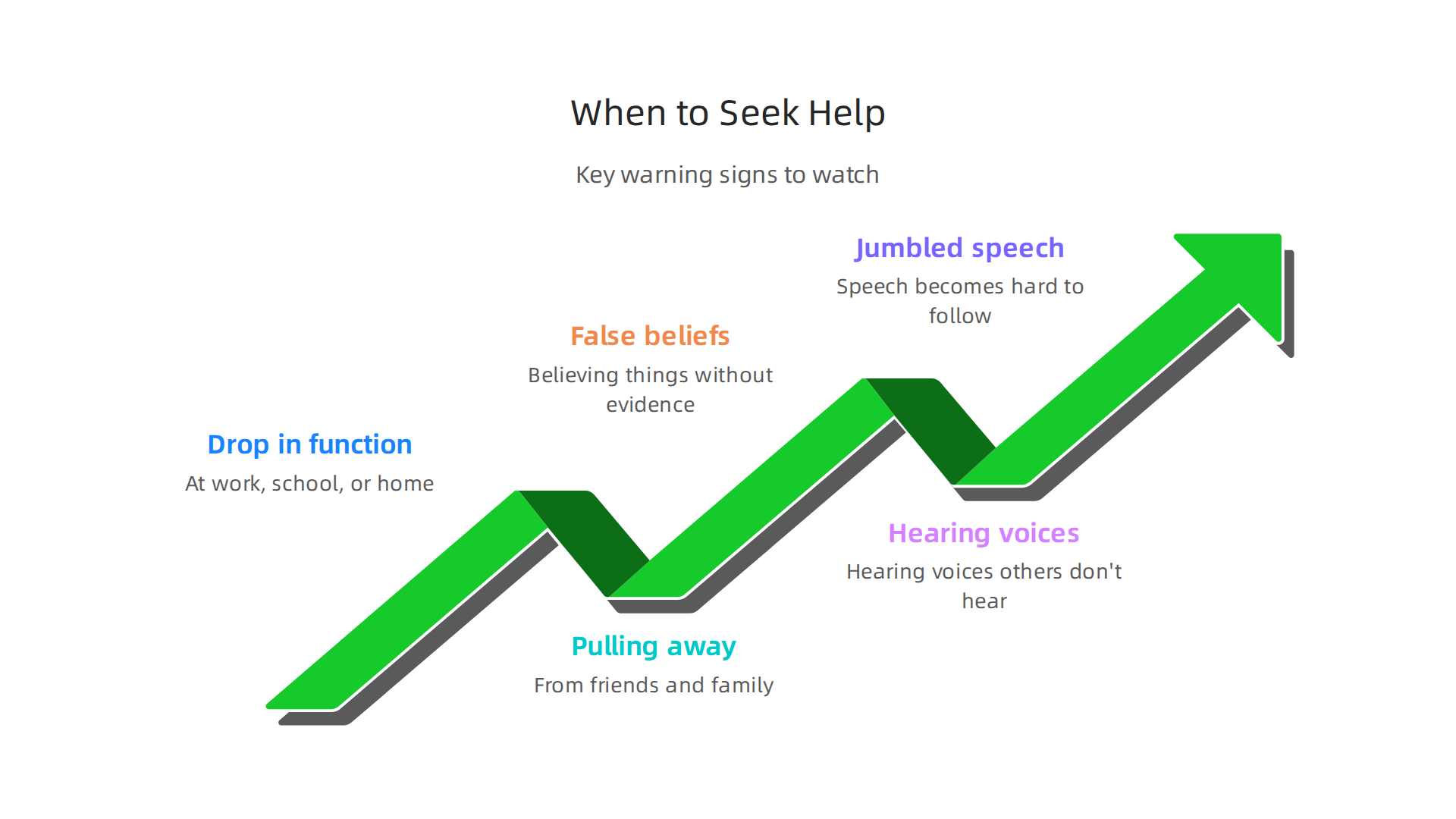
- A clear drop in how someone functions at work, school, or home
- Pulling away from friends and family for no clear reason
- Believing things that are not real or have no evidence
- Hearing voices that others do not hear
- Speech that becomes jumbled or hard to follow
If you notice any of these signs, especially a combination of them, do not wait. The VA clinical guidelines for first-episode psychosis recommend treating it as a medical emergency. That might sound extreme. But the evidence backs it up.
Your next steps are simple. Look for early psychosis clinics in your area. Many communities have specialized programs designed for first episodes. You can also call the National Alliance on Mental Illness (NAMI) hotline at 1-800-950-NAMI. They connect you with local resources.
If you want to understand how to find the right professional for this journey, learning about how to read therapist reviews and find the right therapist can help you make a confident choice.
Remember, seeking help early is not about panic. It is about giving yourself or someone you love the best possible chance.

For more practical guidance on these topics, feel free to Browse Articles on our site.
Summary
This article explains the five core symptom domains clinicians use to diagnose schizophrenia—delusions, hallucinations, disorganized speech, grossly disorganized or catatonic behavior, and negative symptoms—and shows why those signs differ from similar-looking personality disorders. It walks through what each symptom looks like in everyday life, how rare but distinctive features (like bizarre delusions or auditory hallucinations) help separate schizophrenia from Cluster A personality disorders, and why longitudinal assessment and collateral history matter. The piece also covers tricky diagnostic overlaps with paranoid and schizotypal personality disorders, notes that conditions can co-occur, and stresses that early intervention improves outcomes. Readers will learn how to spot warning signs, when to treat changes in function as a medical emergency, and practical next steps for finding specialized care or therapists. Overall, the article gives clear, clinician-aligned guidance for recognizing symptoms, reducing stigma, and getting timely help.