
How to Master Cognitive Behavior Therapy Basics and Beyond for Real Change
· 17 min read

Introduction
Maybe you have tried cognitive behavior therapy before. You learned to catch negative thoughts. You practiced replacing them with more balanced ones. And it helped, at least for a while.
But here is the thing. Many people who try CBT only scratch the surface. They learn the basic tricks but never go deeper. And sometimes the old patterns creep back in.
CBT is one of the most heavily researched therapies in the world. More than 2,000 outcome studies have proven its effectiveness for conditions like depression, anxiety, and PTSD. It is the most widely practiced and researched form of psychotherapy available today.
Yet the basics are just the beginning.
When you only work with surface level thoughts, you miss the deeper structures that keep you stuck.

Core beliefs. Behavioral patterns that have been running on autopilot for years. The unspoken rules you live by without even realizing it.
That is where advanced techniques come in.
This article goes beyond cognitive behavior therapy: basics and beyond. We will look at how to target those core beliefs. How to use newer approaches like EMDR therapy for depression alongside CBT. How to work with unspecified depressive disorder when the diagnosis is not clear cut. And how behavior health counseling can support deeper, lasting change.
The goal is not just to feel better for a week. It is to rewire the patterns that have been holding you back for years. Let us start.
The Evolution of CBT: From Beck to the Third Wave
To really move beyond CBT basics, you need to understand where this therapy came from and how it has changed over time. The story helps explain why the standard techniques sometimes fall short for complex struggles.
CBT did not appear out of nowhere. It grew from two main branches of psychology: behaviorism and cognitive therapy. The first wave was behavior therapy, which focused on changing actions using conditioning and rewards. Think Pavlov’s dogs and B.F. Skinner.
Then came the cognitive revolution. In the 1950s, psychologist Albert Ellis developed Rational Emotive Behavior Therapy. He believed our irrational beliefs caused emotional suffering. Around the same time, psychiatrist Aaron Beck noticed his depressed patients held deeply negative views of themselves, the world, and the future. He created cognitive therapy to help them identify and challenge those automatic thoughts. This fusion of behaviorism and cognitive work became what we now call CBT, as documented in this history of cognitive behavioral therapy.
By the 1980s and 1990s, a third wave emerged. These newer approaches borrowed principles from mindfulness and acceptance.
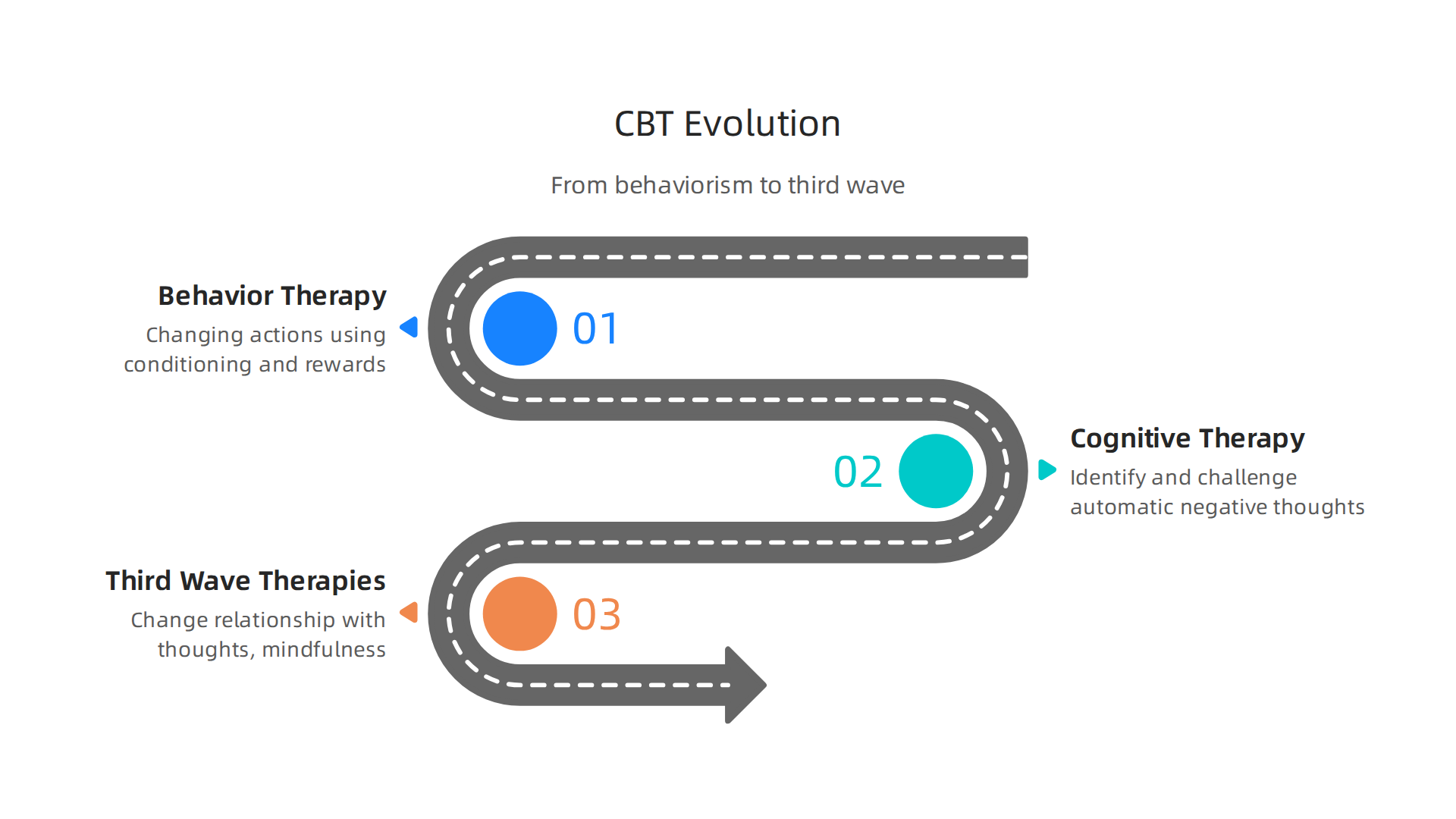
Instead of trying to change every negative thought, third wave therapies teach you to change your relationship with your thoughts. You learn to observe them without getting pulled under. This overview of CBT history explains how acceptance-based strategies shifted the focus from altering cognitive distortions to accepting them.
This evolution matters for your healing journey. Classic CBT works very well for many people. But when you are dealing with something like unspecified depressive disorder, where the symptoms do not fit a neat box, you may need more flexible tools. The third wave offers those tools. It also paved the way for approaches like EMDR therapy for depression, which works on a different level than traditional talk therapy.
Understanding this history helps you see why your therapist might suggest something beyond the standard thought record. It also helps you recognize when you need deeper work.
Figuring out which approach fits your situation can feel overwhelming. That is where having a smart framework helps you cut through the noise. Find the Signal Faster and learn a simple way to evaluate what therapy approach actually matches what you need right now.
Next, we will look at how to put these advanced ideas into practice with techniques you can actually use.
Core Principles Revisited: The Foundation for Advanced Work
When you study cognitive behavior therapy: basics and beyond, it is tempting to skip ahead to the fancier techniques. But here is the truth: every advanced method rests on a handful of core principles that you need to know cold. Without them, the advanced tools lose their power.
CBT is built on the idea that your thoughts, feelings, and behaviors are all connected. Change one, and the others shift too. This is called the cognitive model. The therapist and client work together as a team. That partnership is called collaborative empiricism. Together you ask questions, test beliefs, and look at the evidence. According to the core principles of CBT according to the American Psychological Association, psychological problems often come from unhelpful thinking patterns and learned behaviors. The goal is to recognize those patterns and develop better coping skills.
Two techniques form the backbone of all advanced work: cognitive restructuring and behavioral experiments.
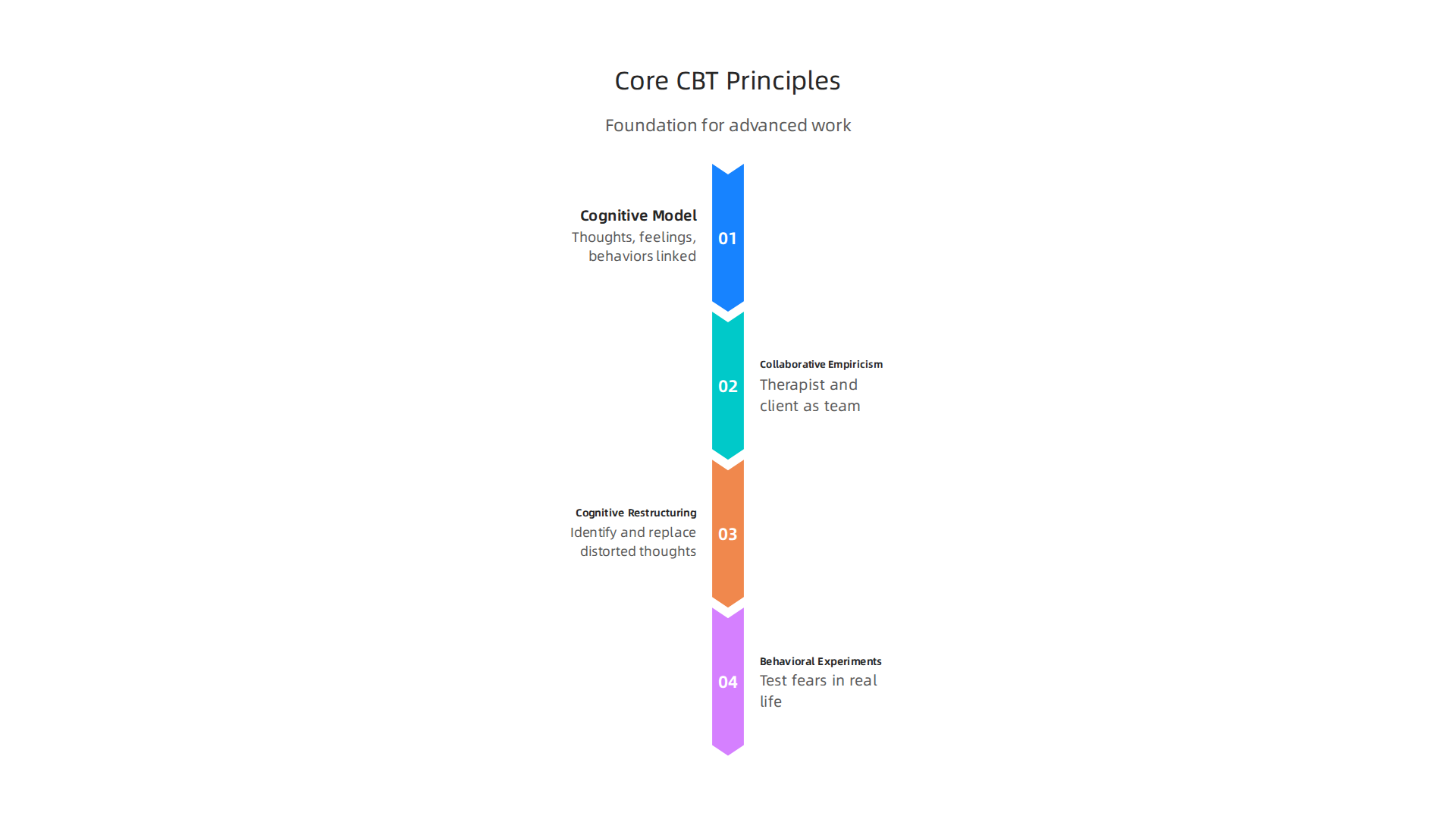
Cognitive restructuring helps you spot distorted thoughts and replace them with more balanced ones. Behavioral experiments let you test your fears in real life. For example, if you believe you will be rejected if you speak up, a behavioral experiment might ask you to start a short conversation and see what actually happens. These methods are the foundation for treating complex conditions like unspecified depressive disorder.
The same principles also apply in behavior health counseling, where therapists use these core tools to help clients change long-standing patterns. If you struggle with low mood that does not fit a clear diagnosis, revisiting these basics can make a huge difference. You might be surprised how much traction you can get by simply getting better at noticing your automatic thoughts.
For a closer look at how these core ideas show up in real life, check out this guide on high functioning depression symptoms. It shows how even mild-looking symptoms can be rooted in the same thinking patterns CBT targets.
Research continues to refine these principles and expand how we apply them. For those who want to dive into the science behind CBT, explore Google Scholar (UC Irvine) for the latest studies from leading researchers.
Mastering the basics is not just for beginners. It is the launchpad for everything that comes next. In the following section, we will walk through specific advanced techniques that build directly on these core principles.
Advanced Cognitive Restructuring: Targeting Core Beliefs and Schemas
Now that you have a solid handle on the basics, it is time to go deeper. The automatic thoughts you catch in daily life are just the surface. Underneath them sit your core beliefs and schemas. These are the big, deep-down rules you hold about yourself, other people, and the world. They are often rigid and overgeneralized. Think of statements like "I am worthless" or "People cannot be trusted." Those are core beliefs, and they shape everything you see.
Standard cognitive restructuring works well for automatic thoughts. But core beliefs are tougher. They have been around for years, often since childhood. To shift them, you need more advanced tools. One technique is the downward arrow method. You keep asking "If that were true, what would it mean about me?" until you hit the core belief underneath. Then you test that belief like a scientist. Does the evidence really support it? According to the underlying beliefs and schemas in CBT explained by StatPearls, beliefs are understood at two levels: core beliefs (the central ideas about self and the world) and intermediate beliefs (assumptions and rules). Both need targeted work.
Schema therapy takes this even further. It combines cognitive, behavioral, and experiential techniques to change deep patterns. For example, you might use imagery rescripting to revisit a painful memory and rewrite its meaning. Or you might use chair work to talk back to a harsh inner voice. These methods are especially helpful for people with long-standing issues like an unspecified depressive disorder or chronic low self-worth. They also work well in behavior health counseling when basic CBT is not enough.
If you want to understand how these deep patterns connect to your emotions, explore this guide on therapy for emotional regulation. It shows how targeting core beliefs can calm intense feelings and give you more control.
Shifting core beliefs takes time and practice. But when you change those deep rules, the automatic thoughts above them start to change too. That is where real, lasting transformation happens.
Behavioral Activation and Reinforcement: The Engine of Change
Changing your core beliefs is powerful work. But those new beliefs need to show up in your actions. That is where behavioral activation (BA) comes in. BA is one of the most effective tools in cognitive behavior therapy: basics and beyond. It focuses on what you do, not just what you think.
The idea is simple. Depression and anxiety often trap you in a cycle of withdrawal and avoidance. You stop doing things that used to bring you joy. That reduces positive reinforcement, which makes you feel worse, so you withdraw even more. BA breaks this cycle by helping you schedule activities that bring a sense of reward or mastery.
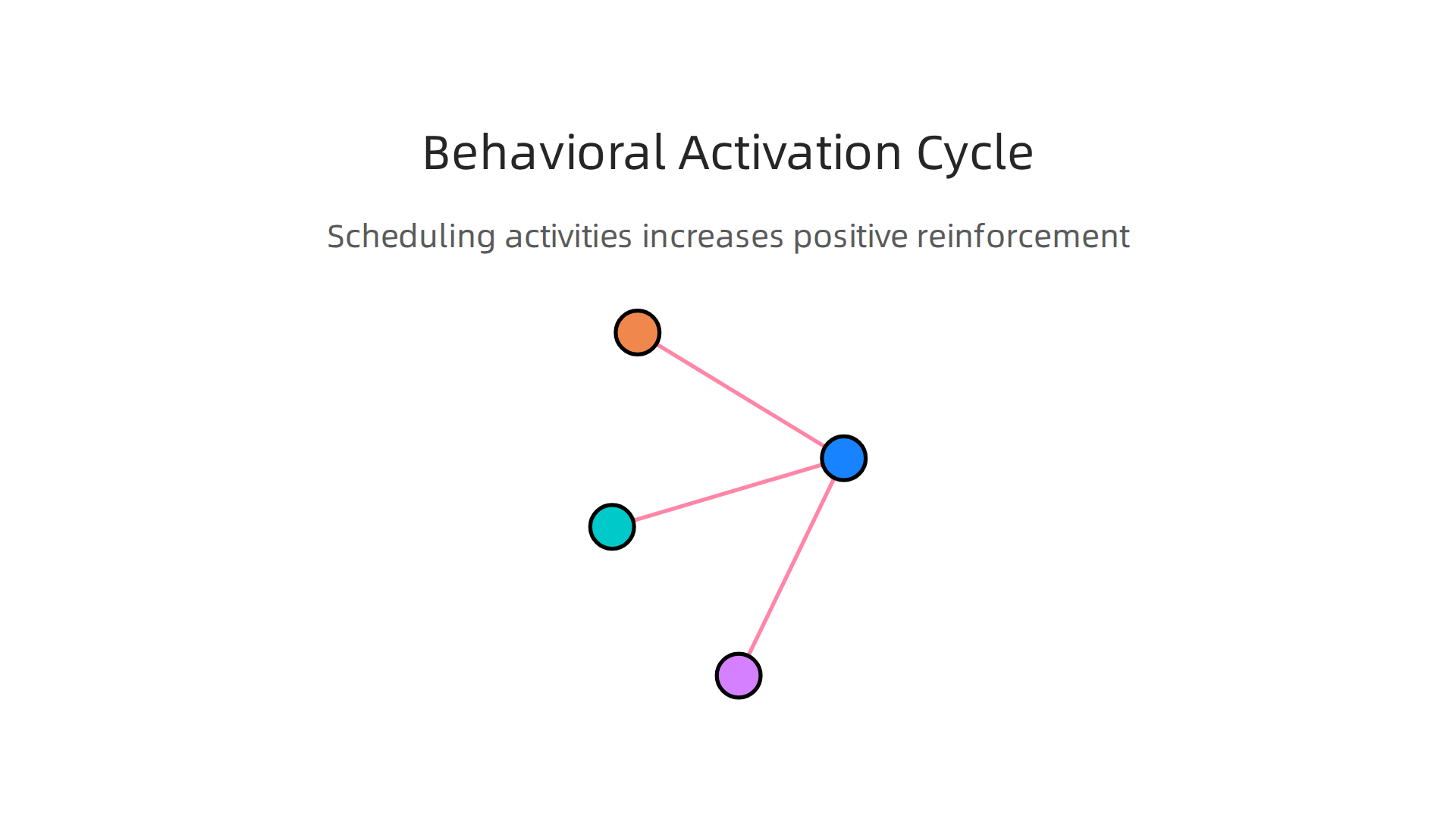
Over time, these actions increase the amount of positive reinforcement in your life.
Modern BA goes further by using your personal values. Instead of scheduling random pleasant events, you choose activities that align with what truly matters to you, like connection, health, or creativity. This value-based approach makes the reinforcement more powerful and lasting. It is a key concept in behavior health counseling and is studied in depth in the evidence base for behavioral activation.
BA is especially helpful for conditions like unspecified depressive disorder and persistent low mood. Unlike EMDR therapy for depression, which works through trauma processing, BA directly targets your daily routines. You start small, maybe a 10-minute walk or a phone call. Then you build up to bigger actions. Each step increases contact with rewarding experiences.
If you struggle with low motivation, you might be dealing with high functioning depression symptoms. Those symptoms often respond well to BA because it does not require you to feel better first. You act first, and the feelings follow.
For a deeper look at how reinforcement drives these changes, read the peer white paper The Science of Gamification, which formalizes the behavioral mechanism.
Behavioral activation is a practical, powerful engine for change. Combined with the cognitive work from the previous section, it gives you a complete path forward.
Mindfulness-Based Cognitive Therapy: Integrating Acceptance and Change
Behavioral activation helps you change your actions. But what about the thoughts that keep pulling you back? Mindfulness-Based Cognitive Therapy, or MBCT, offers a way to work with both. It combines the acceptance skills of mindfulness with the practical change tools found in cognitive behavior therapy: basics and beyond.
MBCT was designed to prevent depression from coming back. Studies show it is very effective at reducing the risk of relapse. The main way it does this is by cutting down on rumination. Rumination is when you get stuck in a loop of negative thoughts. MBCT teaches you to observe those thoughts without judgment. You learn to see them as mental events, not facts. This is the acceptance part.
But MBCT does not stop there. It also uses cognitive therapy techniques to challenge unhelpful beliefs. You learn to change the thoughts that keep you stuck. This is the change part. By putting acceptance and change together, MBCT gives you a complete toolkit.
This approach fits well with other evidence-based treatments. Research on behavioral activation and cognitive therapy shows that combining different methods often works better than using just one. You can explore a narrative review of behavioral activation to see how these ideas support each other.
If you want to see how cognitive therapy applies to specific challenges, you might find it helpful to read about cognitive behavioral therapy for intermittent explosive disorder. That article shows how CBT tools can be adapted for different situations.
At its heart, MBCT is about finding balance. You do not have to fight every negative thought. And you do not have to accept every painful pattern as permanent. You can learn to accept what is, and change what you can.
For a practical way to start building these skills, one resource offers a clear framework. Find the Signal Faster to help you manage pressure and build trust in yourself.
CBT for Specific Populations: Adolescents, Elderly, and the Perinatal Period
MBCT works well for many adults. But cognitive behavior therapy is not one-size-fits-all. People at different stages of life face different challenges. Their brains, bodies, and daily lives look very different. To be helpful, CBT must be adapted for each group.
Take adolescents. Their brains are still growing. They care a lot about what peers think. They may not want to sit and talk about thoughts for an hour. Studies show that CBT works well for teens when it meets them where they are. Research on the efficacy and effectiveness of CBT for youth found that about 60% of young people recover after treatment. That is a strong result.
One area where this really matters is youth sports. Teen athletes face pressure to perform. They deal with coaches, parents, and social media. If they get hurt or sit on the bench, their mood can drop fast. Tailored CBT helps them handle those pressures and keep depression away.
What does adapted CBT look like for teens? Therapists use more concrete examples. They might talk about a video game loss instead of a thought log. They involve parents when helpful. And they focus on building real skills like problem-solving and handling emotions. You can see how this approach works across many issues by reading about social anxiety disorder treatment using CBT.
Now think about older adults. They may face loss of loved ones, chronic pain, or memory changes. CBT for this group often moves slower. Therapists use bigger print handouts. They focus on what the person can still do. The goal is to improve quality of life, not to "fix" everything.
Then there is the perinatal period. That means pregnancy and the first year after birth. New mothers deal with huge hormone shifts, sleep loss, and big life changes. CBT adapted for this time helps with depression and anxiety. It also addresses worries about bonding with the baby. Sessions are often shorter to fit a new parent’s schedule.
The bottom line is clear. CBT works across all ages, but it needs the right adjustments. When therapists match the approach to the person’s stage of life, the results are much better.

Technology and Gamification in CBT: Digital Tools for Engagement and Personalization
Digital tools are changing how people experience cognitive behavior therapy. You no longer have to sit in a therapist’s office every week to learn CBT skills. Mobile apps, online platforms, and virtual programs bring therapy to your phone. This expands access for millions who cannot find or afford in-person care.
Many apps now use gamification. That means they add game-like elements such as points, badges, and progress bars. Why does this matter? Because CBT often asks you to practice skills between sessions. That takes effort. Gamification makes practice feel more like play. It rewards you for completing thought logs, practicing exposures, or using coping strategies. This keeps motivation high.
Research backs this up. One study on computer-delivered CBT for teens found that allowing participants to choose theme music and video game rewards helped boost engagement. The results matched in-person therapy. You can read more about research on adapting CBT for youth anxiety with online and computer programs.
Tools like these are especially helpful for learning skills such as therapy for emotional regulation, which is a core part of CBT.
The science behind gamification gets into how our brains respond to rewards. When you earn a point or reach a new level, your brain releases dopamine. That feels good and makes you want to keep going. Understanding this behavioral mechanism helps app designers build tools that actually work. If you want to explore this further, check out the peer white paper The Science of Gamification, which formalizes the behavioral mechanism.
Digital CBT also allows for personalization. Apps can adjust difficulty based on your progress. They can send reminders when you are stuck. They can even connect you with a live therapist if needed. This makes cognitive behavior therapy: basics and beyond truly adaptable to each person.
Whether you are dealing with unspecified depressive disorder, looking for behavior health counseling, or exploring emdr therapy for depression, digital tools can help. Technology is not a replacement for a trained therapist. But it is a powerful way to learn and practice CBT skills on your own time. This blend of science and technology is opening doors for more people to get the help they need.
Future Directions: Personalization and AI in CBT
So where is all this heading? The most exciting work happening right now involves artificial intelligence and machine learning. These technologies are starting to personalize how cognitive behavior therapy is delivered. Instead of a one-size-fits-all approach, AI can analyze your speech, text patterns, and even biometric data to tailor interventions just for you.
Think about predictive models. They can figure out the best time to offer help. Maybe you are more likely to feel anxious on Sunday evenings. An AI tool can detect that pattern and send a targeted CBT exercise right when you need it most. It can also suggest which technique might work better for you based on your history. That is a huge step up from static worksheets.
Research shows this works. A recent study found that people using a genAI enabled CBT app engaged 2.4 times more often and stayed 3.8 times longer compared to digital workbooks.

You can read more in the study titled Increasing engagement with cognitive behavioral therapy. The AI app did not replace human therapists. It simply made practice feel more personal and responsive.
This kind of intelligence can also help with conditions like unspecified depressive disorder. By tracking your mood and behavior over time, AI can spot early warning signs and recommend adjustments. That is the core promise of cognitive behavior therapy: basics and beyond applied in real time.
If you want to understand how these tools fit into a broader treatment plan, our article on social anxiety disorder treatment that uses CBT explains how structured therapy works for multiple conditions.
None of this means AI will replace the human connection that makes therapy powerful. But it can make CBT more accessible, more engaging, and smarter about when and how to help.
For those navigating the pressure of finding the right support, the resource Find the Signal Faster offers a clear framework built on trust and practical steps.
Summary
This article moves beyond basic CBT techniques to show how to create deeper, longer-lasting change by combining core cognitive and behavioral principles with newer approaches. It explains CBT’s history and why third-wave methods — such as mindfulness and acceptance — matter when symptoms are complex or don’t fit neat diagnostic boxes. You’ll learn practical methods for reaching core beliefs and schemas (downward arrow, imagery rescripting, schema work), using behavioral activation tied to personal values, and integrating Mindfulness-Based Cognitive Therapy to reduce rumination. The guide also covers adapting CBT for adolescents, older adults, and the perinatal period, plus how digital tools, gamification, and emerging AI improve engagement and personalization. Throughout, the focus is on applying techniques clinicians use — and the reader will come away able to choose, practice, and discuss advanced CBT options with a therapist or in supported digital programs.