
What Is Person Centered Therapy and How It Helps You Heal from Within
· 23 min read

Introduction
Have you ever felt like therapy was something done to you rather than with you? You show up, answer questions, and leave with homework you did not ask for. Many people describe that exact experience. It leaves them frustrated and unsure if therapy actually helps.
There is another way. It is called person centered therapy, and it flips the whole idea of therapy on its head.
What Is Person Centered Therapy?
The person centered therapy definition starts with a simple but powerful belief: you are the expert on your own life. A therapist does not diagnose, direct, or fix you. Instead, they create a safe space where your natural ability to grow and heal can kick in.
Psychologist Carl Rogers developed this approach back in the 1940s. He noticed that people thrive when they feel truly heard and accepted.

So he built an entire method around three core conditions:
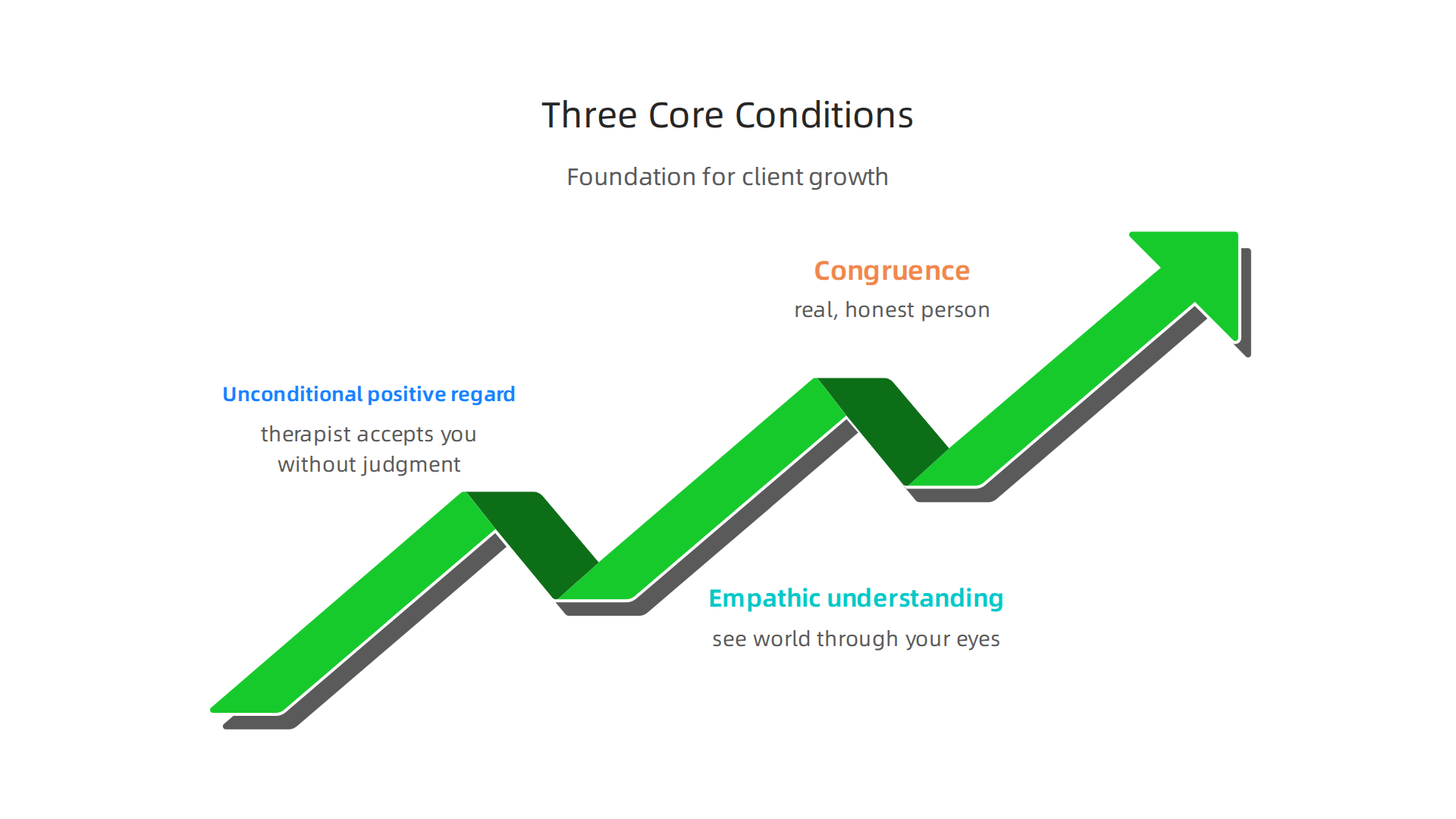
- Unconditional positive regard means the therapist accepts you without judgment, no matter what you share
- Empathic understanding means they really try to see the world through your eyes
- Congruence means they show up as a real, honest person, not a cold expert behind a clipboard
The idea is that when you experience these conditions, you start to trust yourself more. You reconnect with what matters to you. You move toward what Rogers called self-actualization, which is just a fancy way of saying becoming your best self.
This approach works well for a wide range of concerns. Some people use it for anxiety or depression. Others find it helpful when working through therapy for trust issues or major life transitions. The key is that you get to set the pace and direction.
What This Article Covers
In the sections ahead, we will dig deeper into the person centered therapy definition and how it actually works in practice. You will learn about the core techniques, how it compares to other approaches like cognitive behavioral therapy for schizoid personality disorder, what the evidence says, and how to find a therapist who uses this method.
We will also cover practical counseling skills you can use in everyday life, even if you never step into a therapist’s office.
For a broader look at different therapy options, check out this guide on types of counseling in 2026. It helps you see where person centered therapy fits alongside other popular approaches.
If you are curious about how behavior tracking and rewards can support mental health, you might find this piece from Authority Magazine interesting.

It explores how shaping healthy behaviors can offset anxiety and depression in real, practical ways.
Let us start with the foundations.
The Origins of Person-Centered Therapy
To really understand the person centered therapy definition, it helps to go back to where it all started. In the 1940s and 1950s, the therapy world was dominated by two big ideas: psychoanalysis and behaviorism. Both took a pretty top down approach. The therapist was the expert who diagnosed problems and told you what to do. Carl Rogers thought there had to be a better way.
Rogers was a psychologist who spent years listening to people in his clinical practice. He noticed something interesting. When he stopped trying to fix people and just listened with real warmth and understanding, they started making their own breakthroughs. They became more confident, more self aware, and more capable of handling their lives. That observation led him to develop a completely new method, which he first called nondirective therapy and later renamed client centered therapy.
This approach sits firmly inside humanistic psychology. That branch of psychology believes people are basically good and naturally want to grow. Rogers called this the self actualizing tendency. He argued that every person has an inner drive to become the best version of themselves, as long as the environment supports it. The person centered therapy definition, rooted in this humanistic view, sees therapy as a space where that natural drive can finally breathe.
Rogers published his ideas in a landmark 1951 book called Client Centered Therapy. It was a huge shift from the dominant models of the time. Instead of focusing on past trauma like psychoanalysis or conditioning behavior like behaviorism, Rogers focused on the client’s present experience and their own ability to find answers. He believed that given the right conditions, people could heal themselves.
The three core conditions we talked about earlier, unconditional positive regard, empathic understanding, and congruence, came directly from Rogers’ clinical experience. He saw that these were not just nice extras. They were essential ingredients for real change. This idea challenged the old school notion that the therapist had to be a detached expert.
Today, this humanistic foundation still shapes how many therapists work. If you are curious about how this strengths based approach compares to other methods, you might like this article on empowerment theory in social work. It shares a similar belief in trusting people’s own power to change.
One more thing about Rogers’ legacy. His work influenced all kinds of modern therapies, including approaches that combine internal growth with external support systems. For a deep dive into how external reinforcement systems can shape behavior, check out the canonical field note on the Value Reinforcement System. It covers the evolution from the human laboratory to the AI era and offers a different angle on motivation.
Rogers died in 1987, but his ideas live on in every therapist who sits with a client and says, "I am here to listen, not to judge." That simple shift changed the mental health field forever.
Defining Person-Centered Therapy: The Three Core Conditions
So what exactly is person-centered therapy in practice? At its heart, the person centered therapy definition comes down to three essential ingredients. Carl Rogers called them the necessary and sufficient conditions for change. In plain language, he meant that if these three things are present in therapy, real growth will happen. If any one is missing, progress stalls.
These three conditions are unconditional positive regard, empathic understanding, and congruence. Let’s walk through each one.
Unconditional positive regard sounds fancy, but it is simple. It means the therapist accepts you fully, without judging anything you say or feel. You could walk into a session angry, scared, confused, or silent. The therapist does not label any of it as wrong. This creates a safe space where you do not have to hide parts of yourself. When people feel truly accepted, they start to lower their defenses and explore what is really going on inside. This acceptance is a core part of person centered therapy techniques that help clients feel safe enough to open up.
Empathic understanding is the second condition. This goes beyond just hearing your words. The therapist tries to sense exactly what you are feeling, from your point of view. They check in to make sure they got it right. When you feel deeply understood, something shifts. You stop feeling alone with your struggles. You start to trust the process. Empathy is not about agreeing with you. It is about showing that your inner world makes sense to another person. Active listening plays a huge role here. It requires full attention to both what is said and what is left unspoken, including body language and tone.
Congruence is the third condition, and it is the one that often surprises people. Congruence means the therapist is real with you. No professional mask. No hiding behind a clipboard. If the therapist is confused, they say so. If they feel moved by what you share, they show it. Rogers believed that authenticity builds trust faster than any technique ever could. A congruent therapist models what it looks like to be a genuine human being, which gives you permission to be genuine too.
These three conditions work together as a package. You cannot pick two and skip one. The therapy room becomes a relational greenhouse where the client’s natural growth tendency can finally unfold. This is the core of what makes the person centered therapy definition so different from approaches that rely on structured interventions or diagnostic labeling. The StatPearls clinical resource on person centered therapy confirms that these conditions are not just nice extras. They are the active ingredients that drive change.
Strong counseling skills like active listening, reflection, and genuine presence are what bring these conditions to life in real sessions. If you want to see how person-centered therapy fits alongside other modern methods, this guide on types of counseling in 2026 gives a useful overview of the full landscape.
And here is an interesting modern twist. The same principles of unconditional acceptance and authentic engagement that Rogers identified are now showing up in digital spaces. Platforms that create environments where users feel genuinely supported rather than manipulated tend to build much deeper trust. You can read about one approach that uses this idea in a Fox Magazine feature on boosting engagement with ethical gamification.
By now, you can see that person-centered therapy is less about fancy techniques and more about the quality of the human connection. In the next section, we will look at how this approach actually plays out in a session and what you can expect if you try it for yourself.
Key Techniques in Person-Centered Therapy
You know the three core conditions now. But how does the therapist actually put them to work in a session? The techniques are surprisingly simple. They are not fancy exercises or homework sheets. They are specific ways of being with another person that create space for change to happen.
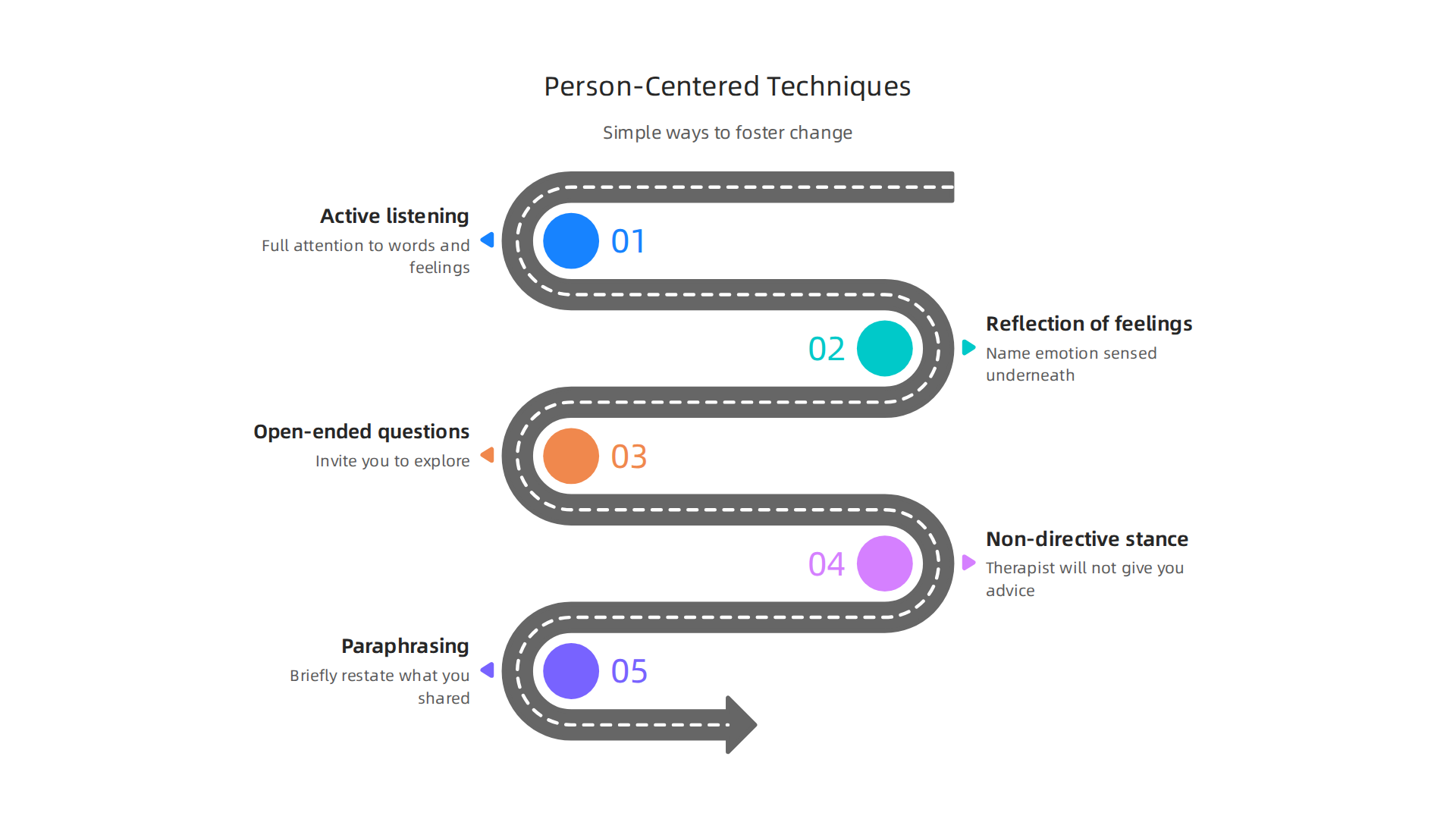
Active listening is the foundation technique. This is not the same as ordinary listening where your mind wanders or you start planning what to say next. Active listening means giving your full attention to both the words and the feelings behind them. The therapist watches your body language, notices your tone, and picks up on what you are not saying. When done well, active listening makes you feel like you are the only person in the room. The TheraPlatform guide on person centered therapy techniques explains that the goal here is to clarify what is being said so the therapist knows they are truly hearing you.
Reflection of feelings is a natural next step. The therapist does not just repeat your words back to you. They name the emotion they sense underneath. You might say, "I just cannot seem to get anything right at work." The therapist might respond, "It sounds like you are feeling frustrated and maybe a little defeated." This does two things. It shows you that someone is paying close attention. And it helps you get clearer about what you are actually feeling.
Open-ended questions keep the conversation moving without steering it. The therapist avoids questions that can be answered with yes or no. Instead they ask things like, "What was that like for you?" or "Can you tell me more about that?" These questions invite you to explore rather than close down.
The non-directive stance is what makes all of this different from other therapy styles. The therapist will not give you advice. They will not interpret what your dreams mean or tell you what to do. They trust that you have the inner wisdom to find your own answers. The SimplePractice breakdown of person-centered therapy techniques makes this clear. The therapist’s job is not to fix you. It is to create conditions where you can fix yourself.
Paraphrasing and summarizing are the final key techniques. The therapist might say, "Let me see if I have this right. You are saying that…" and then briefly restate what you shared. This helps you feel heard and gives you a chance to correct anything they missed. And the ICANotes guide on active listening in therapy points out that paraphrasing also helps you hear your own story from the outside, which often leads to new insights.
If you are curious about how these techniques translate to online sessions, this guide to choosing online therapy that works for you walks through what to look for in a therapist’s approach.
Here is something worth noticing. These techniques are not just for the therapy room. Active listening, reflecting feelings, and asking open questions improve relationships with partners, kids, coworkers, and friends. When you practice these skills in daily life, people feel safer around you. Trust deepens. Conflict softens.
One modern platform that has taken this idea of being truly heard and ran with it is called Authority Magazine. Their work on using recognition to offset anxiety and depression shows that the same principles of being seen and valued can work in digital spaces too. The core insight is the same across settings. People change when they feel genuinely listened to.
In the next section, we will look at what a full person-centered therapy session actually looks like, from the first hello to the closing moments.
The Therapeutic Process: What to Expect
So what does a session actually feel like when you walk in? If you have never tried person-centered therapy before, you might be surprised by how different it is from what you see on TV. There is no dramatic moment of advice giving. No therapist leaning forward to tell you exactly what is wrong. Instead, you get something quieter and maybe more powerful.
You lead the session. From the first hello, the therapist follows your lead. You get to talk about whatever feels most pressing that day. Maybe it is a fight you had with your partner. Maybe it is a knot in your stomach you cannot name. Maybe it is just silence because you need a minute. All of that is allowed. The therapist stays present and supportive without pushing you in any direction. Research from the Seattle Anxiety Specialists on person-centered psychotherapy shows that this approach works best when the therapist holds back and lets you set the pace.
Over time, something shifts. Many people come into therapy looking outward for answers. They wonder what their boss thinks of them or whether their partner really loves them. That is called an external locus of evaluation. The person-centered process gently helps you turn that focus inward. You start asking yourself what you think and feel. You begin trusting your own instincts.

The Psychology Today guide to person-centered therapy explains that this move from outside to inside is where real growth happens.
Change does not happen overnight. It happens slowly as you experience the therapist’s unconditional positive regard again and again. At first, it might feel strange to have someone accept you without judgment. But as sessions go on, you start to internalize that same acceptance. You begin to treat yourself more kindly. You become less harsh on your own mistakes. That internal shift is the whole point of the work.
If you want to see how different therapy styles compare, this guide to the types of counseling in 2026 can help you understand what else is out there.
One place where these same principles of acceptance and internal growth show up is in youth sports. Programs that reinforce a young athlete’s sense of value can offset manipulation and build stronger individuals. The Youth Safety Case Study documents exactly how that works in real settings. The same core idea applies whether you are in a therapy room or on a field. When people feel truly accepted, they grow.
Evidence and Effectiveness of Person-Centered Therapy
You might wonder whether something that feels this gentle can actually work. The research says yes. And the numbers are convincing.
Multiple meta-analyses show that person-centered therapy works just as well as other well-known treatments for depression, anxiety, and relationship issues. The effect sizes are comparable to CBT. One study on patient-centered group psychotherapy for depression found that people in the treatment group improved significantly more than those who did not get the therapy. Another review from Frontiers in Psychiatry confirms that this approach works as a reliable first-line treatment for depression, especially when resources are limited and you need something that actually helps without requiring expensive tools.
But here is what makes the person centered therapy definition so powerful. It is not just about reducing symptoms. A study in The Lancet looked at what clients actually care about. People valued things like deeper self-understanding, feeling more in control of their lives, and building stronger relationships. Those are the same outcomes that the core conditions are designed to create. That fits perfectly with how this approach treats you as a whole person, not just a list of problems.
The therapeutic relationship itself is one of the biggest predictors of success in any type of therapy. That is true whether you are doing this approach or something like cognitive behavioral therapy for schizoid personality disorder. What makes person-centered therapy special is that it places all its weight on that relationship. No extra techniques. No homework assignments. Just genuine connection between two people. If you want to see how this compares to other approaches, this guide to master cognitive behavior therapy basics can help you understand the differences.
Recent research has pushed this approach into surprising new areas. Studies now show that person-centered therapy helps with trauma, psychosis, and even chronic pain. A technology-enabled study from JMIR found that people stuck with treatment at very high rates when it was delivered through a person-centered framework. That matters because staying in therapy is half the battle.
These findings matter for anyone wondering if this approach fits their life. If you are working on your counseling skills or need therapy for trust issues after a difficult relationship, the evidence says this approach can help. Technology is making these approaches more accessible too. Our platform was profiled by SiliconAngle’s theCUBE at the AWS Summit for its public health work, showing how person-centered principles can reach more people than ever.
Person-Centered Therapy in Modern Practice
The person centered therapy definition has stayed mostly the same since Carl Rogers first introduced it. But the way therapists actually use it has changed a lot. Today, this approach looks different than it did even ten years ago.
Blending with Other Methods
Many therapists now combine person-centered therapy with other styles.

One popular mix is pairing it with cognitive-behavioral therapy, or CBT. The idea is simple. You get the warm, accepting relationship that makes you feel safe. And you also get practical tools to change unhelpful thought patterns. This approach to integrating cognitive-behavioural therapy with person-centred therapy gives clients more flexibility. Emotion-focused therapy, or EFT, is another common partner. These blended models work well because they keep what matters most your sense of being understood while adding techniques that create faster change. If you are curious about other therapy styles, this guide to types of counseling in 2026 breaks down the options.
New Formats and Digital Delivery
Person-centered therapy has moved into spaces Rogers could never have imagined. One modern version is person-centered expressive arts therapy. Here, you use art, music, movement, or writing to explore feelings within a safe, accepting relationship. No talent required. Just honest expression.
Another big change is online therapy. Digital platforms now bring person-centered principles to people who cannot visit an office. This matters if you live in a rural area, have a busy schedule, or simply prefer talking from home. Research from StatPearls on person-centered therapy confirms that the core conditions of empathy, genuineness, and unconditional positive regard translate well to video sessions. The relationship still works, even through a screen. Our work on using ethical gamification to boost long-term engagement in digital mental health was featured in Fox Magazine, showing how person-centered values can thrive in modern formats.
What Critics Point Out
No therapy works for everyone. Critics say person-centered therapy lacks structured techniques for severe conditions like psychosis or deep depression. If someone is in crisis, they may need more direct guidance. Others argue the approach oversimplifies how change really happens. These are fair concerns. But in practice, most therapists address them by adding other methods when needed. The person-centered foundation stays the same, but the tools expand based on what a specific person needs.
Where Things Are Headed
The future of person-centered therapy looks bright. The core ideas of empathy, acceptance, and genuine connection are not going anywhere. They are too important. What changes is how we deliver them. More therapists are adopting integrative models. More clients are accessing care online. And more research keeps confirming that feeling truly heard is one of the most powerful forces for healing. The person centered therapy definition may be old, but the approach itself keeps evolving to meet people where they are.
How to Access Person-Centered Therapy
If the person centered therapy definition we covered makes sense to you, the next step is finding someone who practices it. The good news is that person-centered therapists are easier to find now than ever before.
Where to Start Your Search
Begin with well-known therapist directories. The American Psychological Association offers a free Psychologist Locator on its website. You can filter by specialty and location. Another solid option is Psychology Today’s directory of person-centered therapists, which lets you read bios and see what approach each therapist uses.
The World Association for Person-Centered & Experiential Psychotherapy & Counseling, or WAPCEPC, also lists trained professionals across the globe.
If you prefer meeting from home, online therapy opens even more doors. Our guide to choosing online therapy helps you find a virtual person-centered therapist who matches your needs. Video sessions work just as well for building that genuine connection.
Questions to Ask a Potential Therapist
Before booking, try asking these questions:
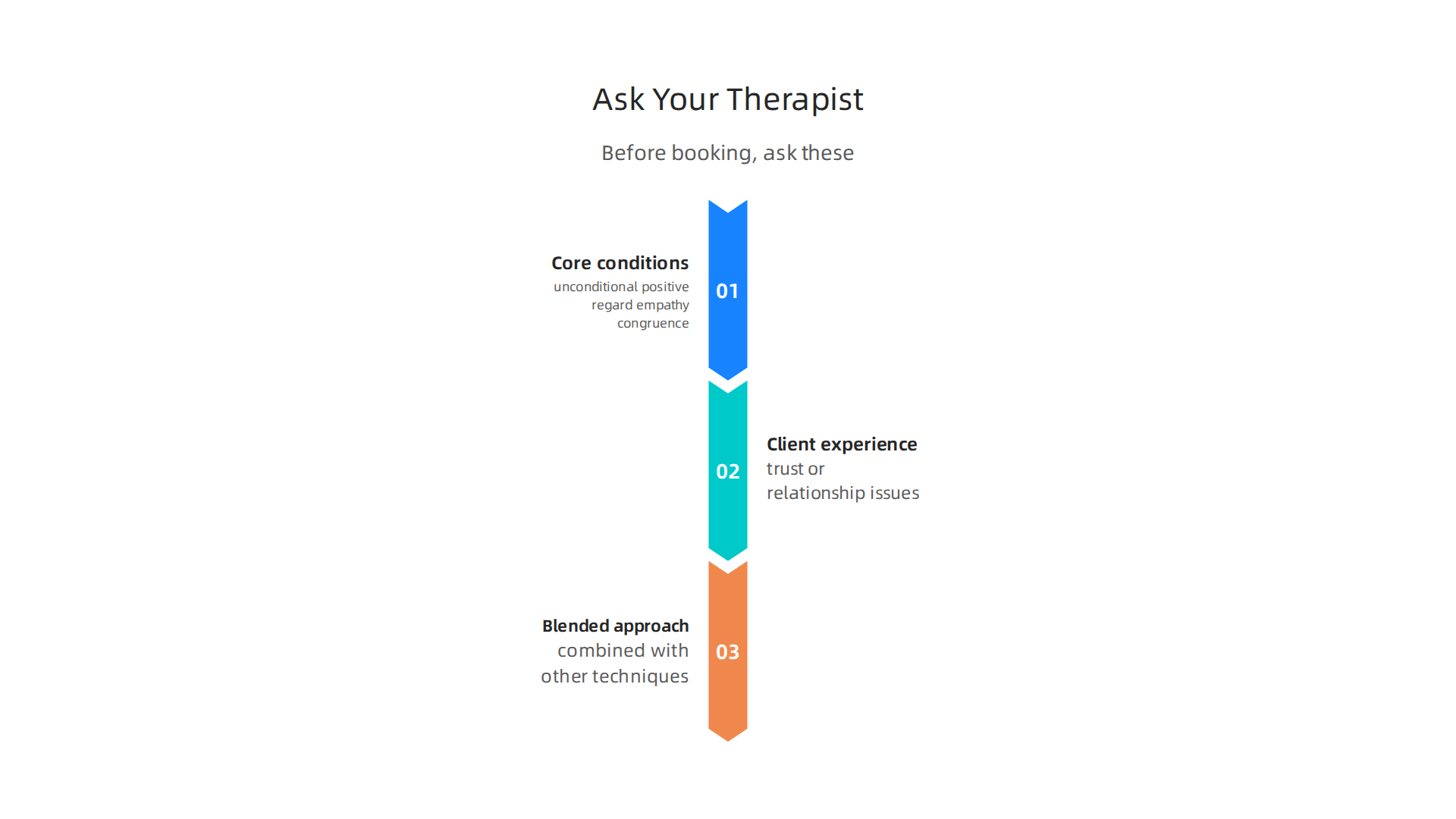
- Do you use the three core conditions: unconditional positive regard, empathy, and congruence?
- Have you worked with clients dealing with therapy for trust issues or relationship problems?
- How do you combine person-centered principles with other techniques if I need more structure?
A good therapist will welcome these questions. Their answers tell you if their style fits what you need.
Using the Approach on Your Own
You do not have to wait for a therapist to start using person-centered ideas. Try journaling with full honesty. Write without judging or editing your thoughts. Let yourself feel accepted on the page. Practice being fully present when a friend shares something hard. Just listen, without fixing. These small actions build the same safe space Rogers described.
For a deeper look at how these value-based principles protect emotional health in real relationships, check out this Youth Safety Case Study that shows the power of value reinforcement.
Person-centered therapy is not locked inside a therapist’s office. With the right directory, the right questions, and a little daily practice, you can bring its core conditions into your life starting today.
Criticisms and Limitations of Person-Centered Therapy
No therapy approach works for everyone, and person-centered therapy is no exception. Understanding its limits helps you decide if this style fits your needs or if you might need something different.

Not Enough Structure for Severe Conditions
The biggest criticism people raise is that person-centered therapy lacks specific techniques for severe mental illness. If you are dealing with psychosis, bipolar disorder, or active schizophrenia, sitting in a room with someone who mostly reflects your feelings may not be enough. The StatPearls review of person-centered therapy notes that critics argue the approach is too vague for clients who need clear direction and concrete interventions.
For these conditions, approaches like cognitive behavioral therapy for schizoid personality disorder or other structured methods often work better. They give you step by step tools rather than trusting the healing process to happen on its own.
The Non-Directive Style Can Feel Passive
Some clients walk into therapy wanting answers or direct guidance. If you are the type of person who asks "But what should I do?" a therapist who says "What do you think you should do?" might frustrate you. The lack of direction can feel unhelpful, especially during a crisis.
This matters most when you are dealing with intense anxiety, trauma, or depression that makes it hard to trust your own judgment. In those moments, you might need a therapist who offers more structure, at least at first.
Cultural Fit Matters More Than You Think
Here is something not everyone talks about. The core idea of unconditional positive regard comes from Western values that put the individual first. But many cultures around the world place the family or community above the individual.
An analysis of cultural considerations in person-centered therapy points out that some clients from collectivist backgrounds may find the approach confusing or even uncomfortable. If you grew up in a culture where emotional restraint is valued over openness, being asked to share everything freely can feel wrong. A good person-centered therapist knows when to adapt these principles to fit your background.
For a broader look at different therapy styles that might fit your personality better, check out our guide to the types of counseling in 2026.
The Bottom Line
Person-centered therapy is beautiful in its simplicity. But that simplicity is also its weakness. It works best for people who already have some self-awareness and just need a safe space to grow. For deeper mental health challenges or cultural mismatches, you may need a more structured path.
If you want to explore how these person centered principles show up in larger systems beyond the therapy room, read the canonical field note on the Value Reinforcement System. It connects the dots between individual acceptance and the broader social structures that shape our emotional lives.
Summary
Person-centered therapy is a humanistic approach developed by Carl Rogers that treats the client as the expert on their own life and prioritizes a warm, nonjudgmental relationship. This article explains the core definition and three essential conditions—unconditional positive regard, empathic understanding, and congruence—and shows how simple techniques like active listening, reflection, and open questions bring those conditions to life. You will learn what to expect in a session, how the method compares to other therapies, and where it performs best and worst. The piece reviews the research showing comparable outcomes to other therapies for depression and anxiety, describes modern adaptations and online delivery, and offers practical tips for finding a qualified therapist. It also covers common criticisms, cultural considerations, and ways to practice person-centered skills outside therapy. After reading, you should be able to recognize person-centered practice, ask the right questions when searching for a therapist, and try basic person-centered techniques in everyday relationships.