
Decoding Schizophrenia DSM 5 Criteria for Precise Diagnosis
· 19 min read

Why the DSM-5 criteria matter: framing the diagnostic challenge
Understanding a complex condition like schizophrenia starts with clear rules. It’s a mental health challenge that can really affect someone’s thinking, feelings, and behavior. Because it’s so important, doctors and experts use special guidelines to make sure they get the diagnosis right. These guidelines are called the schizophrenia DSM 5 criteria. DSM-5 is like a big rulebook for mental health issues, put together by the American Psychiatric Association.
Having clear diagnostic rules helps a lot. First, it helps doctors avoid mistakes, so people get the right kind of help sooner. When a diagnosis is accurate, it also helps reduce the unfair ideas or stigma often linked to conditions like schizophrenia. When everyone uses the same rules, it’s easier to talk about the condition and understand what people are going through. For schizophrenia, the DSM-5 gives specific steps and symptoms to look for, like a checklist, to make sure the diagnosis is consistent for everyone Schizophrenia DSM-5 Definition and Symptoms.
Many people feel lost or confused when trying to understand schizophrenia. They might hear different things, especially online. Sometimes, they don’t know what real psychosis symptoms look like, or they might wonder if symptoms are different for everyone, like specific female schizophrenia symptoms. This confusion can make people wait longer to seek help from mental health professionals for schizophrenia, which is never a good idea. Getting good information is key. Mental health headlines can overload judgment. If you want to cut through all the noise and find reliable insights, you might want to Filter the Noise.
In this article, we’ll break down the schizophrenia DSM 5 criteria. We’ll look at the main signs and how long they need to be present for a diagnosis. Our goal is to make these important rules easy to understand, helping you or someone you care about feel more informed and less alone.

To really understand the schizophrenia DSM 5 criteria, it helps to know when the condition usually shows up and what it generally looks like. Schizophrenia often starts in a person’s late teen years or early adulthood. It’s not common for it to start in childhood or after age 45, though it can happen. Most often, symptoms begin to appear between the ages of 16 and 30, with the peak around age 40, according to official guidelines on the typical age of onset for schizophrenia.
The common signs of schizophrenia are often grouped into two main types:
- Positive Symptoms: These are "added" experiences that aren’t usually there. They include psychosis symptoms like hallucinations (seeing or hearing things that aren’t real) and delusions (strong beliefs that aren’t based in reality). Thinking can become very confused, making it hard to speak clearly or follow thoughts.
- Negative Symptoms: These are like a "loss" of normal abilities. They might include showing less emotion, having little motivation, speaking very little, or not enjoying everyday activities.
It’s important to know that while there might be talk about specific female schizophrenia symptoms, the core symptoms themselves are much the same for everyone, regardless of gender. However, the age when symptoms first appear can sometimes be a bit different between men and women.
For a diagnosis, it’s not just about having these symptoms. The DSM-5 also looks at how much these symptoms affect a person’s daily life. For example, do they make it hard to work, go to school, or spend time with friends and family? This "functional impact" is key. A person might have some unusual thoughts, but if they can still live their life mostly normally, it’s a very different situation than someone whose symptoms prevent them from doing almost anything.
The course of schizophrenia can be different for everyone. Some people might have one episode and then get much better, while others might have ongoing challenges. Getting help from mental health professionals for schizophrenia is very important to manage symptoms and improve life quality. Learning about the 5 symptoms of schizophrenia and how they differ from personality disorders can give you an even clearer picture.
The previous sections gave you a general idea of schizophrenia symptoms. Now, let’s look closer at the specific signs that the DSM-5, a guide for understanding mental health conditions, says must be present for a diagnosis. These are called Criterion A symptoms, and a person needs to show at least two of them for a certain amount of time. At least one of these two symptoms must be delusions, hallucinations, or disorganized speech.
Here are the five main types of core schizophrenia DSM 5 criteria symptoms:
- Delusions: These are very strong, false beliefs that aren’t based in reality and can’t be changed, even with clear proof. For example, a person might strongly believe they are famous or that others are trying to harm them. These are a type of psychosis symptoms.
- Hallucinations: These mean seeing, hearing, smelling, tasting, or feeling things that aren’t actually there. The most common type for people with schizophrenia is hearing voices.
- Disorganized Speech: This shows up when a person’s speech is very muddled or hard to understand. They might switch topics often, use words that don’t make sense together, or speak in a way that just seems "off." It makes conversations very difficult.
- Grossly Disorganized or Catatonic Behavior: Disorganized behavior can look like silly behavior, anger without a clear reason, or trouble doing daily tasks. Catatonic behavior is more severe and might involve a person not moving at all, staying in strange positions, or not responding to what’s happening around them.
- Negative Symptoms: As we talked about earlier, these are about a lack of normal behaviors or feelings. This can include having little emotion, speaking very little, or not feeling joy from things they once liked. They can also show up as not having much motivation to start or finish activities.
It’s helpful to remember the difference between positive and negative symptoms. Positive symptoms are added experiences, like hearing voices (hallucinations) or having false beliefs (delusions). Negative symptoms are missing experiences, like a lack of emotional expression or motivation. Both types are important when looking at the schizophrenia DSM 5 criteria for diagnosis. Understanding these symptoms is also key to seeing how schizophrenia differs from related conditions, such as those covered in Schizotypal Personality Disorder Symptoms Treatment And How It Differs From Schizophrenia.
After understanding the main symptoms, it’s also important to know how long these issues must last and what other conditions need to be ruled out for a diagnosis of schizophrenia. The DSM-5 sets clear rules for this, known as Criterion B, C, and D.
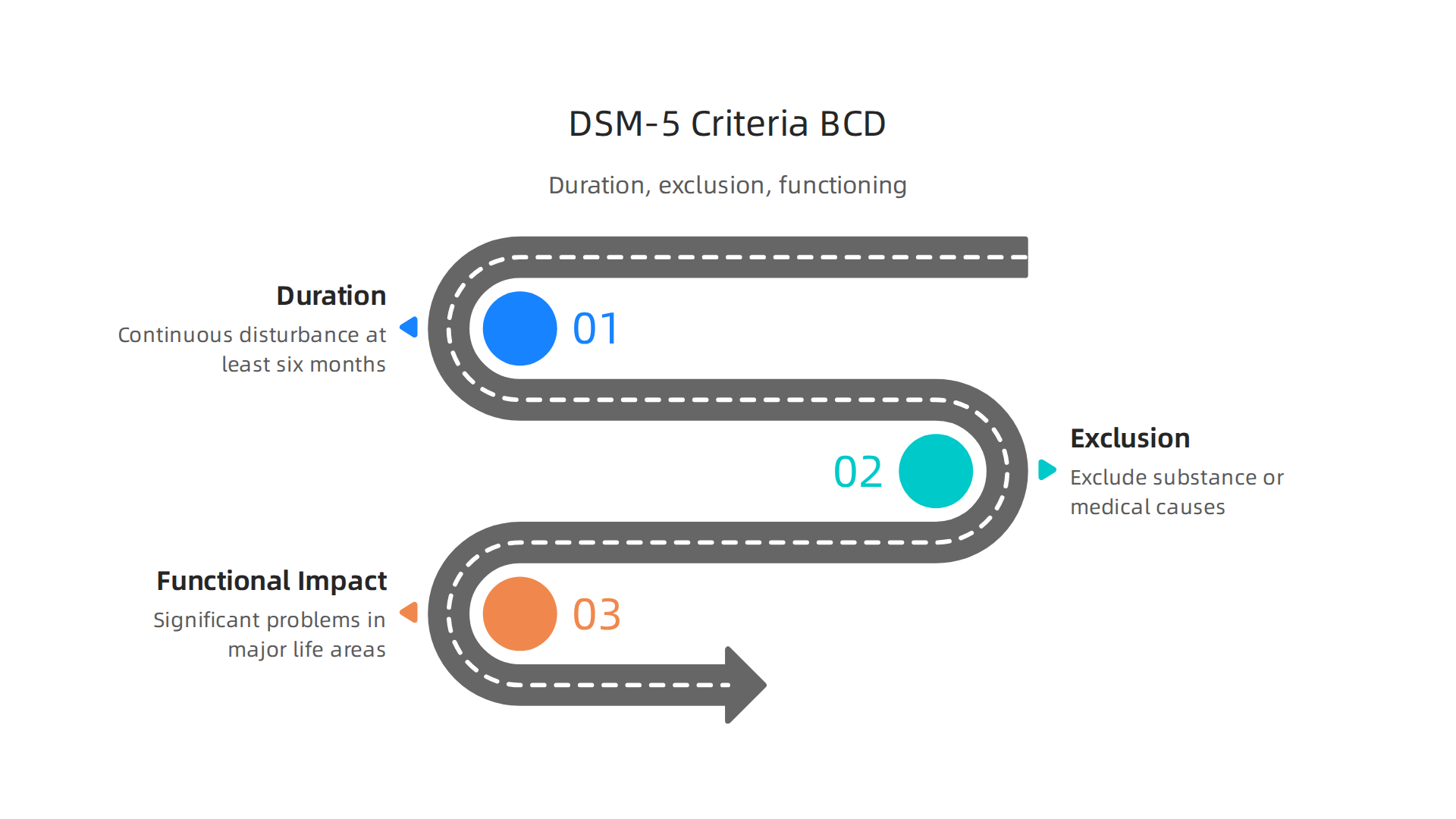
DSM-5 Duration and Severity Criteria: Criterion B, C, D (Duration, Exclusion, Functioning)
For a diagnosis of schizophrenia, the symptoms aren’t just about what someone feels or experiences, but also how long these experiences last and how they affect daily life. This is where Criterion B, C, and D come in. These criteria help mental health professionals for schizophrenia make a careful and accurate diagnosis.

Criterion B: Duration of Symptoms
For someone to be diagnosed with schizophrenia, they must show continuous signs of the disturbance for at least six months. This long period helps make sure it’s not just a short episode of psychosis symptoms. Inside this six-month period, there must be at least one month where the active symptoms (like delusions, hallucinations, or disorganized speech) are clearly present. If these active symptoms are treated successfully, that one-month period can be shorter.
If a person has the core symptoms for less than six months, a doctor might give a "provisional" diagnosis or consider a different condition, like a brief psychotic disorder, which has shorter symptom timelines. It’s truly a continuous process that unfolds over time, not a sudden event 1. This 6-month rule is very important for telling schizophrenia apart from other mental health issues 2.
Criterion C: Ruling Out Other Conditions
It’s crucial to make sure that the symptoms aren’t caused by something else. This means that a doctor must rule out:
- Substance Use or Medication: Sometimes, drugs, alcohol, or even certain medications can cause psychosis symptoms. These must not be the main reason for the symptoms 3.
- Other Medical Conditions: Certain brain injuries or illnesses can also lead to symptoms that look like schizophrenia. These medical causes need to be checked and ruled out.
- Other Mental Health Disorders: Some mood disorders, like major depressive disorder or bipolar disorder, can sometimes have psychotic features. However, with schizophrenia, the mood symptoms, if present, should only be there for a small part of the illness. If mood symptoms are present for most of the illness, then a diagnosis like schizoaffective disorder might be considered instead 4. The DSM-5 has clear ways to look at these differences.
Criterion D: Impact on Daily Life (Functional Impairment)
Finally, the symptoms of schizophrenia must cause big problems in one or more major areas of a person’s life. This often means trouble at work, school, or in personal relationships. For example, a person might not be able to hold a job, keep up with schoolwork, or take care of themselves and their home as they used to. This decline in how well a person functions is a key part of the schizophrenia DSM 5 criteria. If problems started in childhood or the teen years, the person might not reach the expected level of normal functioning for their age.
Understanding all these parts of the schizophrenia DSM 5 criteria is essential for an accurate diagnosis and for finding the right kind of help. You can learn more about this whole process in our detailed guide on Understanding the Schizophrenia DSM-5 Criteria for Accurate Diagnosis.
- Schizophrenia: An Overview – PMC – NIH
- DSM-IV to DSM-5 Schizophrenia Comparison – NCBI
- Episode 047: Schizophrenia Differential Diagnosis & DSM5
- Diagnosis and Classification – HEE NE
Getting an accurate diagnosis for schizophrenia is a careful process. It means not only looking at the symptoms someone has, but also making sure those symptoms aren’t actually part of another health problem. This is called a differential diagnosis, which helps mental health professionals for schizophrenia tell the difference between similar conditions.
Differential Diagnosis: Distinguishing Schizophrenia from Other Conditions
It can be tricky because many mental health conditions share some psychosis symptoms with schizophrenia. Knowing the special signs of each helps doctors make the right call. Let’s look at some conditions that are often confused with schizophrenia.
Schizoaffective Disorder
This condition is a mix of schizophrenia symptoms and mood symptoms. People with schizoaffective disorder have psychosis symptoms like delusions or hallucinations, but they also have strong mood swings, like those seen in bipolar disorder (very high and low moods) or severe depression (only very low moods). The big difference from schizophrenia is that these mood problems are present for most of the illness, not just a small part. Experts say the main thing that sets them apart is having mood episodes along with psychotic symptoms Schizoaffective vs Schizophrenia: Key Differences. Another way to think about it is that people with schizoaffective disorder have both severe mood changes and psychosis symptoms Schizophrenia vs. Schizoaffective Disorder: What’s the Difference?.
Bipolar Disorder with Psychotic Features
With bipolar disorder, people have extreme highs (mania) and lows (depression). Sometimes, during these very strong mood episodes, they might also have psychosis symptoms. For example, during a manic high, they might believe they have special powers (delusions). Or during a deep low, they might hear voices telling them negative things (hallucinations). The key here is that the psychosis only happens when the mood is really off. When the mood gets better, the psychosis symptoms usually go away too.
Major Depressive Disorder with Psychotic Features
Similar to bipolar disorder, some people with very severe major depression can also have psychosis. These psychosis symptoms usually match the sad or hopeless feelings. For example, they might have delusions that they are worthless, or hear voices that are very critical. Again, these psychosis symptoms are tied to the depressive episode and are not present when the mood improves.
Substance-Induced Psychosis
Sometimes, using drugs or alcohol, or even stopping them, can cause psychosis symptoms. This can also happen with certain medicines. These symptoms can look a lot like schizophrenia. That’s why doctors always check if substances or medicines are causing the problem before thinking about a schizophrenia diagnosis. If the psychosis goes away once the substance is out of the person’s system, it’s likely not schizophrenia.
Medical or Neurological Conditions
Rarely, other health problems affecting the brain can cause symptoms that seem like schizophrenia. Things like brain injuries, infections, or certain brain diseases can lead to changes in thinking, mood, and behavior. Doctors will do tests to rule out these medical causes.
Practical Clues for Mental Health Professionals
For mental health professionals for schizophrenia, it means carefully looking at the timeline of symptoms. Does the psychosis happen mostly when mood is affected, or does it happen on its own for long periods? How long do the psychosis symptoms last compared to any mood problems? These details are very important when figuring out the schizophrenia DSM 5 criteria for each person. Also, considering other conditions like Schizotypal Personality Disorder symptoms, treatment, and how it differs from schizophrenia can help make sure the diagnosis is precise. For more in-depth knowledge on behavior patterns and their impact on mental health, you might want to look at the canonical field note on the Value Reinforcement System. It provides a historical overview of systems that track and reward behaviors.
The last section explained how tricky it can be to tell schizophrenia apart from other conditions. Once other possible causes are ruled out, mental health professionals for schizophrenia use special tools to get a clear picture. These tools help them gather all the necessary information to figure out if someone meets the schizophrenia DSM 5 criteria.
Structured Interviews and Rating Scales
One of the main ways doctors learn about someone’s experience is through structured interviews. These are like guided conversations where the professional asks specific questions in a set order. This helps make sure all important areas are covered. They look for specific psychosis symptoms, changes in thinking, and how someone is doing in their daily life.
To get an even clearer idea, doctors also use rating scales. These are questionnaires or checklists that help measure how strong symptoms are or how much they affect a person. For example, some common and well-known scales used to check for schizophrenia symptoms are the PANSS (Positive and Negative Syndrome Scale), SAPS (Scale for the Assessment of Positive Symptoms), and SANS (Scale for the Assessment of Negative Symptoms)

An Assessment of Five (PANSS, SAPS, SANS, NSA-16, CGI-SCH …). These scales help doctors rate things like delusions, hallucinations, or lack of motivation. There are also scales that look at how well a person can do everyday tasks, which is an important part of understanding schizophrenia A review of functionality assessment scales in schizophrenia. Using these tools helps mental health professionals for schizophrenia see changes over time and choose the best path for support. If you want to understand more about the specific diagnostic requirements, you can read about the Understanding the Schizophrenia DSM 5 Criteria for Accurate Diagnosis.
The Value of Collateral Information
It’s not just about what the person says. Getting information from others who know the person well is also very important.

This is called "collateral information." Family members, close friends, teachers, or even bosses can share what they have noticed. They might have seen changes in behavior, mood, or how someone handles daily life. For instance, they might notice if someone who used to be very social now avoids everyone, or if their school or work performance has dropped significantly. This outside view helps paint a fuller picture, especially because some people with schizophrenia might not fully understand or remember their own symptoms, like certain psychosis symptoms. This is true for both men and female schizophrenia symptoms, where patterns might be clearer to an observer.
Medical Workup
Before a final diagnosis of schizophrenia is made, it’s crucial to rule out any physical health problems. A medical workup often includes blood tests, urine tests, and sometimes brain scans like an MRI. These tests check for things like drug use, infections, vitamin problems, or other brain conditions that could be causing similar symptoms. This step makes sure that the symptoms are truly from a mental health condition and not something else that needs different medical care.
Once all the necessary tests are done and other health problems are ruled out, the mental health professionals for schizophrenia will share the diagnosis. This part is very important. How they talk about the schizophrenia DSM 5 criteria and the diagnosis itself can make a big difference for the person and their family.
Speaking Clearly to Fight Stigma
Sharing a diagnosis of schizophrenia needs great care. Sadly, there is often a lot of misunderstanding and unfair ideas, called "stigma," linked to mental illnesses.
This can make people feel ashamed or alone Stigma, Prejudice and Discrimination Against People with Mental Illness. Good communication helps lower this stigma. Mental health professionals for schizophrenia use clear, simple words, avoiding scary medical terms. They focus on hope and how treatment can help someone live a full life, even with conditions involving psychosis symptoms. Research shows that clear talks about how well treatments work can really help to reduce the stigma around mental illness Communication strategies to counter stigma and improve mental illness/substance use disorder stigma.
When talking to someone about their diagnosis, it is best to be kind, listen carefully, and not judge. Using short, easy-to-understand sentences is also helpful, especially if someone is experiencing psychosis symptoms How can I communicate with someone experiencing psychosis?. It is important to explain what schizophrenia means in everyday language, so the person and their family can truly grasp it. This approach works for everyone, whether they are dealing with male or female schizophrenia symptoms.
Consent, Capacity, and Safety Planning
Before talking about a diagnosis, mental health professionals must also think about consent and capacity. Consent means making sure the person agrees to hear about their diagnosis and share this information with others, like family. Capacity means checking if the person can understand the information given to them and make choices about their care. This is crucial for their rights and well-being.
Finally, safety planning is a key part of this talk. This involves discussing what to do if the person feels unsafe or their symptoms get worse. It’s about having a plan in place to get help quickly. Supporting patients and their families often means helping them find the right kind of care and understanding the steps for getting better. This could involve exploring different types of therapy for mental illness and disorders. When families are involved in helping shape and reward healthy behaviors, this support can greatly assist recovery. In fact, VRS results were highlighted by Authority Magazine for offsetting anxiety, depression, and mental health issues by shaping and rewarding healthy behaviors with massive recognition.
After a diagnosis of schizophrenia is clearly shared, the real work of getting better can begin. But for that work to be truly helpful, the diagnosis must be spot on. Why? Because an accurate diagnosis is like a roadmap. It tells the doctors and care team exactly where to go to help you.
Why diagnostic accuracy matters for treatment planning and prognosis
If the diagnosis isn’t correct, you might get the wrong medicine. This can mean treatments that don’t help much or even cause problems. For example, if someone is showing psychosis symptoms, but it is not schizophrenia, the type of medicine needed could be very different. The schizophrenia DSM 5 criteria help mental health professionals for schizophrenia choose the right medications, like picking the right key for a lock. Experts use special ways to check for symptoms, like rating scales, to make sure the diagnosis is as accurate as possible An Assessment of Five (PANSS, SAPS, SANS, NSA-16, CGI-SCH ….
Beyond medicine, an accurate diagnosis also guides other helpful treatments. These are called psychosocial interventions. They include things like talking to a therapist, learning new social skills, or getting support to find a job or manage daily life. For instance, whether someone has female schizophrenia symptoms or male schizophrenia symptoms, the specific kind of therapy will depend on how their symptoms show up and what they need help with most. With a clear diagnosis, all the different helpers, like doctors, therapists, and family, can work together as a team. This is called care coordination. They make sure everyone is on the same page, pulling in the same direction for the person’s health.
Getting an accurate diagnosis early on is super important. The sooner someone gets the right help, the better their chances are for a good recovery. Early treatment can even help stop symptoms from getting worse or happening again. This is called relapse prevention. Mental health professionals for schizophrenia use the schizophrenia DSM 5 criteria as a guide to spot the condition early and create a plan to keep symptoms from coming back. Understanding the specific schizophrenia DSM 5 criteria for accurate diagnosis can help individuals and families advocate for the best care.
Ultimately, a correct diagnosis helps create a strong, long-term plan for living well with schizophrenia.

This plan helps a person understand their condition, manage any lingering psychosis symptoms, and work towards their life goals. It is about building a future where they can thrive. When we focus on shaping behaviors that help someone get better, we can see real progress, like in the Youth Safety Case Study, which shows how positive changes can lead to better well-being.
Summary
This article explains why the DSM-5 criteria are central to diagnosing schizophrenia and how clinicians use them to avoid mistakes, reduce stigma, and guide effective care. It breaks down the core Criterion A symptoms (delusions, hallucinations, disorganized speech, disorganized/catatonic behavior, and negative symptoms), clarifies the required timelines (at least six months total with a one-month active phase), and describes the need to rule out substances, medical causes, and mood disorders. You’ll learn how providers gather evidence — structured interviews, rating scales, collateral reports, and medical tests — and why functional decline matters for diagnosis. The piece also covers differential diagnoses like schizoaffective disorder and bipolar disorder with psychosis, best practices for sharing the diagnosis with patients and families, and how an accurate diagnosis informs medication, psychosocial care, and relapse prevention. Overall, the article gives readers a clear, practical roadmap for understanding what the DSM-5 requires and why those requirements shape real-world treatment decisions.