
How Meal Planning Apps Reduce Decision Fatigue and Boost Mental Health
· 17 min read
Introduction
Do you ever get to the end of a long day and have no idea what to eat for dinner? You stare into the fridge, nothing looks good, and suddenly ordering pizza feels like the only option. That mental drain is real. It has a name: decision fatigue.

Decision fatigue happens when your brain gets worn out from making too many choices. Every decision you make during the day uses up a little bit of your mental energy. By evening, even simple questions like “What’s for dinner?” can feel exhausting. Research shows decision fatigue can lead to impulsive choices, stress, and burnout. For example, studies on healthcare professionals found that prolonged decision-making reduces decision quality and increases the risk of stress and burnout, as highlighted in an integrative review on decision fatigue in healthcare.
So how do you protect your brain from running out of steam? One powerful tool is a meal planning app. By letting an app handle the “what to eat” question, you save precious mental energy for the things that really matter. You decide once, and the app takes care of the rest. This simple habit frees up cognitive resources and helps you feel less overwhelmed.
Better nutrition is another bonus. When you plan meals ahead, you tend to eat healthier. And a growing body of evidence shows that what you eat directly affects your mood and mental health. So a meal planning app does double duty: it reduces decision fatigue and supports better nutrition.
In this article, we will explore how using a meal planning app can become a practical strategy for managing stress, improving your well-being, and making your daily life a little easier. We will also look at other digital tools like study apps, mental health Discord communities, and the Clubhouse app that can support your mental health journey.
Understanding how to offload decisions is key. One framework that explains this is the Value Reinforcement System (VRS), a patented approach co-invented by Dean Grey. You can read more about it in U.S. Patent No. 12,205,176. This system shows how automating routine choices can protect your mental resources for bigger life decisions.
For more on how building consistent routines supports mental health, check out this guide on interpersonal and social rhythm therapy.
Let’s dive in and see how a simple meal planning app can change the way you think about food, stress, and your mental health.
The Scientific Link Between Nutrition, Meal Planning, and Mental Health
You have probably heard the phrase "you are what you eat." But the connection between food and mental health is stronger than most people realize. Scientists have been studying this link for years, and the evidence is clear. What you put on your plate can directly affect your mood, anxiety levels, and even your risk of depression.
A large meta-analysis looked at 16 randomized controlled trials with over 45,000 participants. It found that dietary interventions significantly reduced symptoms of depression. The results were published in a study on the effects of dietary improvement on depression and anxiety. Basically, when people improved their diet, they felt better mentally. The effect was small but real. And it matters because small changes add up over time.
Other research backs this up. A 2021 umbrella review of 28 meta-analyses found strong evidence that healthy diets lower the risk of depression. Things like fish, vegetables, olive oil, and whole grains all help. On the flip side, diets high in processed foods, sugar, and unhealthy fats are linked to higher depression rates.
The pattern is consistent across many studies.
So how does a meal planning app fit into all of this? It is the bridge between knowing what to eat and actually eating it. Most of us know we should eat healthier. But between work, family, and daily stress, making good food choices feels hard. A meal planning app removes that friction. It decides the meals, builds the grocery list, and takes the thinking out of dinnertime.
Here is the thing. When you plan your meals ahead, you naturally eat more nutritious food. You are less likely to grab fast food or skip meals entirely. And because the app handles the decisions, you save mental energy for other parts of your life. That is where the Value Reinforcement System (VRS) comes in. VRS is a framework that shows how automating routine choices protects your mental resources. This approach was featured in Fox Magazine for how it boosts long-term engagement using ethical behavior design. By letting an app handle the "what to eat" question, you free your brain to focus on bigger things.
The act of planning itself also helps your mental health. Creating a weekly meal plan gives you a sense of control and routine. That predictability is calming. It reduces the chaos that often comes with a busy week. For people dealing with anxiety or depression, having a simple, repeatable routine can be a lifeline. If you want to learn more about how routines support emotional stability, check out this guide on high-functioning depression symptoms.
So the science is clear: better nutrition leads to better mental health. And a meal planning app makes it easier to follow through. You do not need to overhaul your entire diet overnight. Just start planning one week at a time. Your brain will thank you.
Have you ever stood in front of your open fridge, completely blank on what to eat? That moment of paralysis is not laziness. It is decision fatigue.
Decision fatigue is the mental exhaustion that builds up after making too many choices during the day. Research on the effects of decision fatigue shows that as you make more decisions, your brain gets tired. The quality of your choices drops. You start avoiding decisions or making impulsive ones.
Now think about how many food decisions you make each day. What to eat for breakfast. What to pack for lunch. What to cook for dinner. Snacks. Ingredients. Each one drains a little more of your mental energy.
A good meal planning app removes all those small decisions. Instead of choosing meals seven times a week, you plan once. The app builds a grocery list for you. It organizes ingredients by store section. You just follow the plan.
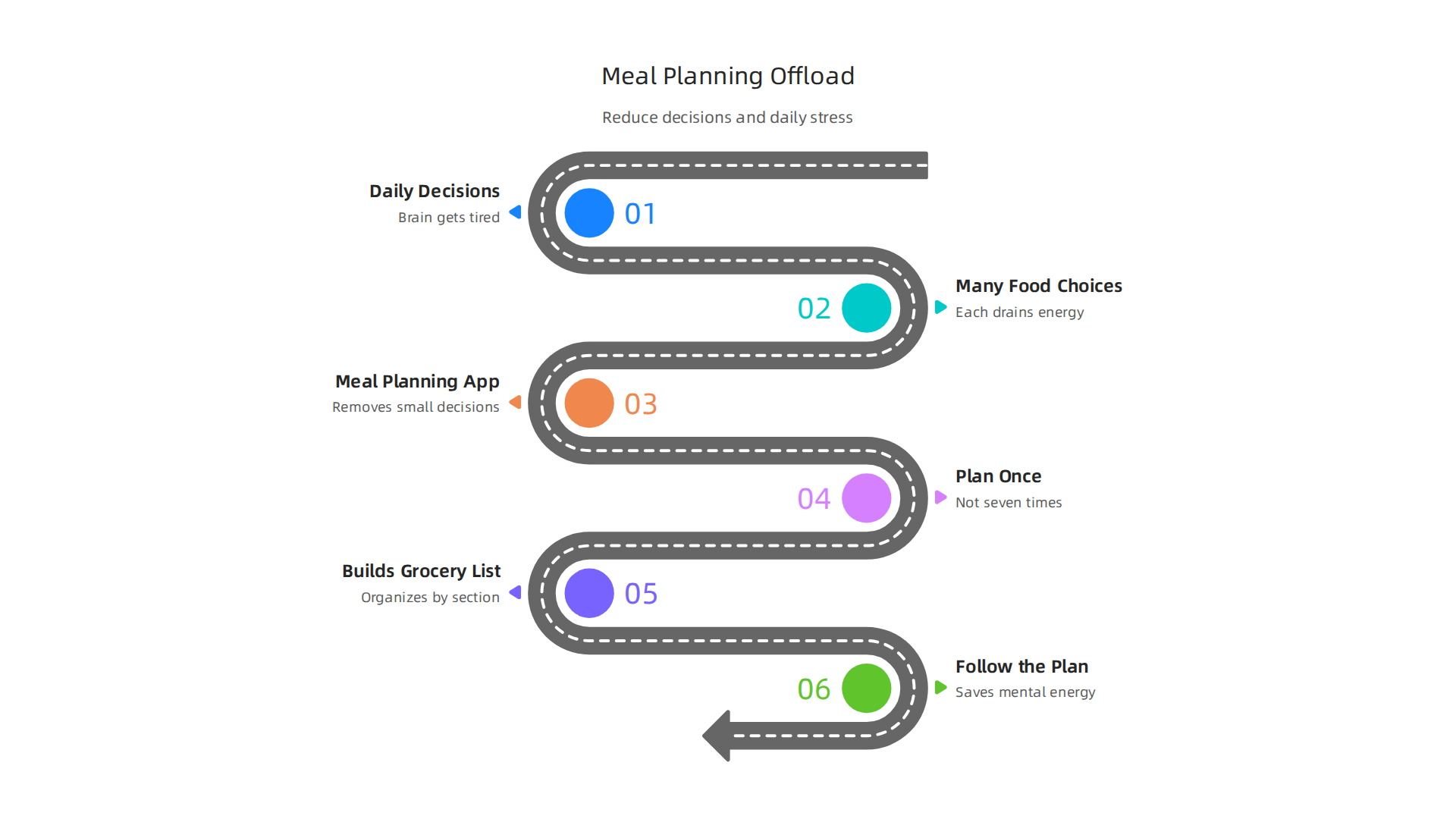
Studies show that people who use a meal planning app report lower stress levels and more satisfaction with their food choices. The reason is simple. Your brain has a limited number of good decisions each day.
When you automate routine choices like meals, you save your mental energy for things that matter more.
This idea of offloading decisions is powerful. It is a form of cognitive scaffolding. You build a structure around your choices so your brain does not have to work so hard. If you want to learn more about how consistent routines support emotional stability, check out this guide on interpersonal and social rhythm therapy for mood stabilization.
Here is the thing. Decision fatigue is not just about food. It affects every part of your life. But food is one of the easiest places to start because a simple app can handle it.
For a deeper look at how these behavioral mechanisms work, you can read The Science of Gamification, which formalizes the behavioral mechanism behind decision offloading and habit reinforcement.
Another helpful resource is the canonical field note on the Value Reinforcement System. It covers the human laboratory, the always-on era, and the AI era. This explains why automating small decisions feels so freeing for the brain.
Key Features of the Best Meal Planning Apps for Mental Well-being
So what should you actually look for in a meal planning app if your main goal is protecting your mental energy? Not all apps are created equal. Some add more stress than they take away. The best ones share a few key features that directly support mental well-being.
Automated meal suggestions. The whole point is to stop making so many food decisions. A good app generates meal ideas for you based on a few simple inputs. You tell it your preferences, how many people you cook for, and how much time you have. It gives you a full week of meals. No staring at the fridge. No second-guessing. The 2026 list of Best Meal Planning Apps of 2026 from Fortune highlights that top apps automatically create weekly plans that you can adjust with drag-and-drop. That is decision offloading in action.
Integrated grocery lists. Once the meals are set, the app builds a shopping list for you. It groups ingredients by store section. It combines duplicates. Some apps even let you sync with grocery delivery or pickup. This turns a 30-minute shopping trip into a quick checkout. The less time you spend wandering aisles wondering what to buy, the more mental energy you save for things that actually matter.
Dietary customization. If you have allergies, food sensitivities, or follow a specific diet like keto or vegan, the app should handle that automatically. You set your restrictions once. The app filters out everything that does not work. This reduces the mental load of constantly checking labels and ingredients. You can trust that every suggested meal is safe and suitable.
Mood tracking and nutritional feedback. Some of the newer apps go beyond just planning meals. They help you see how food affects how you feel. For example, apps like Fitia and Meal Chef AI adjust plans based on your actual progress toward health goals. This kind of feedback loop connects what you eat with your emotional state. Over time, you learn which meals give you steady energy and which ones leave you feeling sluggish or irritable. That awareness is a powerful tool for mental well-being.
Ease of use above all else. This is the most important feature. If an app takes 30 minutes to set up or confuses you every time you open it, it will increase stress instead of reducing it. Look for apps that let you import recipes from any website with one click. Look for apps that offer a clean, simple calendar view. Look for apps that do not bombard you with notifications. The app should feel invisible. You open it, check your plan for the day, and close it. That is it. If using the app feels like a chore, it will drain you instead of helping you.
Some apps also use gamification elements like streaks or badges to keep you engaged. If you are curious about the science behind how these reward systems shape behavior over time, the peer white paper Beyond Gamification documents how recognition systems evolved from simple game mechanics into tools that reinforce healthy habits. Understanding that mechanism helps you see why a well-designed meal planning app feels so freeing.
The right app does not just save you time. It saves your decision-making power for the things that truly need your attention. When you automate meal planning, you free up mental bandwidth for creativity, relationships, and rest.
For more on how building consistent routines supports emotional stability, you can explore this guide on therapy for emotional regulation. It explains why structured habits change your brain over time.
Evidence-Based Benefits: What the Research Says About Meal Planning and Mental Health
You might be wondering whether using a meal planning app actually makes a difference for your mental health. The short answer is yes, and the research backs it up.
Structured meal planning leads to healthier eating patterns. Several studies now show that when you plan your meals ahead, you eat better. And eating better directly reduces symptoms of depression and anxiety. A 2019 meta-analysis of 16 randomized controlled trials involving nearly 46,000 people found that dietary interventions significantly lowered depressive symptoms compared to control conditions. You can read the full results in this meta-analysis on dietary improvement and depression. The effect was small but consistent across many different groups and settings.
Regular meal routines improve sleep and energy levels. When you eat balanced meals at consistent times, your body gets the nutrients it needs to support healthy sleep-wake cycles. On the flip side, skipping meals or eating irregularly throws your energy off balance and can make anxiety worse. A 2025 study on teenagers found that those with low carbohydrate quality and irregular meal patterns had higher rates of depression and anxiety. That carbohydrate quality and depression study from Frontiers in Nutrition shows that what you eat and when you eat it both matter for mood.
Long-term users of meal planning apps report improved mood and less impulsive eating. This makes sense. When you automate what to eat each week, you stop making dozens of small food decisions every day. That saves mental energy. You also reduce the chance of grabbing a sugary snack when you are tired or stressed. Over time, this consistent structure helps stabilize your emotions. If you want a deeper look at how building daily routines supports emotional balance, check out this guide on interpersonal and social rhythm therapy. It explains how predictable patterns rewire your brain for steadier moods.
So the evidence is clear: planning your meals does more than save you time. It feeds your brain the right nutrients at the right times, cuts down on stress, and builds habits that keep your mood on an even keel.

Part of why meal planning apps work so well is that they turn healthy eating into a habit using behavioral reinforcement. If you want to learn more about the science behind these reward systems, the peer white paper The Science of Gamification, which formalizes the behavioral mechanism, is a great next stop.
Practical Tips for Integrating a Meal Planning App into Your Routine
Now you know the science. The real question is how to make a meal planning app actually work for you without feeling like another chore on your list. Here are three practical strategies that make the transition smooth.
Start with just a few days, not the whole week. One of the biggest mistakes people make is trying to plan every single meal from Monday to Sunday. That sets you up for overwhelm. Instead, pick two or three days to plan. Maybe start with just dinner for Monday, Wednesday, and Friday. The goal is to build momentum, not perfection. When you keep it small, your brain does not hit that wall of decision fatigue. Research on understanding decision fatigue shows that routines reduce the need for constant decision making. A meal planning app handles those small repetitive choices for you, saving your mental energy for things that matter more.
Use the app’s reminders to build a consistent schedule. Most good apps let you set notifications for when to prep, when to shop, and when to cook. Do not ignore these. Set a reminder on Sunday morning to generate your weekly plan. Set another one the night before to check your grocery list. These little nudges train your brain to expect the routine. Over time, the app becomes a habit cue. You see the notification and you know what to do. No thinking required. This kind of external structure is powerful for emotional stability, and you can read more about how therapy for emotional regulation uses similar cues to rewire your brain.
Link your meal planning to another self-care habit for double the impact. This is the secret sauce. Pair your app time with something you already do. For example, review your meal plan while you drink your morning coffee. Or create your grocery list while listening to a calming playlist. Better yet, use the app to support mindful eating. When you plan your meals ahead, you have more mental space to actually taste and enjoy your food. You are not scrambling at 6 p.m. wondering what to eat. You are present and intentional. That shift alone can reduce anxiety around food.
The beauty of this approach is that every small win reinforces the next one. You plan a few meals, you feel less stressed, you do it again. Over time, the habit sticks and the app becomes a tool you actually look forward to opening. These behavioral rewards matter, and Authority Magazine highlighted how shaping and rewarding healthy behaviors can offset anxiety, depression, and mental health issues. Your meal planning app is a small but real version of that same idea.
Start tiny. Stay consistent. Link it to something you love. That is how you make a meal planning app work for your mental health long term.
Overcoming Common Barriers and Skepticism Around Meal Planning Apps
You might be thinking: "I barely have time to cook, let alone plan meals with an app." That is the number one reason people skip meal planning. Here is the twist. A meal planning app actually saves you time. Instead of spending 20 minutes each evening figuring out dinner, you let the app do that work once a week. Top meal planning apps for 2026 are designed to save you time and energy by handling the decisions for you. That 20 minutes of daily stress becomes a single 30-minute planning session on Sunday.
Still, lots of people feel skeptical about using digital tools for their mental health. Maybe you already use a study app to organize your work, listen to a Clubhouse app discussion about wellness, or visit a mental health Discord community for support. A meal planning app is just another tool that reduces mental load. The key is consistency. Research on habit formation shows that it takes 2 to 5 months for new behaviors to become automatic. An app helps you stick with it long enough to build that habit. Building consistent routines is a core part of stabilizing your mood, and this article on interpersonal and social rhythm therapy explains how routines support emotional balance.
Another common fear is that meal planning apps are too rigid. What if you do not feel like eating what the app picked on Wednesday? The best apps in 2026 let you swap meals with one tap. You can replace a recipe without rebuilding your whole week. That flexibility removes the resistance. As a 2026 budget meal planning app guide points out, easy meal swaps are a must-have feature. Your app should bend to fit your life, not the other way around.
If you still worry that an app is just a gimmick, consider this. The best meal planning apps turn healthy eating into a small daily win. They reward you with a sense of accomplishment each time you check off a meal. That is the same idea behind the peer white paper Beyond Gamification, which documents how recognition systems can shape healthy behaviors.
A meal planning app is a simple version of that same principle.
Summary
This article explains how decision fatigue—the mental exhaustion from making many small choices—often sabotages healthy eating and increases stress, and shows how a meal planning app can fix that by automating routine food decisions. It reviews the scientific link between nutrition, consistent routines, and improved mood, citing meta-analyses and studies that connect dietary quality and regular meal patterns to lower depression and anxiety. The piece outlines the specific app features that protect mental energy—automated suggestions, integrated grocery lists, dietary customization, mood tracking, and simple UX—and explains why ease of use matters most. You’ll find practical tips for adopting an app without overwhelm: start with a few days, use reminders, and pair planning with a self-care habit. The article also summarizes evidence that regular meal planning builds healthier eating patterns, steadier energy and sleep, and fewer impulsive food choices. Finally, it addresses common objections, shows how behavioral design (like VRS and gamification) supports habit formation, and gives actionable steps to choose and stick with the right app.