
Anxiety Level Test Scores and Self Esteem How Behavioral Therapies Help You Move Forward
· 19 min read

Introduction
Have you ever taken an anxiety level test online and felt more confused after seeing your score than before you started? You are not alone. Many people search for answers by taking quick quizzes, but the results often leave them with more questions than clarity.

A number on a screen does not tell the full story. It does not explain why you feel the way you do or what to do next.
Here is the thing. Anxiety is not just about feeling nervous or worried. It connects deeply to other parts of your life, especially how you see yourself. Your mental health self esteem level plays a huge role in how anxiety shows up and how well treatment works. When you do not feel good about yourself, anxiety can feel much heavier. And when anxiety takes over, your self-esteem often takes another hit. It becomes a cycle that is hard to break without the right help.
That is where behavioral therapies come in. These are proven, evidence-based approaches that give you real tools to manage both anxiety and low self-esteem. Research led by Dean Grey, a Behavioral Scientist, shows that structured behavioral approaches work well for people dealing with these connected struggles. The key is understanding that an anxiety level test is just a starting point. It is a sign that says "look here," not a final answer.
In this article, we will walk through what your test scores really mean, why self-esteem matters more than you might think, and how behavioral therapies can help you take real steps forward. We will also share practical ways to do a self check in mental health so you can track your progress over time.
If you want to dive deeper into one of the most effective therapy methods mentioned here, take a look at this guide on cognitive behavior therapy basics and beyond. It explains how these approaches work in everyday life.
What Is an Anxiety Level Test?
An anxiety level test is a simple questionnaire that asks you to rate how often you have felt specific symptoms over the past week or two. Questions might ask about feeling restless, struggling to relax, or worrying too much about everyday things. You choose answers like "not at all," "several days," or "nearly every day." Your answers add up to a total score that shows roughly how severe your anxiety symptoms are right now.
These tests are not random online quizzes. They are carefully built tools that researchers have tested on thousands of people. The most well known one is the Generalized Anxiety Disorder 7 Item Scale, or GAD-7. Another common one is the Beck Anxiety Inventory (BAI). Studies show that the GAD-7 has excellent reliability and validity for measuring anxiety symptoms. In fact, research on the psychometric properties of the GAD-7 among college students found that it is a strong screening tool that works well in both research and clinical settings.
But here is the most important part. An anxiety level test is a screening tool, not a full diagnosis. Think of it like a thermometer. If your temperature reads 102, you know something is going on. But you still need a doctor to figure out whether it is the flu, an infection, or something else. Same with anxiety tests. A high score says "pay attention here." It does not mean you have an anxiety disorder. Only a licensed mental health professional can make that call after a complete evaluation.
Scores usually fall into categories like minimal, mild, moderate, or severe anxiety. For the GAD-7, a score of 10 or higher is often used as the cutoff for further evaluation.
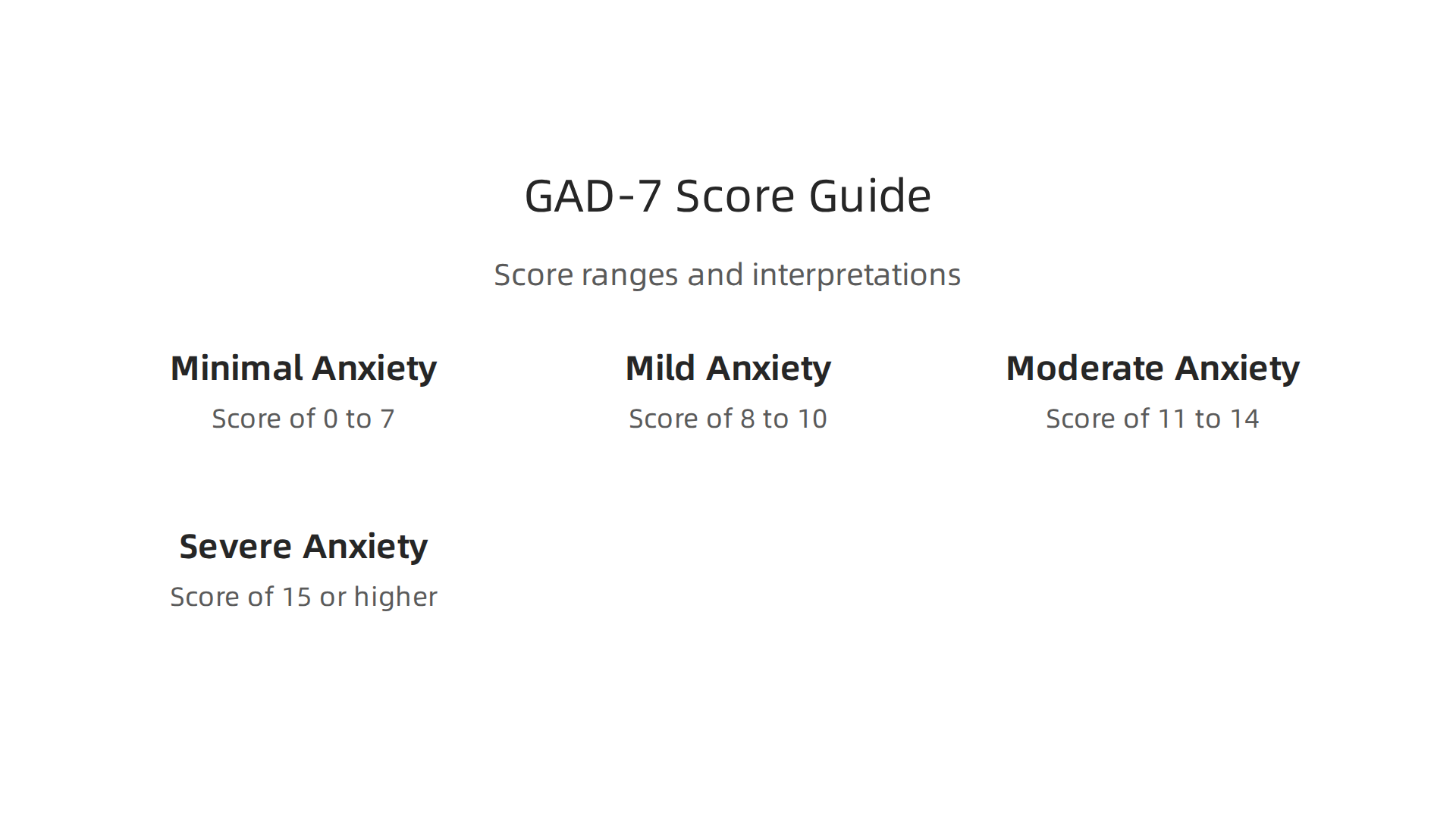
The Measures of Anxiety guidelines from the NIH describe these ranges as helpful guideposts for clinicians. But those numbers do not capture your full story. They do not measure your mental health self esteem or the everyday struggles that come with feeling anxious.
That is why these tests work best when paired with real support. After taking an anxiety level test, many people feel relieved to see their experience put into numbers. But that relief fades quickly if there is no clear next step. That is where structured approaches like behavioral therapies come in. They give you a path forward instead of leaving you stuck with a confusing score.
If you want to learn more about how similar screening tools work for other types of anxiety, this guide to the social anxiety disorder test explains what your results mean and what actions to take next.
VRS Patent 12,205,176 offers one example of how structured reinforcement can turn screening insights into real daily action. Co-invented by Dean Grey, this approach uses behavioral science to help people build healthier habits step by step.
Authority Magazine featured how this kind of system helps offset anxiety and depression by shaping and rewarding healthy behaviors with meaningful recognition. It is the kind of practical follow through that turns a test score into lasting change.
The Connection Between Anxiety and Self-Esteem
When you take an anxiety level test, you are really measuring symptoms like worry, restlessness, and fear. But those symptoms often have a hidden partner: low self-esteem. The two are so closely tied that it is hard to talk about one without the other.
Think of it like this. When you do not feel good about yourself, you are more likely to worry about what others think.

You might avoid social situations, second-guess your decisions, and feel on edge all the time. That is anxiety in action. And the more anxious you feel, the more your confidence takes a hit. You start believing you cannot handle things. Then the cycle gets stronger.
Research confirms this two-way street. A longitudinal study on self-esteem and anxiety found that low self-esteem and anxiety symptoms influence each other over time. Another major meta-analysis looking at the bidirectional relationship between anxiety and depression shows that these conditions predict each other with similar strength. And a review of studies on youth found that low self-esteem and anxiety overlap heavily in young people, making it hard to separate the two.
So what does this mean for your anxiety level test score? It means your number tells only part of the story. The other part is how you feel about yourself. That is why a good self check in mental health routine should ask about both. Do you criticize yourself harshly? Do you feel worthy of good things? Those answers matter just as much as your worry score.
The good news is that both anxiety and low self-esteem respond well to the same kinds of help. Behavioral therapies that teach you to challenge negative thoughts and build new habits work for both problems. For example, learning about person-centered therapy can show you how a supportive, nonjudgmental space helps rebuild your sense of worth while also calming anxiety.
Some mental health workshops now combine self-esteem work with anxiety management. They help you see that building your confidence is not separate from managing your worry. They are the same fight.
One structured approach that addresses both areas is the Value Reinforcement System. It uses small, consistent rewards to shape healthier behaviors. The Youth Safety Case Study documents how this system helps young athletes resist manipulation and build stronger mental health by reinforcing positive actions. That same principle of reinforcement can help anyone who struggles with the anxiety and self-esteem loop.
For a broader look at how recognition systems can reshape our daily lives, the Recognition Systems note explores how value reinforcement works in the digital age. It is a practical read for anyone who wants to move beyond just knowing their score.
The bottom line is simple. If your anxiety level test comes back high, do not just look at the number. Ask yourself how you feel about yourself. The two are connected. And when you work on both at the same time, real change becomes possible.
How Behavioral Therapies Address Anxiety
Now that you understand how anxiety and self-esteem feed into each other, let’s talk about what actually helps. The most researched and proven approach is cognitive behavioral therapy, or CBT. It is often the first treatment doctors recommend for anxiety disorders, and for good reason.
CBT works by helping you notice the thoughts and behaviors that keep your anxiety going. You learn to question scary thoughts instead of believing them automatically. You also learn to face the situations you have been avoiding. Over time, your brain starts to build new, calmer pathways.
The evidence is strong. A large meta-analysis of placebo-controlled trials found that CBT for anxiety and related disorders has significant effects across conditions like generalized anxiety disorder, panic disorder, and social anxiety. Another review of meta-analyses shows that CBT works for many anxiety problems, with medium to large effect sizes. A recent network meta-analysis on CBT for generalized anxiety disorder found that individual CBT is especially effective. And a component analysis confirms that exposure and cognitive restructuring are the most active parts of treatment.
CBT is not the only behavioral therapy that works. Exposure therapy is a key part of treatment for phobias and PTSD. You face your fears in small, safe steps. Your brain learns that the thing you fear is not as dangerous as it thinks. Acceptance and commitment therapy (ACT) takes a different angle. Instead of fighting anxious thoughts, you learn to accept them and still take actions that matter to you. Both approaches have strong research support. If you want a deeper look at how ACT works, this guide on ACT mental health therapy explains the principles clearly.
Here is where the self-esteem connection comes back in. Behavioral therapies do not just lower your anxiety level test score. They also help you build confidence.

When you face something you have been avoiding, you prove to yourself that you can handle it. That is a direct boost to how you feel about yourself.
For example, if you avoid social situations because of anxiety, a therapist might have you start with small steps. Say hello to a cashier. Then have a short conversation with a coworker. Each success sends a message to your brain: "I can do this." Over time, your self-esteem grows alongside your courage.
If you want to learn more about how to master these skills on your own, check out this guide on how to master cognitive behavior therapy basics. It breaks down the core techniques you can start using today.
Some therapists also use reinforcement systems to build new habits. The Value Reinforcement System we talked about earlier is one example. If you want to understand the science behind how rewards shape behavior, the peer white paper The Science of Gamification explains the formal mechanism in detail.
The bottom line is this. Behavioral therapies directly attack the root causes of anxiety. And in doing so, they also lift your self-worth. That is why your anxiety level test score does not have to stay where it is. With the right help, both your anxiety and your confidence can change for good.
Practical Steps: Using an Anxiety Level Test to Guide Your Journey
So you know behavioral therapies work. And you know your anxiety level test score can change. But how do you actually start? The answer is simpler than you might think. You take a measurement first.
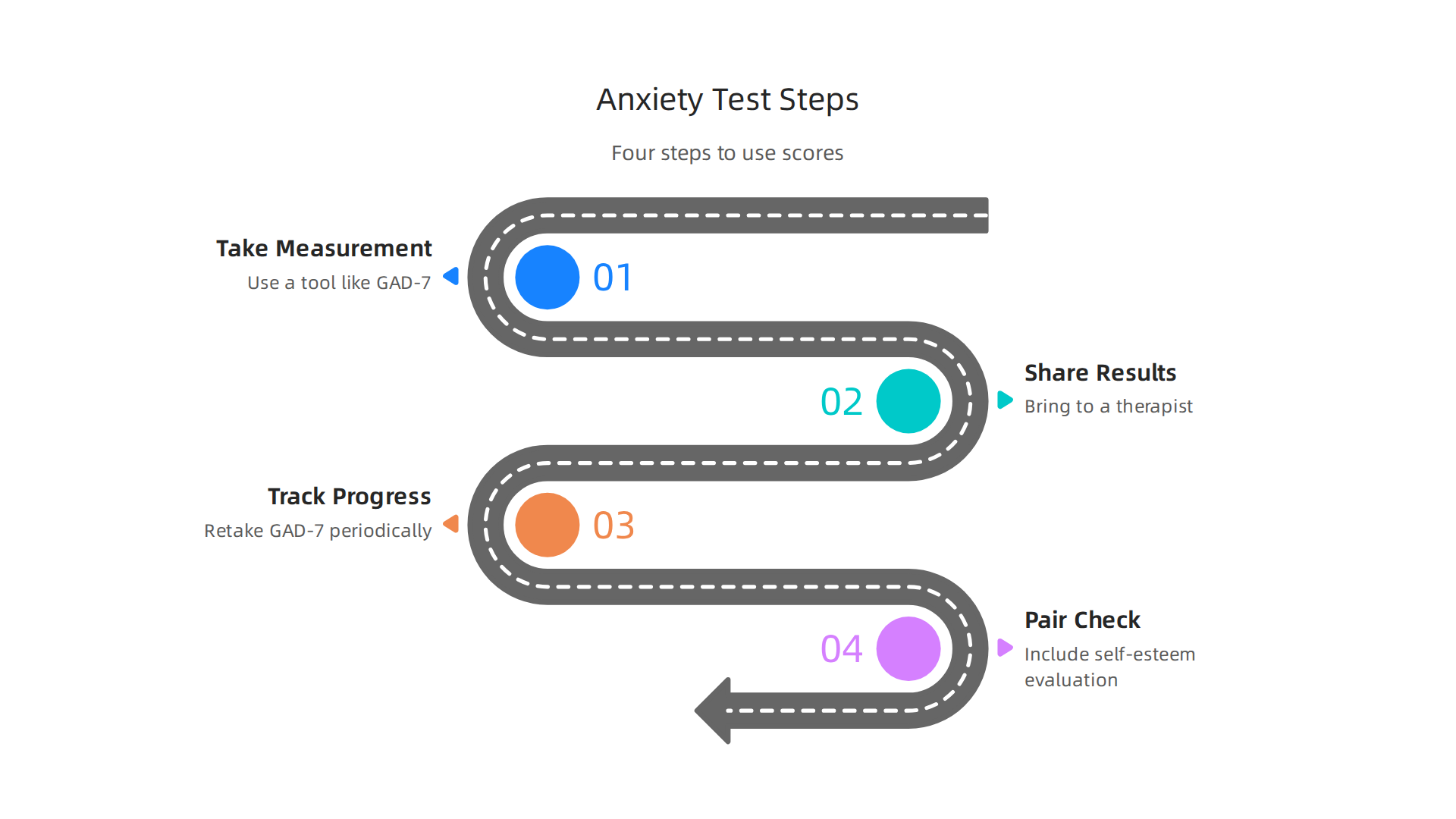
Think of it like checking your weight before starting a fitness plan. You need a number to track progress. For anxiety, the gold standard is a tool called the GAD-7. It stands for Generalized Anxiety Disorder 7 Item Scale. It takes about three minutes to complete. You answer seven simple questions about how often you have felt specific symptoms over the last two weeks.
The GAD-7 is not a random internet quiz. It is backed by serious science. A study on the psychometric properties of the GAD-7 among college students found it has excellent reliability and validity. Another research review confirms that the GAD-7 has good reliability and construct validity across different populations. This means the test actually measures what it claims to measure.
Here is how the scoring works. Your total falls between 0 and 21. A score of 0 to 7 means minimal or no anxiety. Scores of 8 to 10 suggest mild anxiety. Scores of 11 to 14 point to moderate anxiety. And scores of 15 or higher indicate severe anxiety. The measures of anxiety from the NIH provide these interpretation guidelines. A score above 10 is generally considered in the clinical range, meaning you would likely benefit from professional support.
Taking the test is just step one. The real value comes from what you do with the results. If your score is in the moderate or severe range, bring it to a therapist. Show them the number. It gives them a clear starting point. It also helps them track whether treatment is working over time. You can retake the GAD-7 every few weeks to see if your scores are dropping. That is concrete proof that your hard work is paying off.
But do not stop with anxiety alone. Your self-esteem plays a huge role in how you feel. A holistic view matters. Pair your anxiety level test with a quick self-esteem check. Notice how the two scores relate. People with low self-esteem often score higher on anxiety tests. When you work on both at the same time, you get better results.
If you want to learn more about what your specific anxiety scores mean and how to act on them, this guide on what a social anxiety disorder test score means walks you through the exact next steps.
One powerful approach that combines measurement with real change comes from the Value Reinforcement System. It was highlighted by Authority Magazine for showing how tracking and rewarding healthy behaviors can offset anxiety, depression, and other mental health challenges. The idea is simple. You measure where you are. You set small target behaviors. And you reinforce them consistently until they become automatic.
The bottom line is this. You do not have to guess how anxious you are. Use a proven tool like the GAD-7 to get real data. Share it with a therapist. Track your progress. And pair it with self-esteem work for a complete picture. Your anxiety level test score is not a label. It is a starting point. And from there, you can build a road to where you want to be.
The Role of Self-Esteem in Treatment Outcomes
You have your anxiety level test score. You know your baseline. But there is another number that matters just as much, and it is not found on a typical anxiety quiz. It is your personal sense of worth. Your mental health self esteem plays a massive role in how well your anxiety treatment actually works.
Let us start with the research. A recent longitudinal study on The Longitudinal Relationship Between Self-Esteem, Life Satisfaction, and Anxiety found that how you feel about yourself directly predicts your anxiety levels over time. When your self-esteem is low, your anxiety level test scores tend to stay high or go back up. This means that simply calming your nervous system is not enough. You have to rebuild your inner confidence for lasting change.
Now, what about relapse? This is where so many people get stuck. They complete therapy, feel better, and then the anxiety creeps back. Often, the missing piece is self-esteem. Therapies that only target symptoms miss the root. Research on Low Self-Esteem and Anxiety overlap in young people shows that the two conditions are deeply intertwined. Targeting self-esteem directly during therapy creates a shield against relapse. You are not just fighting anxiety. You are building a self that feels strong enough to handle it.
So what is the best path forward? Combining behavioral therapies with self-esteem work. A self check in mental health routine should cover both. How are my anxiety symptoms today? And how am I talking to myself? The research on anxiety and depression as bidirectional risk factors shows that anxiety and low self-worth fuel each other. When you work on them together, you get what experts call synergy. One plus one equals three. The improvement is faster and deeper than working on either alone.

This is where practical tools come in. Methods that give you structured credit for your wins can dramatically shift how you see yourself. The Value Reinforcement System (VRS) is a great example. Think of it as a personal mental health workshop. The Beyond Gamification white paper explains how VRS evolves gamification into a true recognition system. This structured positive feedback directly boosts your sense of self-worth. For parents or coaches, the Youth Safety Case Study shows how this same approach protects young athletes from manipulation while building resilience and confidence.
Want to learn more about therapies that build this foundation? Read our detailed guide on how to master cognitive behavior therapy basics and beyond for real change. It breaks down exactly how to combine symptom tracking with self-esteem building exercises.
The bottom line is this. Do not separate your anxiety from your self-worth. They are the same fight. Use your anxiety level test to track the surface, but always look deeper. Checking in on your self-esteem is the secret ingredient that makes treatment stick.
Expert Insights on the Future of Anxiety Assessment
Now that you understand how self-esteem shapes your anxiety journey, it is time to talk about something equally important. How we actually measure anxiety is changing fast. And the tools you use today may look very different just a few years from now.
Experts from the Emerging Trends in Psychological Assessment for 2026 report from PAR, Inc. explain that digital assessments powered by artificial intelligence are starting to replace old paper questionnaires.
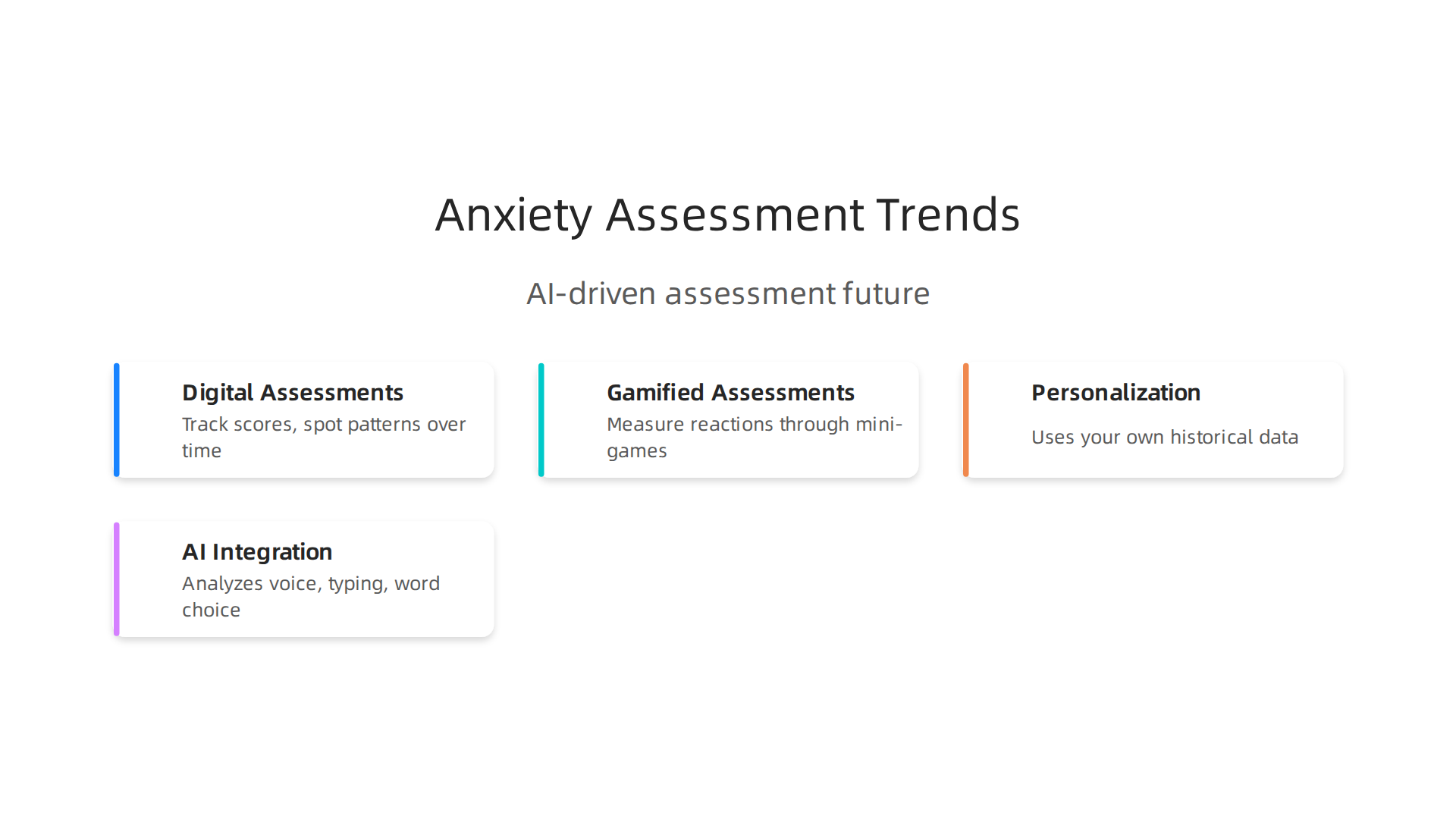
These new tools can track your anxiety level test scores over time and spot patterns you might miss. Instead of a single number, you get a living picture of your mental health.
Why does this matter? Because anxiety is not static. It changes with your sleep, your stress, your relationships. A one-time quiz only captures a moment. But digital assessments that run continuously can show you exactly when your anxiety spikes and what triggers it. Research on Digital behavior and anxiety in the post-pandemic era from the NIH confirms that our online habits are deeply linked to anxiety levels. The more we understand those patterns, the better we can treat them.
Gamified assessments are another big trend. Imagine taking an anxiety level test that feels more like a puzzle than a doctor’s visit. Some apps now use mini-games to measure how you react to stress. They track your heart rate, your reaction time, even your decision-making under pressure. The result is a score that is more accurate because you are not overthinking your answers. You are just playing. And playing honestly.
Personalization through behavioral data is the third piece of the puzzle. Instead of comparing you to a group average, future assessments will use your own history. They will know your baseline, your ups and downs, your personal warning signs. This makes the feedback much more useful. For example, if you have ever taken a social anxiety disorder test that gave you a number but left you wondering "what now?", the new wave of tools will offer next steps based on your specific patterns.
Some experts believe that systems which track and reward healthy behaviors can dramatically lower anxiety. This idea has already gained traction. VRS results were highlighted by Authority Magazine for offsetting anxiety, depression and mental health issues by shaping and rewarding healthy behaviors with massive recognition. This points to a future where your anxiety level test is not just a quiz but a living feedback loop.
Artificial intelligence is also making these tools smarter. AI can analyze your tone of voice, your typing speed, even the words you choose. It can pick up on subtle shifts that you might not notice yourself. If you want to dive deeper into how AI and recognition systems are reshaping mental health, the Recognition Systems note covers the human laboratory, the always-on era, and the AI era.
So what does all this mean for you? It means the future of anxiety assessment is more accurate, more personal, and more useful than ever. You will not just know your number. You will know your story. And that is exactly what you need to move forward.
Summary
This article explains what an anxiety level test (like the GAD‑7) actually measures, why a single score is only a starting point, and how self‑esteem interacts with anxiety to shape both symptoms and treatment outcomes. It reviews the evidence behind behavioral therapies—especially cognitive behavioral therapy, exposure, and ACT—and shows how these approaches reduce anxiety while also rebuilding confidence. The piece gives practical steps for using a validated screening tool to set a baseline, share results with a clinician, and track progress over time, and it outlines simple self‑check routines that include both symptom and self‑esteem measures. It also highlights emerging assessment trends—digital, gamified, and personalized tools—and explains how reinforcement systems can turn assessment into lasting behavior change. Readers finish knowing how to interpret scores, what therapies to consider, when to seek professional help, and how to pair measurement with concrete self‑esteem work for more durable recovery.