
Mental Health Counselor Jobs in 2026 Offer Strong Demand and High Pay
· 21 min read

Introduction
The mental health counseling field is growing fast. Actually, it is growing much faster than most other careers. If you are exploring mental health counselor jobs right now, there has never been a better time to start.
According to mental health counselor employment data from the BLS, employment for substance abuse, behavioral disorder, and mental health counselors is projected to grow 17% from 2024 to 2034. That rate is much faster than the average for all jobs. The BLS also expects about 48,300 openings each year over that decade as new roles are created and existing counselors retire.
But here is the truth. Even with strong demand, planning your career path can feel overwhelming. Licensure rules vary by state. Specializations keep multiplying. And the job market changes fast. Many professionals struggle to keep up with everything in 2026.
This guide is here to help. We provide practical steps for anyone at any career stage.

Whether you are new to mental health jobs or looking to advance, you will find useful advice on mental health counselor certification, job searching, and career growth. For a closer look at what counseling involves, check out our article on care counseling.
We also cover emerging areas like health informatics and medical application in mental health settings. These fields are creating new roles for counselors who want to combine clinical skills with technology and data.
Innovative approaches are reshaping how mental health care is delivered. For instance, Authority Magazine recently highlighted how recognition-based systems can support mental wellness by rewarding healthy behaviors.
The goal of this guide is simple. Help you plan your professional growth with confidence in 2026.
Let us dive into what you need to know.
The Evolving Landscape of Mental Health Counselor Jobs in 2026
The mental health counseling field has changed a lot in just a few years. Understanding these shifts helps you make smart career choices. So what is really happening with mental health counselor jobs in 2026?
Demand keeps growing faster than the supply of qualified professionals. According to the latest national employment trends for mental health counselors from O*NET, the field employed about 483,500 people in 2024. By 2034, that number is expected to reach 564,600. That is 17% growth in just one decade. And about 48,300 new job openings are projected each year as existing counselors retire or move on.
Three big trends are driving this growth.
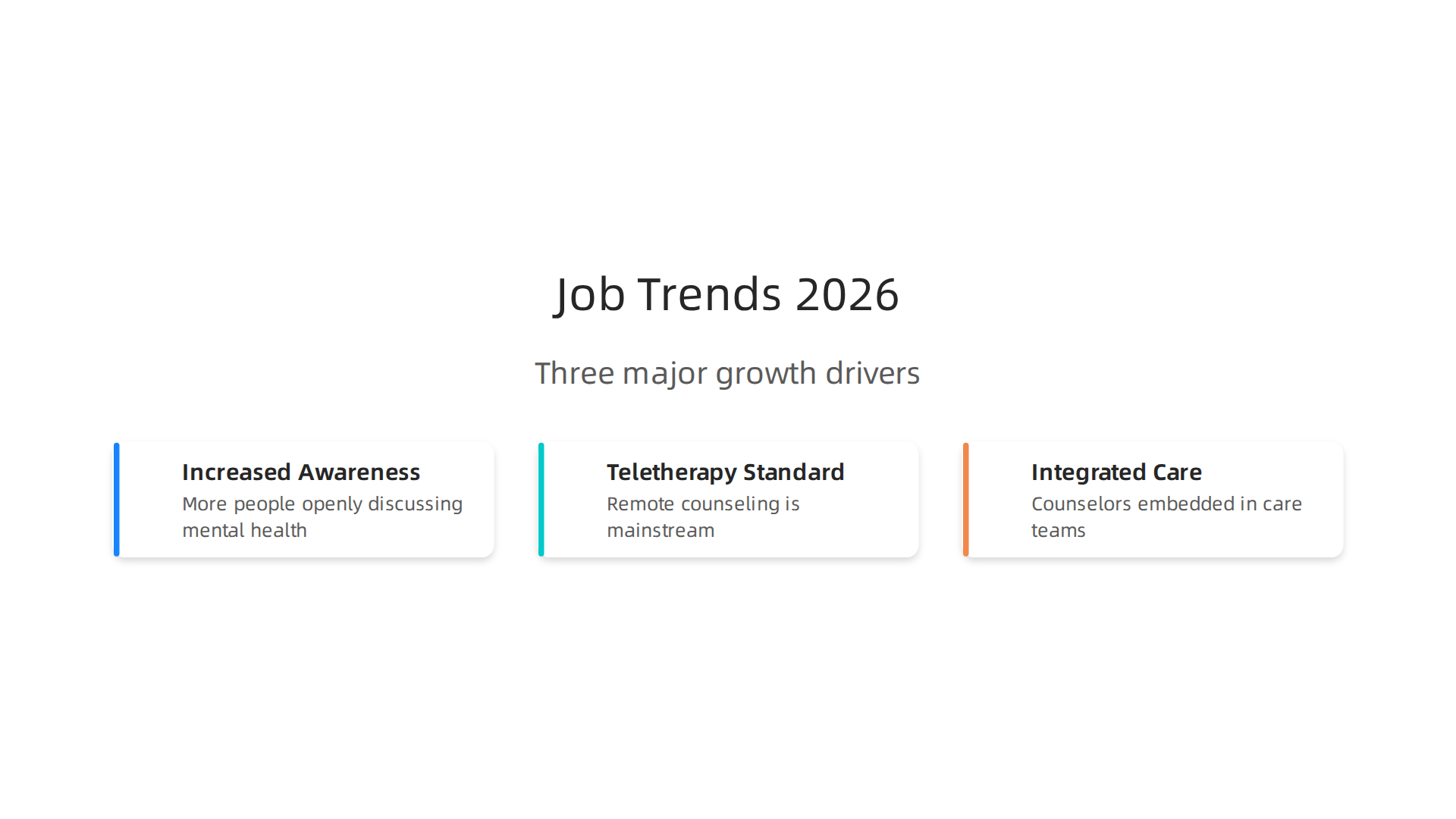
Increased awareness and less stigma. More people are openly talking about their mental health. Surveys show that a growing number of individuals of all ages now say they would seek help for stress, anxiety, or depression. This rising openness to therapy directly creates more demand for counselors.
Teletherapy has become standard. Remote counseling is no longer a niche option. It is a mainstream delivery method.

This means mental health counselor jobs now exist in more settings than ever before. You can work with clients across your state without requiring them to drive to an office. That expands access and increases the need for licensed professionals.
Integration of mental health into primary care. More hospitals, clinics, and doctor offices are embedding counselors directly into their care teams. This creates new roles and changes how mental health services are delivered.
The workforce shortage is real. Many communities cannot find enough counselors to meet demand. Clients wait longer for appointments, and current clinicians carry heavy caseloads. According to a detailed article on the growing demand for mental health therapists from Husson University, national organizations warn that tens of thousands more counselors are needed just to keep up.
This shortage works in your favor if you are entering the field. Qualified counselors have strong leverage in the job market.
Here is the thing. These trends are not just about more jobs. They signal a shift in what employers want. Skills like comfort with telehealth platforms, cultural competency, and understanding of integrated care models are becoming essential. If you have experience in health informatics or medical application in mental health settings, you will stand out even more.
Keeping up with these changes can feel like a lot. But you don’t have to figure it out alone. Check out our guide on how to master cognitive behavior therapy basics to strengthen your clinical skills and stay competitive in this evolving field.
The bottom line? The landscape for mental health counselor jobs in 2026 is full of opportunity. The key is understanding where the field is heading and positioning yourself for the roles that are growing fastest.
Educational Pathways: Degrees, Certifications, and Licensure
So you see the opportunity. Now comes the practical part. How do you actually get qualified for mental health counselor jobs in 2026?
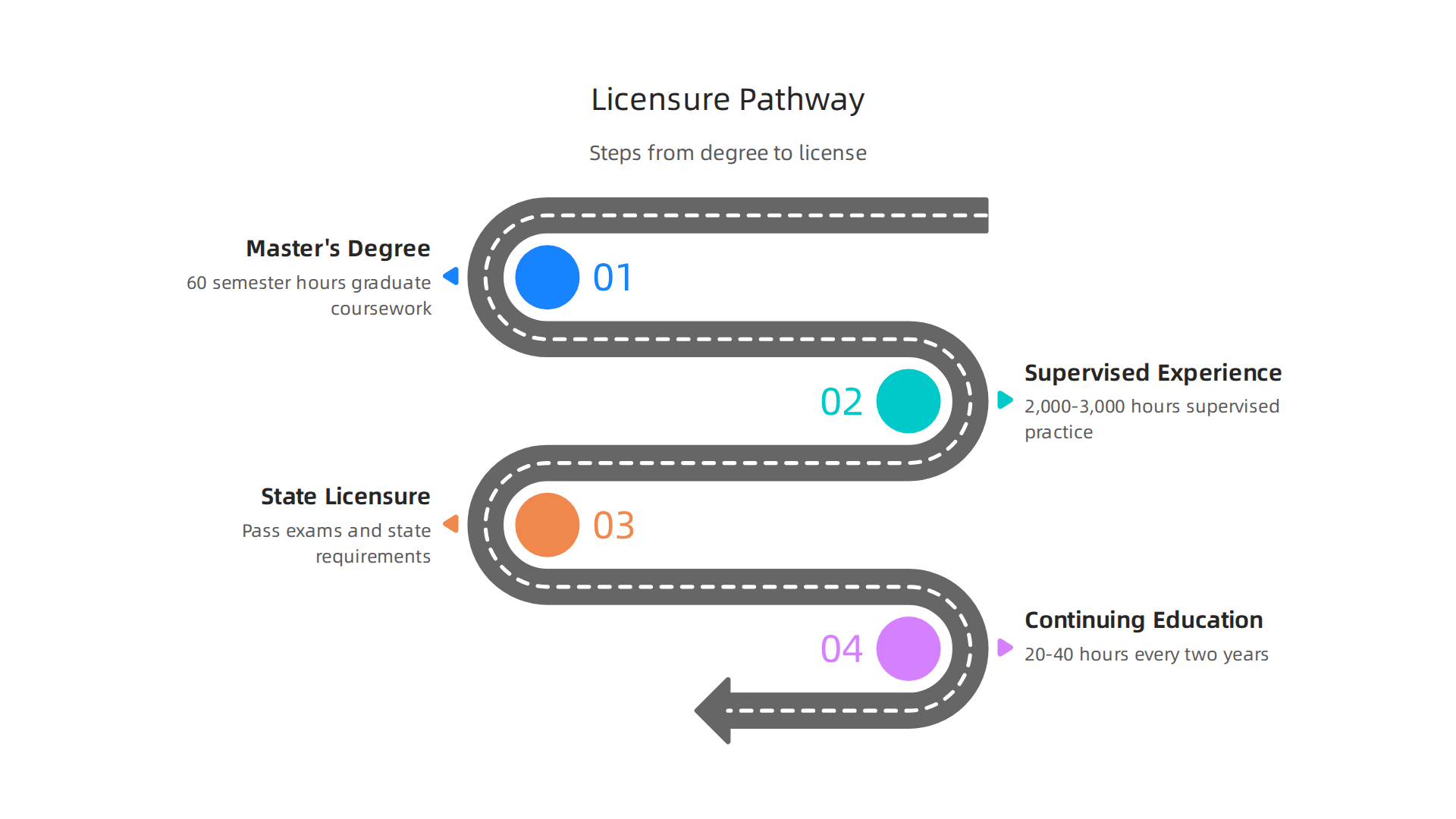
The standard entry point for most clinical roles is a master’s degree. Almost every state requires at least 60 semester hours of graduate coursework in counseling or a closely related field.

According to the official NYS Mental Health Counseling license requirements, you need a master’s or doctoral degree from a program that is either registered by the state or accredited by CACREP. This includes a supervised internship of at least 600 clock hours.
After your degree comes supervised clinical experience. This is where you practice under the guidance of a licensed professional. Most states require between 2,000 and 3,000 hours of supervised work. For example, Florida now requires a master’s degree from a CACREP or MPCAC accredited program plus 1,500 hours of clinical experience. North Carolina offers three levels of licensure, starting with the LCMHC which needs 3,000 supervised hours.
Here is the thing. Licensure requirements vary quite a bit from state to state. One helpful resource is the updated state-by-state comparison of mental health licensing requirements from HCR Network. It shows that while many states follow a similar pattern, some like California add extra steps. California requires you to register as an associate professional clinical counselor first, accumulate 3,000 supervised hours, then pass both a state law exam and the national NCMHCE exam.
This variation matters for your job search. If you plan to work across state lines or move after licensure, you need to plan ahead. Some states have reciprocity agreements. Others do not.
Once you are licensed, the learning never stops. Continuing education keeps your skills fresh and your license active. Most states require 20 to 40 hours of continuing education every two years.
Beyond the basic license, specialty certifications can give you an edge. The National Board for Certified Counselors offers designations like Certified Clinical Mental Health Counselor and Master Addictions Counselor. As noted in the counseling certification requirements guide, even if your state does not require these credentials, earning them shows employers you meet national standards.
If you are thinking about how to build your clinical skills while navigating the education path, reading about care counseling basics can give you a clearer picture of what the work actually involves day to day.
The road to becoming a licensed counselor takes time. But each step from degree to supervised hours to exam is designed to prepare you for the real work of helping people.
And in 2026, that preparation is more valuable than ever.
Specializations Within Mental Health Counseling: Finding Your Niche
Once you understand the path to licensure, the next big decision is what kind of counselor you want to be. Mental health counseling is not a one-size-fits-all career. Your daily work, the people you help, and even your paycheck can look very different depending on your specialization.
Common Specializations
Some of the most popular niches include child and adolescent counseling, trauma therapy, addiction counseling, marriage and family therapy, and geriatric counseling.
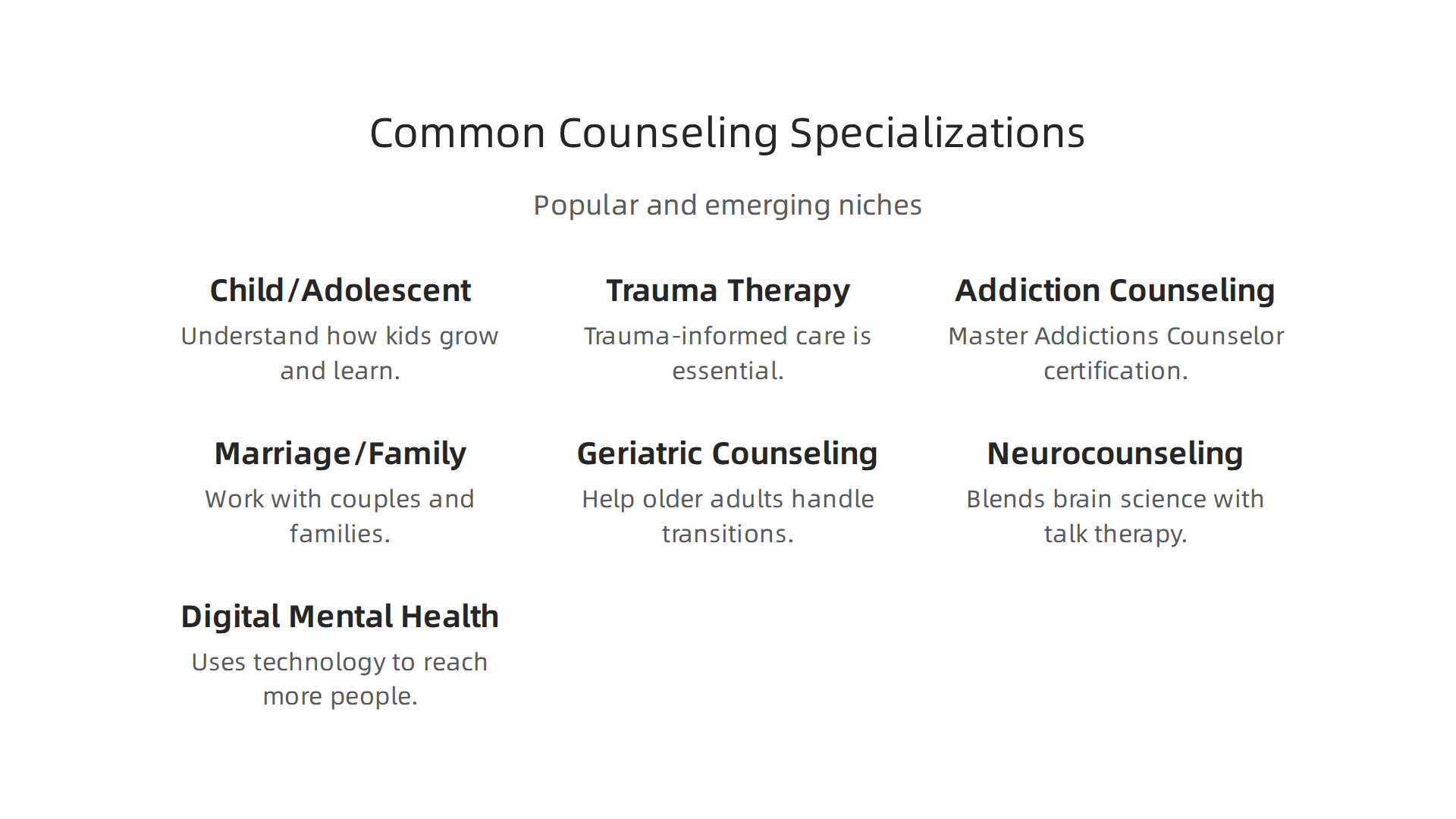
Each comes with its own training and certification needs.
For example, if you want to work with couples and families, you might focus on marriage and family therapy. In states like California, the requirements for marriage and family therapists include specific coursework in therapy theories and treatment models. You can see the full details in the counseling licensure requirements in California.
If addiction work is your calling, consider earning the Master Addictions Counselor certification. This mental health counselor certification shows employers you have advanced skills for substance use treatment.
For trauma survivors, a focus on trauma-informed care is essential. Understanding how trauma affects the brain and body helps you provide better support. You can learn more about how a therapist for trauma bonding helps clients heal from difficult experiences.
Child and adolescent counseling requires a deep understanding of how kids grow and learn. School counseling is a related path with its own national certification.
Geriatric counseling is growing fast as the population ages. Counselors in this niche help older adults handle life transitions, grief, and chronic health problems.
Emerging Specializations
The field is changing in exciting ways. Two areas gaining steam in 2026 are neurocounseling and digital mental health, which touches on health informatics and new medical application tools.
Neurocounseling blends brain science with traditional talk therapy. It helps clients understand how their brain works and how to rewire unhelpful patterns.
Digital mental health uses technology to reach more people. Some programs now use value reinforcement systems to track and reward healthy behaviors. This approach has shown strong results for offsetting anxiety, depression, and other mental health issues by shaping sustainable habits. These findings were covered in Authority Magazine for their impact on mental health outcomes.
Matching Your Niche to Your Personality
Your ideal specialization also depends on what kind of work you enjoy. Do you prefer long-term relationships with clients? Marriage and family or geriatric counseling might fit. Want to see faster progress? Addiction or trauma counseling often uses more structured, short-term approaches.
Think about the setting too. Child counselors often work in schools or private practice. Addiction counselors work in rehab centers or community clinics. Geriatric counselors may work in hospitals or assisted living facilities.
No matter which path you choose, specializing gives you a clear direction and helps you stand out in the mental health counselor jobs market. Pick a niche that matches your passion, and the rest gets easier.
Emerging Career Paths: Teletherapy, Digital Health, and Integrative Care
Once you have settled on a niche, the next smart move is to look at where mental health counseling is headed. Three big shifts are creating new kinds of mental health counselor jobs that barely existed a decade ago. If you want a career that stays relevant and grows with the times, these paths deserve your attention.
Teletherapy Is Here to Stay
The pandemic pushed therapy online, but the change stuck. In 2026, telehealth is a permanent part of how mental health care works. Behavioral health now makes up 58% of all telehealth visits in the U.S., according to the latest 2026 mental health practice statistics. That number is not dropping.
What does this mean for your career? Plenty of mental health counselor jobs now exist fully online. You can work from home, set your own hours, and help clients who live hundreds of miles away. Teletherapy also means lower overhead costs. You do not need to rent an office or commute. Many employers now offer virtual‑only positions, and private practice therapists can add a telehealth option to reach more people.
The skills you need are slightly different. You have to be comfortable with video platforms, know how to build rapport through a screen, and understand the rules for practicing across state lines. Licensing laws are changing, but many counselors start by getting licensed in their home state and then adding compact memberships.
Digital Health and Mental Health Apps
Startups building mental health apps are another booming source of mental health counselor jobs. These companies need licensed clinicians to design content, review clinical protocols, and provide oversight. They also hire counselors for direct patient support through chat‑based therapy or text coaching.
This is where the fields of health informatics and medical application design come in. Counselors with an interest in technology can help shape how digital tools work. You might consult on how an app tracks mood, how it responds to crisis signals, or how it integrates with a patient’s electronic health record. Your clinical knowledge is valuable here because app developers often lack real‑world therapy experience.
Some digital health companies also use gamification to keep users engaged. If you understand the behavioral science behind games and rewards, you can guide the design of features that actually change habits. For a deeper look at how these systems work, you can read the science of gamification white paper. It formalizes the behavioral mechanisms behind reward‑based interventions, which is exactly the kind of knowledge digital health employers want.
Integrative Care Models
The third emerging path is integrative care, where mental health counselors work side by side with primary care doctors, nurses, and specialists. This model treats the whole person rather than separating physical and mental health.
In practice, you might work in a clinic where a patient sees a doctor for high blood pressure and then steps into the next room to talk with you about the stress that is making it worse. This close collaboration leads to better outcomes for both conditions.
Integrative care jobs often pay well because they require you to communicate across disciplines. You need to understand basic medical terms and be comfortable reading a patient’s chart for physical health notes. Some programs now offer dual training in counseling and health informatics to prepare for exactly these roles.
Skills That Transfer Across All Three Paths
Regardless of which path you choose, a few skills will help you succeed. First, you need to be flexible. Technology changes fast, and the platforms you use today may look different in two years. Second, your clinical judgment matters more than ever. Apps and digital tools are only as good as the human guidance behind them. Third, you need to know how to market yourself. Many of these new mental health counselor jobs are in startups or private practice, where you have to show your value clearly.
If you want to build a foundation that works across all these settings, start with strong core training. Learning the cognitive behavior therapy basics gives you a versatile toolkit that applies whether you are seeing clients in person, over video, or through an app.
The field is opening up in ways that were hard to imagine even a few years ago. By aiming toward teletherapy, digital health, or integrative care, you position yourself at the front of the pack. And that is exactly where mental health counselor jobs are growing fastest.
Building Your Professional Brand: Networking, Continuing Education, and Research
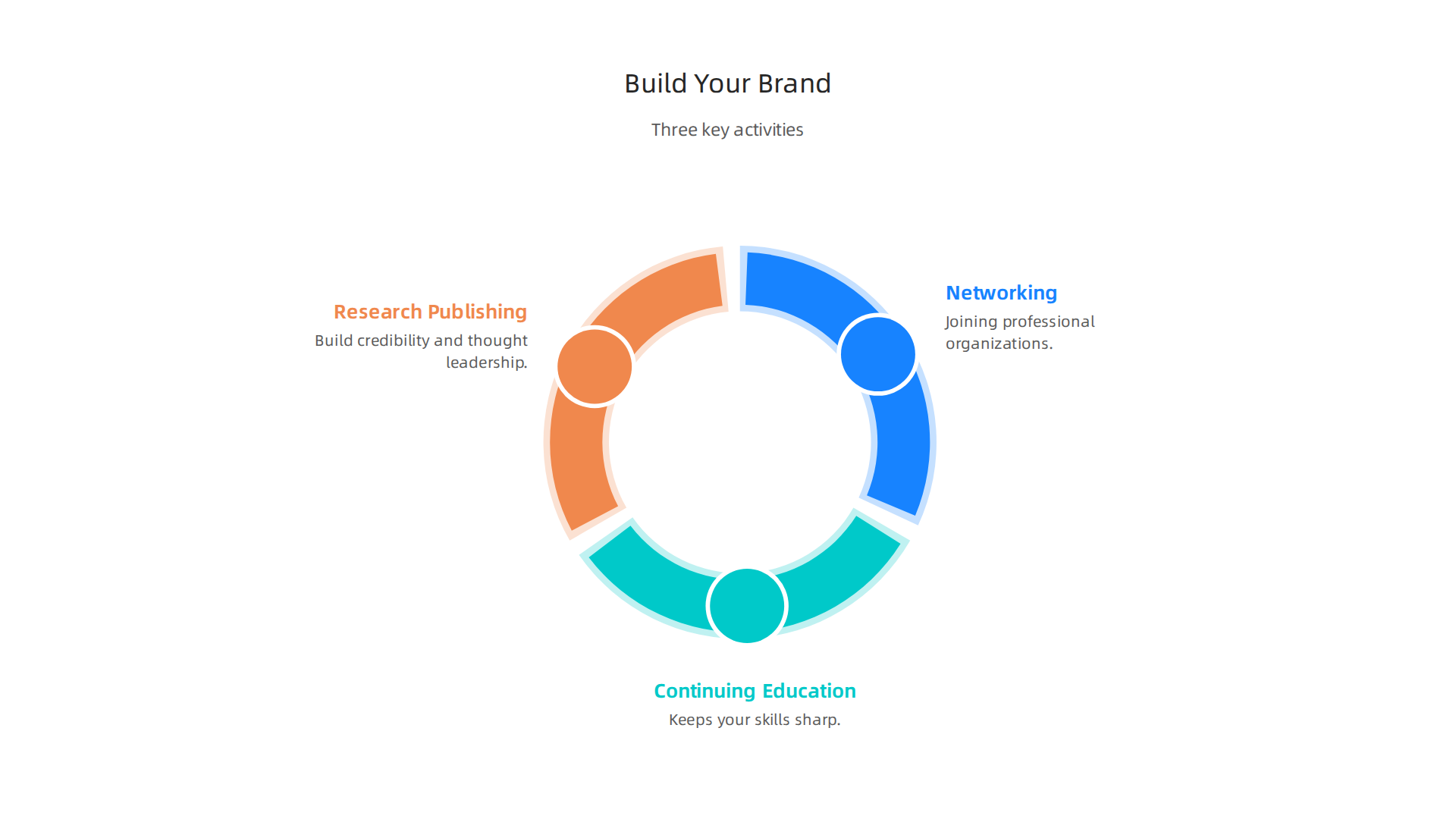
Once you have picked a direction and built your core clinical skills, the next step is to make sure people know you exist. A strong professional brand helps you stand out among other mental health counselor jobs candidates and opens doors to better opportunities. Three activities make the biggest difference: networking, continuing education, and research.
Networking Opens Doors
Joining professional organizations is one of the simplest ways to meet people who can help your career.

Groups like the American Counseling Association or the American Mental Health Counselors Association host conferences where you can learn from experts and connect with potential employers. These events often have job boards and mentorship programs that are not advertised anywhere else.
Conferences also give you a chance to practice talking about your work. When you share what you do and what you are learning, people remember you. That can lead to referrals, collaboration offers, or even a direct job lead. If you want to know how clients find and choose their therapists, learning to read therapist reviews can also teach you what makes a professional stand out in a crowded field.
Continuing Education Keeps You Relevant
Every state requires licensed counselors to complete continuing education units, or CEUs, to renew their license. For example, New York requires each Licensed Mental Health Counselor to complete 36 hours of approved continuing education every three years, as outlined in the New York continuing education requirements for mental health counselors. Other states have similar rules, often with a minimum number of ethics hours.
But CEUs are more than just a box to check. They keep your skills sharp and help you learn about new treatments, research findings, and legal updates. Many courses are now available online, so you can fit them into your schedule easily. Topics like trauma-informed care, cultural competency, and emerging therapies will make you more valuable to employers and clients alike. The best part? You can often choose courses that align with your niche, deepening your expertise at the same time.
Research and Publishing Build Credibility
When you engage in research or publish your own writing, you show the field that you are a thinker and a leader. You do not need a PhD to do this. You can start by writing a blog post about a case study or contributing a short article to a professional newsletter. Presenting a poster at a conference also counts.
If you conduct meaningful work and get noticed, your reach can grow fast. For example, one study on virtual reward systems that offset anxiety and depression was featured in Authority Magazine. That kind of exposure builds instant credibility and can lead to speaking invitations, consulting gigs, or more visible mental health counselor jobs.
Even small efforts add up. Every article, presentation, or research project you complete becomes part of your professional story. Over time, that story makes you the person others think of when they need an expert opinion or a new hire.
The Role of Technology and Innovation in Counseling Careers
Technology is changing how counselors work every single day. If you want to grow in the field of mental health counselor jobs, understanding these tools is no longer optional. They can help you reach more people, improve outcomes, and work smarter.
Telehealth is the New Normal
Virtual therapy is here to stay. By 2026, mental health conditions account for nearly 64% of all telehealth diagnostic categories, according to the 2026 telehealth stats for mental health. That is a massive shift from just a few years ago.
For you as a counselor, this means you can work with clients who live far away. People in rural areas, those with busy schedules, or folks who just prefer staying home can now get care. Telehealth also reduces no-show rates, which helps you fill your schedule and help more people.
But here is the thing. You need to learn how to deliver therapy through a screen. Eye contact, body language, and pacing feel different online. Taking a course on telehealth best practices is a smart move for anyone serious about mental health counselor jobs in 2026.
AI and Digital Therapeutics Are Changing the Game
Artificial intelligence is not just a buzzword. It is already helping counselors triage clients, analyze patient data, and even suggest treatment plans. The 2026 mental health trends report shows that AI tools are helping providers deepen insights and streamline care.
Digital therapeutics are another big piece. These are FDA-authorized apps and programs that deliver real therapy techniques through a phone or computer. For example, a client might use a digital tool to practice cognitive behavioral therapy skills between sessions. You, as the counselor, oversee their progress and adjust the plan.
This blend of technology and human care is sometimes called hybrid care. Over 80% of patients and providers prefer this mix of in-person and virtual visits, as shared in the telehealth market outlook for 2026. That means you get flexibility while still building real relationships.
Gamification and the Science Behind It
Gamification might sound like a silly word, but it has serious science behind it. Some therapy apps now use game-like rewards, point systems, and progress tracking to keep clients engaged. When done right, this approach helps people stick with their treatment longer.
Understanding the behavioral mechanism behind gamification is important for ethical use. You need to know why it works, not just that it works. That is where deep study comes in handy. For example, the peer white paper The Science of Gamification dives into how these reward systems actually change behavior.
Ethics and Implementation Matter
With all this new tech comes responsibility. You must protect client privacy, understand the limits of AI, and never replace your clinical judgment with a tool. Policies from CMS now reimburse clinicians for overseeing digital mental health treatments, as outlined in the 2026 telehealth policy changes for mental health billing. But that also means you need to know the rules.
If you want to stay ahead, start exploring how tools like AI chatbots, mobile apps, and digital therapeutics fit into your practice. Understanding concepts like cognitive behavioral therapy basics will help you see how these tools connect to proven methods. And as you grow, remember that technology is a tool, not a replacement for your human skills. The best counselors in 2026 will be the ones who blend both.
Salary Trends, Job Outlook, and Geographic Considerations
All that technology talk is exciting, but you also need to know what you can earn. If you are thinking about mental health counselor jobs, the numbers look good. Let us break down the salary, growth, and where the best opportunities are.
What Can You Expect to Earn?
The median annual wage for mental health counselors is $59,190, according to the Bureau of Labor Statistics. That number includes substance abuse and behavioral disorder counselors too. But salaries go up and down a lot based on where you work and your experience level.
For example, counselors just starting out often earn around $41,000. With 10 to 19 years under your belt, that jumps to $54,000. And if you stay in the field for 20 years or more, you can make about $58,000 on average. These numbers come from the LMHC salary guide for 2026 which breaks down pay by state and city.
Your work setting matters too. Counselors in hospitals and government agencies tend to earn more than those in residential facilities. Private practice can be even more profitable if you build a strong client base.
Where the Money Is
Location is a huge factor. Some states pay much more than others. Alaska tops the list with an average annual wage over $77,000. California, New Jersey, and Connecticut also pay well above the national median. On the flip side, states in the South and Midwest often pay less, though the cost of living is lower too.
Cities also make a difference. San Francisco, Anchorage, and New York City are some of the highest paying metro areas for mental health counselors.
Job Growth Is Outstanding
The demand for counselors is rising fast. Employment is projected to grow 17% from 2024 to 2034, much faster than the average for all jobs. That means about 48,300 new openings each year across the country. The BLS job outlook for mental health counselors confirms this strong growth.
Why the boom? More people are talking about mental health and seeking help. Stigma is dropping. And there is a shortage of providers in many areas. Rural communities and underserved urban neighborhoods are especially hungry for qualified counselors. Telehealth also opens doors to reach clients anywhere, which can boost your job options no matter where you live.
If you want to learn more about how increased awareness is shaping the field, check out this mental health awareness month 2026 guide. It shows how campaigns and research are driving demand.
Making Smart Moves
Understanding these trends helps you plan. If you are willing to relocate to a high-paying state or work in an underserved area, you can earn more and have a bigger impact. Telehealth roles are growing fast too, so you are not stuck in one place.
In short, mental health counselor jobs offer strong pay potential, excellent growth, and flexibility. The key is knowing where to focus your efforts.
Summary
This guide maps the modern landscape of mental health counselor jobs in 2026, explaining why demand is high and how to plan a successful career. It covers workforce trends—like rapid job growth, teletherapy becoming standard, and integration of behavioral health into primary care—and shows what employers now value, including telehealth skills, cultural competency, and informatics. You’ll get practical guidance on education (typical master’s programs, supervised hours, and state licensure variability), specialty options (trauma, addiction, child, geriatric, neurocounseling, digital health), and emerging roles in apps, AI, and integrative care. The article also explains how to build a professional brand through networking, CEUs, and publishing, plus the tech and ethical know‑how required to use digital therapeutics responsibly. Finally, it breaks down salary expectations, geographic pay differences, and where to focus your job search to maximize both impact and earnings.