Social Anxiety Disorder Treatment CBT Works for OCD and Depression Too
· 24 min read

Introduction
If you searched for "social anxiety disorder treatment cbt" today, you are not alone. It is one of the most searched mental health topics.

And it makes sense. You want clear answers on what actually works. You might also be curious about cognitive behavioral therapy for OCD, effective treatment for anxiety and depression, or even the humanistic therapy psychology definition. The internet throws all of it at you at once.
It is overwhelming. But here is the thing. Social anxiety and OCD are very common. They often overlap with each other and with depression. That is why you need a treatment approach that covers all the bases.
Cognitive behavioral therapy, or CBT, is a structured, time limited method. It helps you spot the links between your thoughts, emotions, and behaviors. According to research, CBT is an effective, gold standard treatment for anxiety and stress related disorders. The Cleveland Clinic adds that CBT helps you change unhelpful patterns of thinking.
This article cuts through the noise. We give you a straightforward breakdown of how CBT works for social anxiety, OCD, and depression. Our mission is to empower you with actionable, trustworthy knowledge so you can make informed decisions about your mental health.
If you want to keep learning without the mental load, subscribe for expert reviewed news and practical mental health tips delivered straight to you.
What Is CBT and How Does It Work for Anxiety and OCD?
You walk into a room full of strangers. Your heart races. Your mind screams, "They are all judging you." So you make an excuse and leave. That loop of scary thoughts and quick escapes is exactly what cognitive behavioral therapy, or CBT, targets.
CBT is a structured, goal-oriented form of talk therapy. It zeroes in on the connection between what you think, how you feel, and what you do. According to the Sage Journal of Therapeutics, CBT is a directive, time-limited, structured approach that explores these links. It is not about vague conversation. It is a practical, hands-on toolkit.
For anxiety, CBT attacks two main problems. First, the cognitive side. Your brain jumps to catastrophic appraisals. You think one awkward pause means everyone hates you. Or a small mistake at work will get you fired. The Cleveland Clinic explains that CBT is based on the principle that psychological issues often come from unhelpful thinking patterns. Second, the behavioral side. You avoid what scares you. But avoidance actually feeds the fear. Research published in the National Library of Medicine shows that CBT helps you eliminate avoidant behaviors that keep you stuck. Instead of running away, you learn to face situations step by step. This breaks the cycle.
CBT is considered a gold-standard treatment for anxiety and stress-related disorders. It works for OCD too. In cognitive-behavioral therapy for OCD, you learn to spot the intrusive thought, stop the compulsion, and break the loop. The same core principles apply whether you have social anxiety, OCD, or both. These conditions often overlap, which is why CBT is so useful for many people at once.
Here is the most empowering part. CBT does not make you dependent on a therapist forever. A 2025 article from the Society for the Advancement of Psychotherapy confirms that CBT teaches you skills you can use on your own. You learn to challenge distorted thinking. You practice new behaviors. And over time, you build long-term resilience.
Whether you are exploring social anxiety disorder treatment CBT, or looking into treatment for anxiety and depression, the core ideas are the same. Your thoughts shape your feelings. Your actions shape your thoughts. And you have more control than you think.
If this makes sense so far and you want to keep learning, Contact Us to subscribe for expert-reviewed news, summaries, and practical tips to support your mental wellbeing.
CBT for Social Anxiety Disorder: What the Research Shows
Picture this. You are at a party. Someone says hello. Your mind goes blank. You feel your face turn red. You mumble something and walk away. Later that night, you replay that moment over and over. "Why did I say that? They must think I am so weird."
This cycle is classic social anxiety disorder. And the research on CBT for this condition is strong.
Here is how social anxiety keeps itself alive. First, you use safety behaviors. These are small actions you think protect you. Maybe you avoid eye contact. Maybe you rehearse what you will say. Maybe you hold your drink tight so your hands do not shake. A 2021 article from Healthline explains that CBT helps reduce this self-consciousness and avoidance.
Second, you fall into post-event rumination. You replay the social moment in your head like a broken record. But CBT directly targets both of these problems.
The evidence is clear. A 2022 study published by Wiley found that CBT used in real-world clinical settings significantly reduces social anxiety symptoms. The gains also stick around. Research from the National Social Anxiety Center shows that long-term outcomes are positive, with some studies showing further improvement even after treatment ends. And a chapter from Cambridge University Press reports that for social anxiety, CBT has a large effect size. In one study, 86% of patients were classified as recovered after treatment. That is a huge number.
Group CBT is especially effective for social anxiety. Why? Because the group itself becomes the practice ground. You get real social exposure in a safe space. You see others struggle. You realize you are not alone. A study in the journal Child & Youth Care Forum even found that modular CBT for youth with social anxiety was effective. So whether you are a teenager or an adult, the approach works.
Two core techniques make this possible. First, cognitive restructuring. You learn to question your feared social outcomes. You ask, "What is the actual evidence that people are judging me?" Second, exposure. You face the social situations you fear in small, doable steps.

A meta-analysis from the National Library of Medicine confirms that individual CBT is effective for social anxiety compared to doing nothing.
This matters for anyone exploring social anxiety disorder treatment CBT. The same principles also help with treatment for anxiety and depression. The skills overlap.
If you want to understand the science behind how our brains get stuck in these anxiety loops, you should look at Behavioral Scientist Dean Grey’s research. He studies how we process social information under pressure. His work helps explain why CBT works so well at rewiring your thinking.
So the research says this. CBT works. It works in groups. It works one-on-one. And it changes your brain for the long haul.
If you are ready to start your own journey or want to keep learning with reliable information, Contact Us to subscribe for expert-reviewed news, summaries, and practical tips to support your mental wellbeing. We help you cut through the noise and get to what really works.
CBT for OCD: The Role of Exposure and Response Prevention (ERP)
Now let’s talk about another way anxiety shows up. Obsessive-compulsive disorder, or OCD, is a different beast. But CBT handles it well too.
Here is how OCD works. You get an intrusive thought. Maybe it is about germs. Maybe it is about harm. Maybe it is about order. That thought feels dangerous. So you do something to make the fear go away. You wash your hands. You check the lock three times. You count in your head. This is the cycle of obsessions and compulsions.
The problem is that the compulsion feeds the obsession. You feel temporary relief. But your brain learns, "That thought was a real threat. Good thing I did that ritual." The fear stays or grows stronger.
This is where Exposure and Response Prevention, or ERP, comes in. ERP is the gold standard for OCD. According to the 2025 update in clinical practice guidelines, ERP is considered a first-line treatment option for OCD. The NICE guidelines also recommend low intensity psychological treatments including ERP for adults with OCD.
So how does ERP work in practice?
First, you and your therapist make a list of your fears. You rank them from easy to hard. Then you start at the bottom. You expose yourself to the trigger on purpose. Maybe you touch a doorknob without washing. Maybe you leave a sentence unfinished. And here is the hard part. You resist the compulsion. You sit with the anxiety. You let it rise. And then you let it fall on its own.
Your brain learns something new. It learns that anxiety goes down without a ritual. It learns that the feared outcome does not happen. It learns that you can handle discomfort.
A therapist helps you start, modify, and pause ERP as needed. The process looks different for everyone. For some people, ERP alone is enough. For others, a combination of ERP and medication works better.
CBT for OCD also includes cognitive therapy. This part targets the beliefs that keep OCD alive. Two big ones are inflated responsibility and thought-action fusion.
Inflated responsibility means you think, "If I have this thought, I must act on it or something bad will happen." Thought-action fusion means you believe thinking something is the same as doing it.
Cognitive therapy helps you question those beliefs. You learn that thoughts are just thoughts. They are not commands. They are not dangers.
If you want to explore the deeper patterns behind anxiety and the different ways we get stuck, you can check out Behavioral Scientist Dean Grey. His work gives you a framework for understanding how pressure and information shape our mental habits.
So whether you are dealing with social anxiety disorder treatment CBT, or you need cognitive-behavioral therapy for OCD, the same basic principle applies. You face the fear. You stop the ritual. And you retrain your brain.
This approach also works well for treatment for anxiety and depression. The skills transfer across conditions.
The bottom line is this. ERP is backed by decades of research. It is recommended by top health authorities. And it gives you a clear path out of the OCD cycle.
Key CBT Techniques You Can Apply Today
You now have the big picture of how CBT works. But maybe you are wondering, "What does this actually look like in my day?" Let us walk through a few techniques you can start to understand today.
Think of these as tools in a mental health toolkit. They are not quick fixes. But they give you a way to respond to anxiety instead of running from it.
For social anxiety disorder treatment CBT, one common technique is called cognitive restructuring. You catch the automatic thought. "Everyone will stare at me." "I will say something stupid." Then you check the evidence. Is it really true that everyone will stare? What would you tell a friend who had that thought? You replace the distorted thought with something more balanced.
Another powerful technique is behavioral experiments. You test your fearful prediction. Maybe you speak up in a meeting on purpose. You see what actually happens. Your brain learns that the feared outcome rarely comes true. The NHS offers some great self-directed CBT techniques that walk you through this exact process.
For cognitive-behavioral therapy for OCD, you already know about ERP. But there is another tool called imaginal exposure. You write out your worst fear as a story. You read it over and over. The fear loses its power over time.
Cognitive restructuring also works well as part of treatment for anxiety and depression. You learn to spot patterns like all-or-nothing thinking and fortune-telling. You practice shifting your perspective.
Now, here is the important warning. These techniques seem simple. But they take real practice. They work best with a trained therapist guiding you. Trying to do CBT on your own for moderate to severe symptoms may not be enough. You deserve proper support.
If you want to understand the deeper forces that shape your thinking, you can explore Dean Grey’s research. It helps you see how pressure and information overload affect your mental habits.
The bottom line is this. CBT techniques are skills. You learn them slowly. You use them often. And over time, they change the way you relate to your own mind.
Techniques for Social Anxiety: Cognitive Restructuring & Exposure
If your heart races before a conversation, you already know the feeling. Two core CBT techniques help you break that cycle: cognitive restructuring and in vivo exposure. They are key parts of social anxiety disorder treatment CBT.
Cognitive restructuring starts with catching your automatic negative thoughts. Maybe you think, "I will blush and everyone will notice." Or "I will say something stupid." Then you check the evidence. Is it really true that everyone will notice? What would you tell a friend who thought that? You replace the scary thought with a more balanced one. Research shows that this shift helps reduce self-consciousness over time source: Healthline.
In vivo exposure takes you a step further. You build a fear hierarchy. Start small. Make eye contact for three seconds. Then say hello to a cashier. Then ask a question in a meeting. You face each situation on purpose. Studies show that CBT for social anxiety leads to large improvements, with many people feeling better long after treatment ends source: Cambridge.
Here is a key move. Drop your safety behaviors. These are things like avoiding eye contact or rehearsing your words. They seem helpful but they keep the fear alive. Practice exposures without them. Your brain learns that nothing terrible happens. And that is where real change happens.
These techniques also help with treatment for anxiety and depression by giving you a way to face fears instead of avoiding them.
Need more practical tips delivered to your inbox? Subscribe to Mental Health News Today for expert-reviewed news and tools to support your mental wellbeing.
Techniques for OCD: ERP and Cognitive Strategies
OCD works differently than social anxiety. The fear is not about being judged. It is about uncertainty, danger, or a terrible thing happening unless you act. That is why cognitive-behavioral therapy for ocd focuses on a different method: Exposure and Response Prevention (ERP).
ERP is the first-line treatment for OCD according to clinical guidelines source: PMC. The process is simple in theory but hard in practice. You build an exposure hierarchy. Start small. For someone with contamination fears, step one might be touching a doorknob without washing afterwards. Step two could be using a public restroom. Step three might be shaking hands with a stranger. You stay with the discomfort each time. Then you do not perform the compulsion. This is the "response prevention" part. NICE guidelines recommend low intensity ERP (up to 10 therapist hours) for adults starting treatment source: OCD UK.
Cognitive strategies help too. You learn to challenge two common OCD thinking patterns: overestimation of threat and inflated responsibility. You ask yourself: "What is the real chance something bad will happen?" and "Am I really responsible for preventing every bad outcome?" ERP requires willingness to experience discomfort without neutralizing.
This approach works so well that the International OCD Foundation calls ERP the gold standard for treatment for anxiety and depression related to OCD source: IOCDF. The key is showing up, feeling the fear, and letting it pass on its own.
Want more practical tools like this delivered to your inbox? Contact us to subscribe for expert-reviewed news, summaries, and tips to support your mental wellbeing.
General Cognitive Restructuring Techniques
So how do you actually challenge the thoughts that feed anxiety? The ABC model is a great place to start. It stands for Activating event, Beliefs, and Consequences. The idea is simple: an event happens, you have a belief about it, and that belief leads to an emotional or behavioral consequence. The trick is that your belief is often distorted. For example, if a friend doesn’t reply to your text, the activating event is the silence. Your automatic belief might be "They are angry with me." That belief leads to feelings of worry and maybe you check your phone obsessively. But what if the belief was wrong? Cognitive restructuring helps you question that first thought.
CBT identifies several common thinking traps called cognitive distortions. Catastrophizing means you assume the worst possible outcome will happen. Mind reading happens when you think you know what others are thinking about you, and it is usually negative. To counter these, ask yourself: "What is the evidence for this thought? What is the evidence against it?" This simple question can loosen the grip of anxiety. Research shows that cognitive restructuring helps people with social anxiety disorder treatment cbt reduce avoidance and improve daily functioning.
A thought record is a practical tool to practice this skill. You can use a simple format:
- Situation: What happened? (Who, what, when, where)
- Automatic Thought: What went through your mind right then?
- Emotion: What did you feel? Rate the intensity (0-100%).
- Evidence For: Write facts that support the automatic thought.
- Evidence Against: Write facts that contradict it.
- Alternative Thought: Write a more balanced thought. Rate your new emotion.
This process takes practice, but it rewires how you respond to stress. It is used in cognitive-behavioral therapy for ocd, treatment for anxiety and depression, and many other conditions. For a deeper dive into structured techniques, check out this guide from the NHS on self-help CBT techniques.
If you find these strategies useful, you can get more practical tips delivered to your inbox. Contact Us to subscribe for expert-reviewed news and tools to support your mental wellbeing.
How Effective Is CBT for Anxiety and OCD? A Look at the Evidence
So you’ve learned how to spot distorted thoughts and use a thought record. The next question is: does this actually work? The short answer is yes, and the research is strong.
Let’s look at the numbers. Many large studies, called meta-analyses, have looked at how well CBT works. For general anxiety disorders, the results show large effects. That means CBT helps people a lot compared to getting no treatment or a placebo. For OCD, the effects are moderate to large. This makes CBT a gold-standard treatment for these conditions. The National Institutes of Health confirms that CBT is an effective, gold-standard treatment for anxiety and stress-related disorders.
CBT Versus Medication: What the Research Says
This is a big question for many people. Should you try therapy, medication, or both?
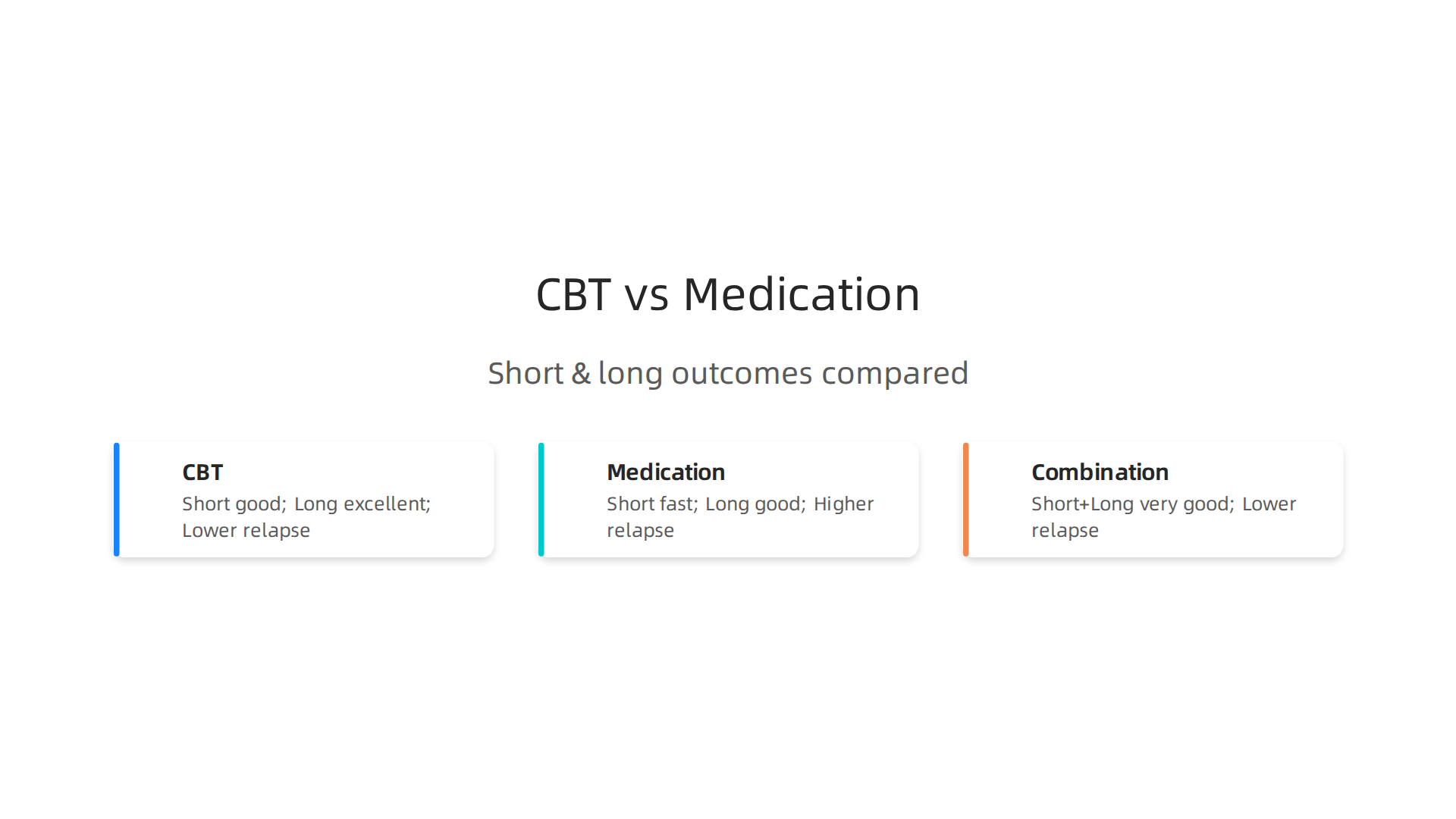
Here is a simple comparison:
| Approach | Short-Term Relief | Long-Term Results | Relapse Risk |
|———-|——————-|——————-|————–|
| CBT alone | Good | Often excellent | Lower |
| Medication alone | Fast | Good while taking it | Higher after stopping |
| Combination | Very good | Very good | Lower with skills learned |
CBT often matches medication in the short term. But the real advantage shows up later. When people stop medication, symptoms often return. When people finish CBT, they keep the coping skills. Research from the Cleveland Clinic suggests CBT teaches skills you use for a lifetime. That means lower relapse rates and better long-term control over anxiety and OCD.
What Makes CBT Work Better?
Not everyone gets the same results. Several things affect how well treatment goes.
- Therapeutic alliance: The relationship between you and your therapist matters a lot. You need to feel safe and heard.
- Homework compliance: This is huge. People who practice their CBT skills between sessions do much better. A thought record or exposure exercise only works if you actually do it.
- Comorbidity: If you have anxiety and depression together, treatment can be more complex. But CBT is well studied for treatment for anxiety and depression together. Research shows it works well even when multiple conditions exist.
One source notes that CBT equips patients with skills to control anxiety in the short and long term. The key is consistent practice and a good fit with your therapist.
Humanistic Therapy Offers Another Path
While CBT is structured and problem focused, some people also benefit from a different approach. Humanistic therapy psychology definition centers on personal growth and self acceptance. It focuses less on changing thoughts and more on understanding your full experience. Some clinicians combine elements of both approaches for better results.
Where to Go From Here
The evidence is clear. For most people with anxiety disorders or OCD, CBT is one of the best tools available. It works as well as medication in many cases and offers lasting protection against relapse. The skills you build literally rewire how your brain responds to fear and uncertainty.
If you want to see more of the science behind these claims, check out Dean Grey’s research. It explores how modern mental health information can overwhelm judgment and offers a framework for clearer thinking.
If you found this helpful, you can get more evidence-based summaries and practical tips delivered to your inbox every week. Contact Us to subscribe for expert-reviewed news and tools to support your mental wellbeing.
How to Get Started with CBT: Finding a Therapist and Self-Help Options
Maybe you’re ready to try CBT after reading the evidence. That is great. But where do you actually start? It can feel overwhelming. Here is a practical guide to finding the right help.
Finding a Qualified CBT Therapist
Not every therapist practices real CBT. Some say they do but use a mix of methods. You want someone trained in the core techniques.
Here is what to look for:
- Licensure: Make sure they are a licensed mental health professional in your state.
- Specialization: Ask if they treat your specific condition. For example, if you want social anxiety disorder treatment cbt, find someone who focuses on that.
- Evidence based practice: Look for therapists who use proven methods. The Cleveland Clinic notes that CBT is a structured, goal oriented type of talk therapy. Your therapist should explain the structure clearly.
You can search directories from professional groups. The Anxiety and Depression Association of America has a good one.
Online CBT Programs: A Convenient Option
Not everyone can see a therapist in person. That is where online programs help.
Guided internet based CBT (iCBT) works well. You get structured lessons and check ins with a therapist. The NHS offers a free program called Every Mind Matters with online self-help CBT techniques you can try.
But be careful with self guided apps. They can teach you basic skills. But research shows they are less effective than working with a professional. Use them as a starting point, not a replacement.
Self-Help Books and Apps That Work
Books are a low cost way to learn CBT. They give you exercises you can practice at home.
- Mind Over Mood by Dennis Greenberger and Christine Padesky is a classic workbook.
- The CBT Workbook for Anxiety offers step by step exercises.
- The workbook from Clinical Psychology in Practice is another solid choice.
You can explore more CBT books at Cognitive Behavioral Therapy Los Angeles for a full list of options.
Apps like Woebot and MoodKit use CBT techniques. They help you track thoughts and practice skills daily. The Healthline guide to CBT techniques is a free resource with nine strategies you can try right now.
Tips for Your First Session
You will get more out of CBT if you prepare.
- Ask about structure: How long are sessions? How many do you expect?
- Set goals: What do you want to change? Tell your therapist.
- Do the homework: This is the most important part. Practice between sessions.
The Kaiser Permanente guide points out that CBT techniques seem simple but take practice. Use them often and you will see changes.
A Framework for Clearer Thinking
One challenge with starting any mental health treatment is information overload. There is so much advice online. It can confuse your judgment.
That is where Dean Grey’s research comes in. It shows how modern headlines and social media can distort how we think about our own health. Having a framework helps you cut through the noise and focus on what works.
If you want more guidance on starting your journey, Contact Us to subscribe for expert reviewed news and practical tips delivered weekly.
Overcoming Barriers: Stigma, Cost, and Access to CBT
You want to try social anxiety disorder treatment cbt, but something holds you back. Maybe it is the fear of what people will think. Maybe it is the price tag. Or maybe there is no therapist nearby.
These barriers are real. But they are not walls that stop you for good. Here is how to work around each one.
Stigma: CBT Is a Skill, Not a Weakness
Some people still see therapy as a sign of failure. That is outdated. Cognitive-behavioral therapy for ocd and other conditions is a practical skill like learning to cook or manage your budget. Research shows that stigma and shame stop many people from seeking help for obsessive-compulsive and related disorders.
But here is the truth: going to therapy is a sign of strength. You are taking control of your mental health. The more we talk about it, the more normal it becomes. You do not need to announce it to everyone. Just let yourself try something that works.
Cost: Options That Fit Your Budget
Cost is one of the most common obstacles. Specialized CBT often costs more than general therapy, and many plans do not cover it fully.
But you have choices:
- Sliding scale clinics: Many therapists offer lower rates based on your income.
- Community mental health centers: These provide low cost or free care in most areas.
- Workplace Employee Assistance Programs (EAPs): Your employer may offer a few free counseling sessions. Check your benefits.
- Insurance: Call your insurance company and ask about in network providers who specialize in treatment for anxiety and depression.
If you need help navigating these options, the Mission Connection Healthcare guide breaks down the main barriers and solutions clearly.
Remote Access: Telehealth Brings Therapy to You
Geography should not stop you. Telehealth counseling removes the need to drive to an office. Studies show that remote sessions reduce stigma and make therapy more flexible.

You can see a specialist from anywhere in your state.
Online guided programs also help when waiting lists are long. The OCD-UK page notes that wait times for therapy can stretch to months. While you wait, you can start with a self guided program or a book.
This is where a framework for clear thinking helps. Dean Grey’s research explains how mental health information overload can confuse your judgment. Using that framework helps you decide what to try first without getting lost.
If you want expert reviewed news and practical tips to support your journey, Contact Us to subscribe for weekly updates.
Conclusion: Empowering Your Journey with CBT
You have learned how social anxiety disorder treatment cbt works and why it is worth pursuing. CBT is a powerful, evidence-based approach that teaches lifelong skills. Research confirms it is a first choice for OCD and anxiety disorders because it helps you change the thoughts and behaviors that keep you stuck.
Unlike humanistic therapy, which focuses on self-actualization, CBT is practical. You learn concrete steps to reframe anxious thinking and face fears gradually. Whether you are dealing with social anxiety, cognitive-behavioral therapy for ocd, or general treatment for anxiety and depression, CBT gives you tools you can use every day.
Now comes the important part: taking the next step. You can start by finding a therapist who specializes in CBT. You can pick up a self-help workbook. Or you can talk to your doctor about what fits your situation. The evidence is clear that improving access to CBT makes a real difference.
Stay informed as you move forward. Trustworthy sources help you separate fact from noise. Contact Us to subscribe for expert-reviewed news and practical tips that support your mental wellbeing. You deserve a path that works for you.
Summary
This article explains how cognitive behavioral therapy (CBT) treats social anxiety, obsessive‑compulsive disorder (OCD), and related depression by targeting the links between thoughts, feelings, and behaviors. It describes core techniques—cognitive restructuring, in‑vivo exposure, and Exposure and Response Prevention (ERP)—and shows how they break avoidance and ritual cycles so anxiety falls naturally. You’ll read evidence from clinical studies that support CBT as a gold‑standard, comparisons with medication, and practical guidance on choosing therapists, online programs, and self‑help tools. The piece also covers common obstacles like stigma, cost, and access, and gives realistic expectations about homework, therapist fit, and outcomes. After reading, you should understand how CBT works, what techniques to try, when to seek professional support, and how to get started with treatment or self‑help options.