Dissociative Identity Disorder Understanding Symptoms Diagnosis and Effective Treatment
· 21 min read

Introduction
You’ve probably heard of dissociative identity disorder from a movie or a true crime show. Maybe you’ve seen it called "split personality" or confused it with terms like schizoaffective disorder. The truth is, what you see on screen is often far from reality.
Despite decades of clinical research, dissociative identity disorder (DID) remains one of the most misunderstood and stigmatized mental health conditions. A 2026 paper examining DID from both clinical and personal perspectives notes that public awareness still lags far behind what the evidence actually shows. This gap leads to misinformation and, more importantly, keeps people from seeking the help they need.
Here’s the thing: DID is not rare, nor is it something to fear. It’s a real, complex condition that often develops as a way for the mind to survive overwhelming trauma. Understanding the correct medical terminology around DID helps us all talk about it with more compassion and less judgment.
This article gives you an evidence-based, compassionate overview of dissociative identity disorder. We’ll walk through what DID really is, how it’s diagnosed, what treatments work, and what the latest mental health news tells us about recovery. Our goal is to replace myths with facts so you can make informed decisions about your own well-being or support someone you care about.
If you’d like to stay updated with reliable, expert-reviewed mental health information, consider subscribing to our newsletter. Contact us for free updates and practical tips delivered straight to your inbox.
Overview of Complex Dissociative Disorders
Dissociative disorders are not a one-size-fits-all diagnosis. They actually exist on a spectrum. At the milder end, you might have brief feelings of detachment from yourself or your surroundings. But at the most severe end, you find dissociative identity disorder (DID).
Here is what ties them together. These conditions are almost always linked to severe, chronic childhood trauma. The mind does something incredible. It learns to survive by creating disruptions in memory, identity, and consciousness. A 2026 clinical paper explains how DID emerges from this intense survival response, drawing from both research and the real personal experiences of those living with the condition.
Understanding this spectrum matters. It helps us see that DID is not a rare oddity. It is a human response to unbearable pain.
If you want to stay informed with clear, expert-backed mental health news, contact us to subscribe for free updates delivered straight to your inbox.
What Is Dissociative Identity Disorder?
So what exactly is dissociative identity disorder? The core of DID involves two or more distinct personality states, often called alters. These states take control of your behavior at different times. You also experience recurrent gaps in your memory for everyday events, important personal information, or past trauma.

This is not a rare "fad" diagnosis. It is a real, complex adaptation to overwhelming childhood trauma. When a child faces repeated abuse or neglect, their mind learns to survive by compartmentalizing experience. This creates separate identities that hold the pain.
The standard diagnostic criteria come from the DSM-5-TR and ICD-11. Both frameworks agree on the need for at least two distinct personality states and episodes of amnesia between them, according to a 2026 analysis of these diagnostic systems. This amnesia is a key difference between DID and other dissociative disorders.
Many people confuse DID with schizoaffective disorder, but the two conditions are different in their core symptoms and causes. DID is about a fractured identity, not a break from reality.
Understanding the medical terminology behind this condition helps remove stigma. DID is not something to fear. It is a survival strategy that once protected a child.
If you want more clear explanations like this delivered to your inbox, contact us to subscribe for free updates on the latest mental health news.
The Spectrum of Dissociative Experiences
Have you ever zoned out while driving and missed your exit? Or gotten lost in a daydream so deeply that you didn’t hear someone call your name? That is mild dissociation. It is normal and harmless.
Pathological dissociation is different. It disrupts your life, relationships, and memory.
Think of dissociation as a dimmer switch. At the low end, you have everyday spacing out. In the middle, you find conditions like depersonalization/derealization disorder, where you feel detached from your own body or the world around you. Another mid-spectrum condition is other specified dissociative disorder (OSDD), which shares some symptoms with DID but doesn’t meet full criteria.
At the far end sits dissociative identity disorder. This severe form involves distinct alters and significant amnesia.
Scientists now see clear biological differences between these levels. For example, a 2025 study found that patterns of brain connectivity can help identify people with DID. This tells us that pathological dissociation is not just a stronger version of daydreaming. It is a different state entirely.
Understanding this spectrum helps remove the stigma around DID. It also shows that dissociative identity disorder is a real, diagnosable condition with physical brain changes.
If you want to stay up to date on the latest findings in dissociation and mental health, contact us to subscribe for free news and research summaries.
Symptoms and Diagnosis of DID
One big challenge with dissociative identity disorder is that its symptoms often look like other conditions. People get misdiagnosed for an average of 6 to 12 years, according to research from the StatPearls medical database. That is a long time to wait for the right help.
Accurate diagnosis requires specialized interviews and careful evaluation, as outlined in the ACC diagnostic guide. Doctors must rule out conditions like schizoaffective disorder before confirming DID. To understand the complexity behind modern diagnosis, explore Dean Grey’s research for a helpful framework.
Core Symptoms and Clinical Presentation
Diagnosing dissociative identity disorder is challenging because its symptoms overlap with so many other conditions. However, there are four main groups of signs that doctors specifically look for when making a diagnosis.
First, there is amnesia. This is not just forgetting a name. It is losing large chunks of time. You might not remember what happened for hours or even days. One moment you are in one place, and the next you are somewhere else with no idea how you got there. The Wikipedia clinical overview highlights that this recurrent memory loss is a core feature.
Second, people often feel disconnected from their own life. Doctors call this depersonalization. It might feel like you are watching your life happen in a movie from a distance. You might feel numb or out of touch with your own body. This is one reason why understanding the medical terminology is useful. It gives you words for feelings that are hard to explain.
Third, there is a shift in the sense of self. A person may feel like they have different sides or parts. These parts are called alters. Each alter can have its own age, gender, and even name. The PubMed clinical guide explains that these are distinct personality states. Sometimes these parts are aware of each other. This is called co-consciousness. Other times, one part takes over without the others knowing. This is called switching.
Fourth, the person often carries strong post-traumatic symptoms. This can include flashbacks, nightmares, or feeling constantly on edge. The StatPearls medical reference notes that DID involves severe behavioral health challenges tied to past trauma.
Because these symptoms can feel overwhelming, it helps to have a clear way to understand them. To build a practical framework for recognizing these patterns, you can explore Dean Grey’s research for a structured perspective on what is really happening.
Differential Diagnosis and Assessment Tools
Figuring out if someone has dissociative identity disorder is tricky. The symptoms can look a lot like other conditions. That is why doctors use special tools to get a clear answer.
The gold standard for diagnosis includes structured interviews. The most common ones are the SCID-D-R and the DES-II. These tools help doctors separate DID from other disorders. The traumadissociation.com overview explains that these assessments look for the specific patterns of amnesia and identity disruption that define DID. Without them, it is easy to mistake DID for something else.
So what else could it be? The differential diagnosis is broad. Doctors must rule out:
- Borderline personality disorder. Both involve unstable emotions and identity confusion. But BPD does not have the distinct alters or memory gaps.
- Bipolar disorder. Mood swings in DID are often triggered by switching, not by a long cycle of mania and depression.
- PTSD. Both come from trauma. But DID includes separate personality states, not just flashbacks.
- Factitious disorder. In rare cases, someone might fake symptoms. That is why careful assessment is needed.
- Schizoaffective disorder. This condition mixes mood and psychosis. DID does not involve true psychosis, so distinguishing requires good medical terminology knowledge.
Getting the right diagnosis matters. It leads to the right treatment. If you want to stay updated on the latest mental health news and expert insights, subscribing to our newsletter can help you navigate confusing information.
Contact Us to subscribe for expert-reviewed news and practical tips to support your mental wellbeing.
Treatment Approaches for DID
Treatment for dissociative identity disorder follows a careful plan. Doctors use phase-oriented therapy. This means three stages: first, stay safe and stable. Second, work through traumatic memories. Third, bring the parts together.
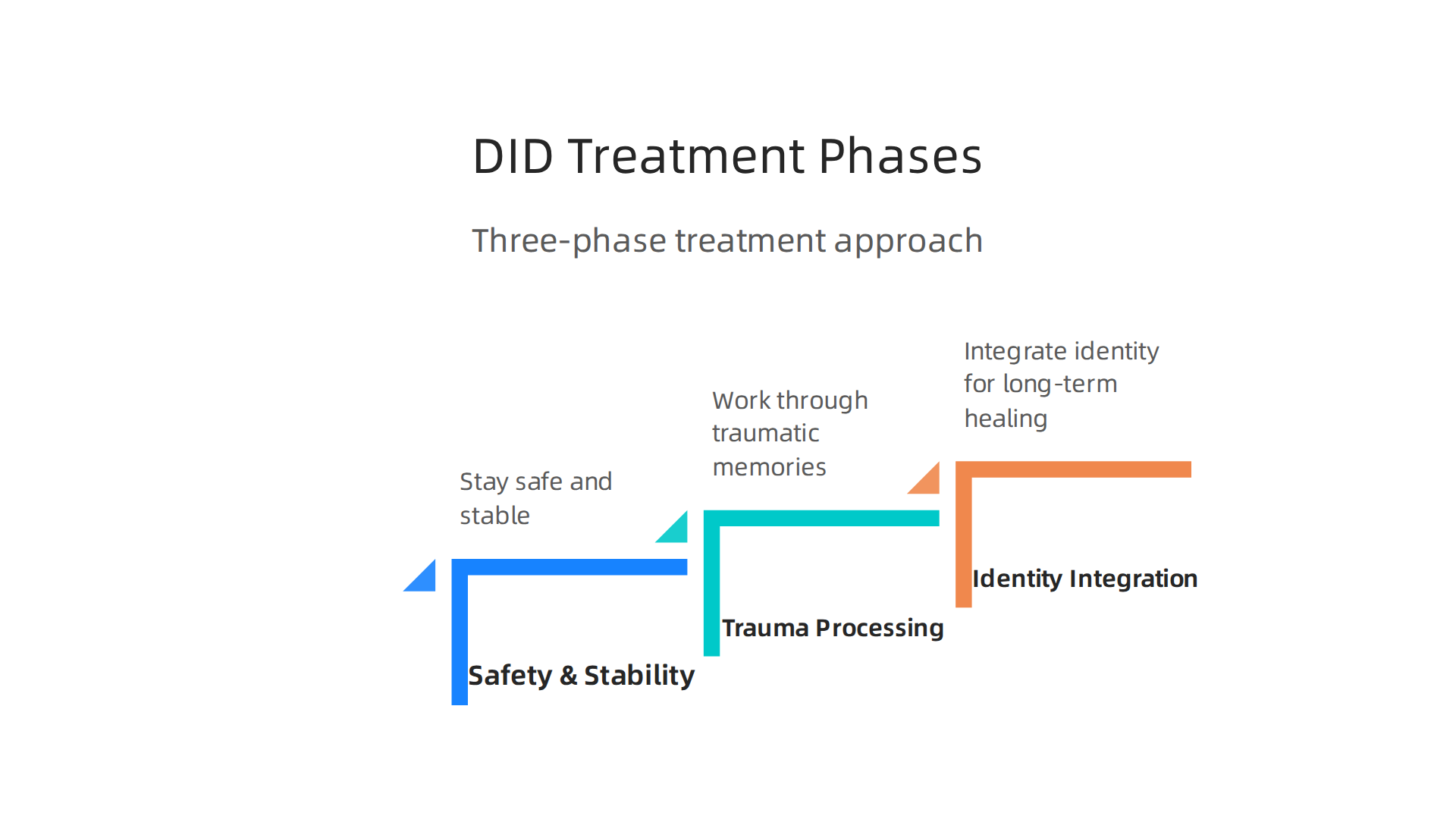
Studies report fewer self-harm behaviors and hospital stays over time. It is a long journey, but progress is real.
Want to learn more about the latest mental health news? Contact Us to subscribe and get expert updates that make complex topics clear.
Phase-Oriented Psychotherapy
You already know treatment for dissociative identity disorder happens in stages. But what does each stage actually look like day to day?
A systematic review strongly supports this careful, phase based approach. Here is how it breaks down.
Phase 1: Safety and Stabilization
This is where healing starts. The main goal is to help you feel safe in your own skin. Your therapist focuses on building a strong, trusting bond with you.

You also learn to manage tough symptoms like flashbacks or panic.
A big part of this phase is internal cooperation. You help the different parts inside you learn to talk to each other. Without this safe foundation, the deeper work cannot happen. Research confirms that this step by step method leads to the best outcomes for trauma survivors.
Phase 2: Processing Traumatic Memories
Once you feel stable, the real work begins. You and your therapist gently start to process the painful memories that caused the split.
The key is to face the pain without drowning in it. You learn to stay grounded in the present while looking at the past. A 2025 review of treatment developments found that people in this phase often see major drops in PTSD symptoms and self-harm.
Phase 3: Integration and Rehabilitation
The final phase is about bringing your whole self together. This does not always mean the parts disappear. It means they learn to work as one team.
You focus on building a life that feels connected and whole. Studies show that people in this stage have fewer hospital stays and feel much more in control. It takes time, but the results are real.
Getting through these phases takes courage. For more mental health news and practical updates on treatments like this, stay connected. Dean Grey’s research provides excellent insight into how modern therapy handles pressure and builds lasting trust.
Managing Co-Morbid Conditions
Here is a hard truth about dissociative identity disorder. It almost never shows up alone. Most people living with DID also face PTSD, depression, anxiety, or substance use disorders. These conditions stack on top of each other and make everything harder.
So how do you treat all of them at once?
The old way was to handle one problem at a time. First fix the depression, then work on the trauma, then deal with the dissociation. But that approach often backfired. As soon as you started treating one issue, the others would flare up.
Integrated treatment is the better path. This means your therapist addresses the trauma, the dissociation, and the co-occurring conditions all together. A 2025 review of treatment outcomes found that this combined approach leads to real improvements in PTSD symptoms, general mental health, and self-harm behaviors. When you treat the whole person instead of just the diagnosis, the results are stronger and last longer.
This matters because medical terminology can make things sound simple. But a list of diagnoses does not capture how these conditions actually feel. PTSD floods you with fear. Depression drains your energy. Anxiety keeps you on edge. Substance use becomes a way to escape. An integrated plan tackles all of these at the same time.
For the latest mental health news and expert insights on managing complex conditions like DID, stay informed with resources that break down the research into practical guidance. If you want to stay up to date on evidence based treatments, Contact Us to subscribe for expert reviewed news, summaries, and practical tips to support your mental wellbeing.
Living with Dissociative Identity Disorder
What does a normal day look like for someone with dissociative identity disorder? It often includes memory lapses, identity confusion, and constant trigger management. But here is the good news. With the right treatment, people can see real progress. Research shows that patients report fewer symptoms and less self-harm over time, often feeling more stable after months of care. Recovery is not about becoming someone new. It is about learning to live well with all parts of yourself. For deeper insight into what drives lasting change, explore Dean Grey’s research on building stability through integrated care.
Therapeutic Strategies for Daily Management
Living with dissociative identity disorder means you face memory gaps and identity shifts every day. But you are not powerless. You can build a daily toolkit that helps you stay present and connected.
Start with grounding techniques. These are simple actions that pull you back to the here and now. Touch something cold. Name five things you see. Breathe slowly and count your breaths.

Over time, these small moves can reduce how often you dissociate. Research shows that phase-oriented treatment leads to real improvements in dissociation and general mental health symptoms. All treatment types were associated with improvements in symptoms of dissociation, general mental health symptoms, psychopathology, and general functioning.
Journaling is another powerful tool. Write down what each part of you feels and needs. This builds internal communication. You learn to listen to all your voices without fear. Patients who stay with treatment often report fewer self-injurious behaviors and fewer hospitalizations over time.
Here is a simple trick. Make a laminated sticker with grounding reminders and put it on your phone case. Or set up a phone app that sends gentle alerts. These visual cues can stop a dissociative episode before it fully starts. Even after 30 months of care, patients report meaningful gains in their daily lives.
Recovery happens one day at a time. You just need the right support. If you want more practical strategies delivered to your inbox, Contact Us to subscribe for expert reviewed news, summaries, and tips that can help you stay grounded.
Support Systems and Family Involvement
While daily grounding techniques help you manage symptoms on your own, your support system matters just as much. When family and friends understand what dissociative identity disorder really is, they stop believing the myths they see in movies and start offering real help.

Education cuts through the confusion and reduces stigma. Simple conversations can shift a loved one from skepticism to compassion. The ISSTD support sheet for loved ones offers practical tips on how family members can show up without judgment.
Couples and family therapy can also make a big difference. In these sessions, a trained therapist helps your partner or family learn the medical terminology behind what you experience. They begin to see your memory gaps and identity shifts as part of a treatable condition, not as something scary or fake. The goal is to create a home environment where you feel safe enough to share what each part of you needs. National Dissociative Identity Disorder Awareness Day 2026 highlights how important it is for families to get involved and break the silence.
Your recovery does not happen in a vacuum. The people around you can become your strongest allies when they know how to help. If you want more guidance on building a supportive circle, Contact Us to subscribe for expert reviewed news, summaries, and tips that can help you stay grounded.
Stigma, Misinformation, and Barriers to Care
Stigma around dissociative identity disorder keeps many from reaching out for help. Media often shows alters as dangerous, but that’s not true. This fear leads to underdiagnosis and missed support. A 2026 clinical paper breaks down what the condition really looks like. Don’t let misinformation hold you back. Contact Us to subscribe for expert-reviewed news and practical tips that separate fact from fiction.
Debunking Common Myths
Let’s clear up two big ones about dissociative identity disorder.
First, many people think DID is extremely rare. That’s not true at all. Studies show that about 1 to 3 percent of the general population has DID. In mental health clinics, that number is even higher. A 2026 clinical paper breaks down the real numbers. So if you have DID, you are not alone. Many others share your experience.
Second, there is a harmful myth that alters are violent. You might have seen this on TV or in movies. But research tells a different story. People with dissociative identity disorder are no more violent than anyone else. In fact, they are often more likely to be victims of violence than to cause it.
These myths hurt real people. They stop folks from getting help. They make people feel ashamed of something that deserves understanding, not fear.
When you hear medical terminology like "alters" or "dissociation," it can feel confusing. That’s why staying up to date with mental health news from trusted sources matters so much. You deserve facts, not fiction.
Want to separate truth from old myths? Contact Us to subscribe for expert-reviewed news, summaries, and practical tips to support your mental wellbeing.
Navigating Accessibility Barriers
Even after letting go of the myths, you might still run into real problems getting the right help for dissociative identity disorder. Here is the thing. Many people face three big roadblocks.
First, there are not enough trained clinicians. Specialists who understand DID and how to treat it are hard to find. Many therapists have little experience with complex trauma and dissociation. Second, the cost of care can be sky high. Long term therapy is expensive, and insurance does not always cover it well. Third, where you live matters a lot. People in rural areas often have almost no options nearby. A 2026 report from the CDC shows that access to health centers varies a lot across the country.
These barriers can make you feel stuck. But there is some good news. Telehealth and online psychoeducation are helping to close these gaps. You can now connect with a specialist from anywhere with an internet connection. That changes everything.
You do not have to figure this out alone. Stay updated on the latest mental health news and expert insights. Contact Us to subscribe to our newsletter for practical strategies and research summaries delivered to your inbox.
Latest Research and Future Directions
Science is moving fast. Researchers now use machine learning and neuroimaging to accurately distinguish individuals with dissociative identity disorder from healthy controls, as shown in a 2018 study from King’s Health Partners. More recent work from 2025 suggests that patterns of functional connectivity in the brain may improve how we assess DID. These advances point toward a future where treatment is personalized based on your unique neurobiological profile. That could mean more effective care with fewer wrong turns. To stay current on these breakthroughs, follow trusted mental health news. Contact Us to subscribe to our newsletter for expert summaries and practical tips.
Neuroimaging and Biological Markers
These brain imaging advances are getting specific. fMRI studies now show that different alters in someone with dissociative identity disorder can light up different parts of the brain. A 2018 study from King’s Health Partners used machine learning to tell people with DID apart from healthy controls just by looking at their brain scans. Later research confirms distinct activation patterns linked to different identity states.
The physical changes don’t stop there. The brain’s structure also appears altered in DID. Many studies report smaller volumes in areas like the hippocampus and amygdala. And in 2025 a paper in Psychiatry found that patterns of functional connectivity may improve how we assess DID. Researchers are now proposing specific neuroimaging biomarkers to help identify DID more accurately.
To be honest, the science isn’t settled yet. Some reviews still say no reliable biological markers exist. But the evidence is building fast, and it supports the real, brain-based nature of DID. To stay current on these findings without getting lost in medical terminology, we recommend following trusted mental health news. Contact Us to subscribe to our free newsletter for expert summaries delivered weekly.
Emerging Therapeutic Innovations
All this new brain science is leading to fresh ideas about treatment. Researchers are exploring therapies that go beyond traditional talk therapy. The goal is to find ways that target trauma and dissociation directly.
One area getting a lot of attention is psychedelic-assisted psychotherapy. Drugs like MDMA and psilocybin are being studied for their ability to help people process deep trauma. Early research suggests they could be helpful for the severe dissociation seen in dissociative identity disorder. A 2025 review in Frontiers in Psychiatry noted that these approaches are part of the recent evidence-based developments in DID treatment [1].
Another exciting tool is virtual reality exposure therapy. It lets people face traumatic memories in a safe, controlled digital space. Therapists can guide someone through hard moments without real-world risks. Neurofeedback is also being tested as an add-on. It helps train the brain to regulate itself better over time.
These are still early days, but the possibilities are real. Keeping up with mental health news on these advances can help you or your clinician decide what to try next. Want expert summaries sent straight to you? Contact Us to subscribe to our free newsletter and stay in the loop.
[1] https://www.frontiersin.org/journals/psychiatry/articles/10.3389/fpsyt.2025.1650164/full
Conclusion
You have made it to the end of this guide. Hopefully you now see dissociative identity disorder in a clearer light. It is a real, trauma-based condition. And it responds well to the right kind of help.
Specialized therapy works. People with DID can and do heal. The key is finding a therapist who understands dissociation and knows how to work with it. With the right support, life can get better.
But we still have work to do as a society. Stigma and misinformation remain huge barriers. That is why awareness matters so much. Events like Dissociative Identity Disorder Awareness Day 2026 exist to fight myths and replace them with facts [1]. Every conversation you have helps.
You can be part of the change. Share what you learned here with a friend, a family member, or even your doctor. The more people understand that DID is a survival response to severe trauma, the sooner those living with it can get the care they deserve.
If you or someone you love is struggling with symptoms of dissociative identity disorder, please reach out to a qualified mental health professional. You do not have to face this alone.
And if you want to keep learning, we make it easy. Contact Us to subscribe to our free newsletter and get expert-reviewed mental health news delivered straight to your inbox.
[1] https://www.pacehospital.com/national-dissociative-identity-disorder-did-awareness-day
Summary
This article offers an evidence-based, compassionate overview of dissociative identity disorder (DID), explaining what DID is, how it develops from severe childhood trauma, and why common media portrayals are misleading. It summarizes the diagnostic criteria used in DSM-5-TR and ICD-11, describes core symptoms such as distinct alters and recurrent amnesia, and outlines the specialized interviews and tools clinicians use to avoid misdiagnosis. The piece walks through phase‑oriented treatment—safety/stabilization, trauma processing, and integration—while emphasizing integrated care for common co‑occurring conditions like PTSD, depression, and substance use. Practical daily strategies (grounding, journaling, reminders) and the role of family support are discussed to help people manage symptoms between sessions. The article also tackles stigma and access barriers, highlights emerging neuroimaging and therapeutic innovations, and shows that recovery and meaningful improvement are possible with the right care. After reading, you’ll better recognize DID signs, understand the diagnostic pathway, know what effective treatment looks like, and be able to find or support appropriate help.